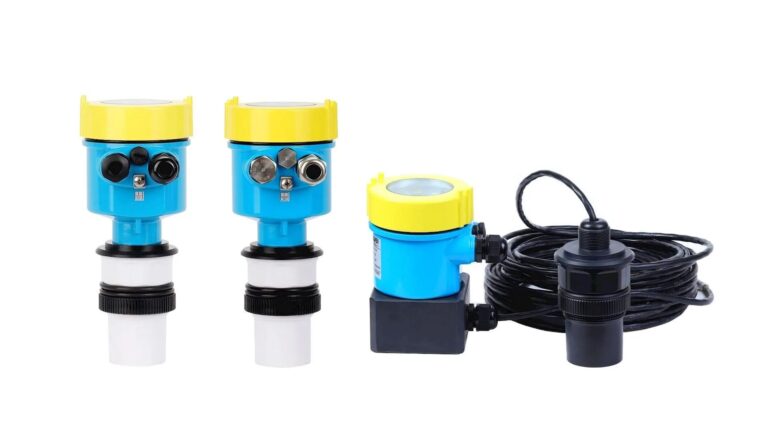
Ultrasonic level transmitters are widely used in water treatment, chemical processing, and storage tanks due to their non-contact measurement and easy installation.
However, many engineers encounter the same frustrating issues:
- Unstable readings
- False echoes
- Signal loss
- Measurement failure
๐ The truth is:
In over 80% of cases, the root cause is NOT the instrument โ but an overlooked parameter: beam angle.
What Is Ultrasonic Beam Angle?
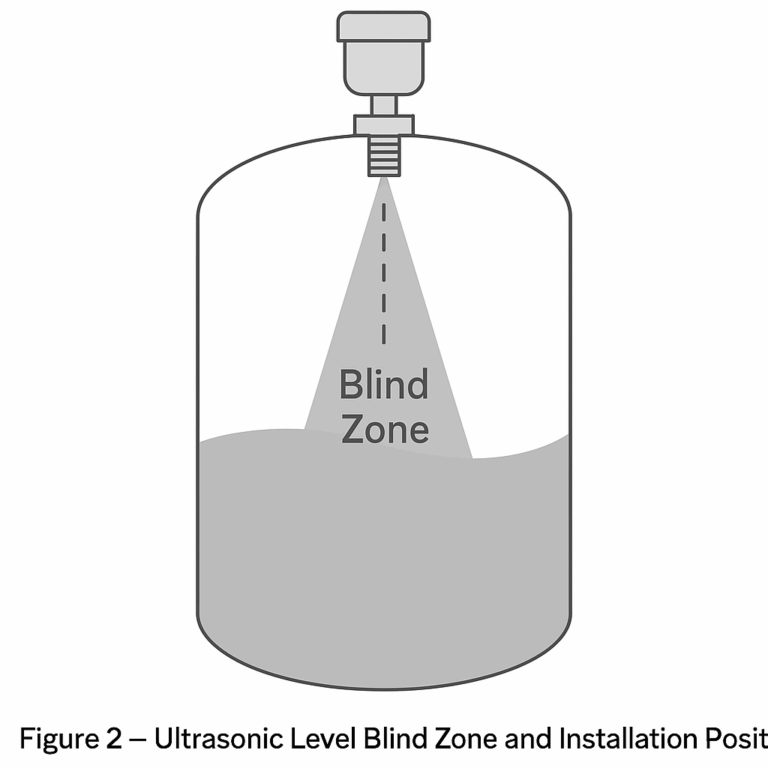
The beam angle defines how ultrasonic waves spread after being emitted from the sensor.
Technically, it is defined as:
๐ The angle where sound pressure drops to -6 dB (half power point) from the central axis.
In simple terms:
- Ultrasonic waves are not straight lines
- They spread like a cone (similar to a flashlight beam)
- Everything inside this cone can reflect signals back
๐ Example:
A sensor with a 10ยฐ beam angle will cover a diameter of ~1.75 m at 10 m distance.
๐ That means:
ANY object in this range can interfere with measurement.
Why Beam Angle Matters More Than You Think
Most measurement failures happen because the beam hits unintended objects:
- Tank walls
- Pipes
- Ladders
- Agitators
- Foam / turbulence
๐ When reflected signals from these objects are stronger than the liquid surface echo, the sensor gives wrong readings.
Real Case โ Why Measurement Fails
A real example:
- Tank height: 5 m
- Beam angle: 15ยฐ
- Distance to wall: 0.3 m
Calculation shows the beam fully hits the tank wall.
๐ Result:
- Continuous false echoes
- Completely unreliable measurement
Conclusion: Even correct installation cannot fix wrong beam angle selection.

What Determines Beam Angle?
Two key factors:
1. Transducer Size (D)
- Larger diameter โ smaller beam angle โ better focus
2. Frequency (f)
- Higher frequency โ smaller beam angle
- BUT โ higher attenuation โ shorter measuring range
๐ Trade-off:
- Small beam angle = better accuracy
- Large beam angle = longer range but more interference
Selection Rule (Critical for Real Projects)
Before choosing a model, you MUST calculate:
๐ Beam radius at max distance:
R = H ร tan(ฮธ/2)
Where:
- H = measuring distance
- ฮธ = beam angle
โ Installation requirement:
๐ Distance to any obstacle must be greater than R + 20% safety margin
How We Solve This in Real Projects
In many projects, unstable measurement is not solved by replacing instruments โ but by correct beam angle selection and installation optimization.
We typically help clients:
- Calculate beam coverage based on tank size
- Recommend suitable frequency & sensor size
- Avoid nozzle and wall interference
- Optimize installation position
๐ This approach solves most issues without trial-and-error replacement
5 Common Mistakes to Avoid
- Choosing based only on range, ignoring beam angle
- Assuming all manufacturers use the same beam angle standard
- Relying on software filtering to fix physical interference
- Blindly choosing higher frequency sensors
- Ignoring side lobe reflections
๐ These mistakes lead to most field failures.
Key Takeaway
Ultrasonic level measurement reliability is NOT determined by a single parameter.
๐ But beam angle is the core factor that connects:
- Selection
- Installation
- Performance
- Troubleshooting
Need Help Selecting the Right Model?
If you are experiencing:
- Unstable readings
- Echo loss
- Difficult tank conditions
- Unsure about beam angle selection
๐ We can help you select the right model based on your application.
๐ Just provide:
- Tank size
- Medium
- Installation conditions
We will recommend the most suitable solution.