
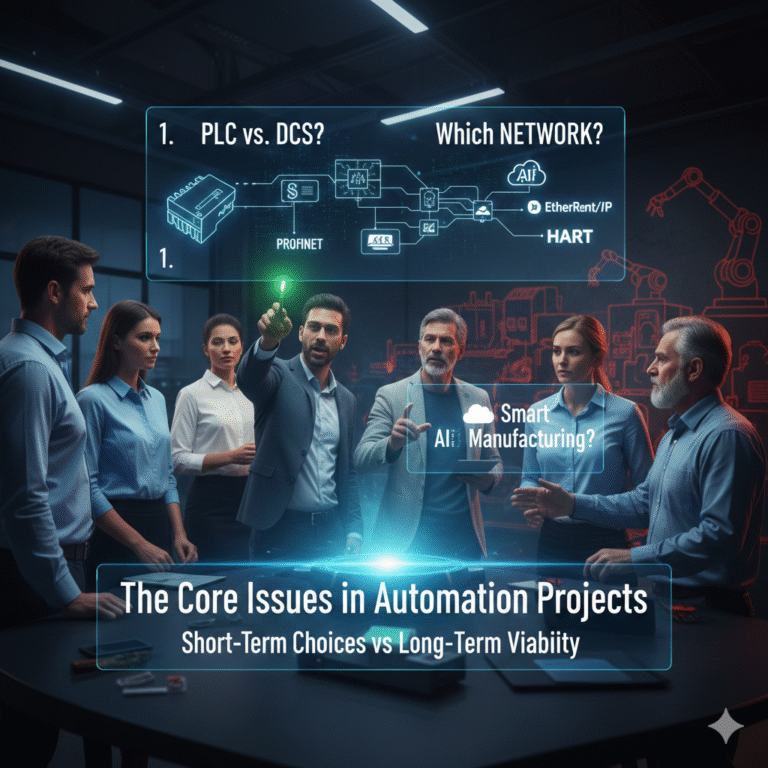
At the project initiation stage of many automation systems, the discussions often center around several key issues:
Should we use PLC or DCS?
Which industrial network should we choose?
Should we jump straight into “smart manufacturing”?
These questions are undoubtedly important, but they do not determine whether a system will remain useful five or ten years down the line.
The reality of many projects is that the system may appear advanced and stable when it is first commissioned, but after a few years of operation, maintenance becomes increasingly difficult, and the system becomes more fragile.
The true differentiator is not the choice of controllers or networks, but whether the field layer is equipped with systematic engineering capabilities. This is where the Fieldbus Control System (FCS) plays a pivotal role.
Where is the Most Expensive Cost in Automation?
In traditional automation systems, the field layer typically uses point-to-point wiring, where each device transmits signals back to the control cabinet via individual cables.
The typical characteristics of this system are:
Each instrument only transmits a single value.
The system is unaware of the device’s “health.”
Fault diagnosis heavily relies on manual experience.
As the system ages, reliance on skilled technicians grows.
While such systems may function well in the initial phase, over time, issues become apparent: high modification costs, low fault diagnosis efficiency, and no early warning for device aging.
These hidden costs are rarely assessed at the project initiation stage but can often be the most expensive part of the lifecycle.

What Problems Does FCS Solve?
Many believe that the value of FCS lies in “reducing wiring” or “switching communication methods.” While this is true to some extent, it is merely the surface. The essence of FCS is integrating “fieldbus” and “control systems” into a complete engineering framework that transforms field devices from “signal sources” into “manageable intelligent nodes.”
In essence:
FCS = Field device intelligence + Networked communication + Rational distribution of control functions + Integrated engineering and maintenance.
To achieve this, FCS introduces a key change: a field-layer network structure centered around fieldbus.
“Transmitting Information” — A Key Step of FCS
A fieldbus can be understood as an industrial-grade network for the field: a single bus connects multiple devices, and these devices can exchange not only values but also status, diagnostics, and parameter information. This allows the control system to see not just “signals,” but “the devices themselves.”
In traditional I/O systems, the system only collects signals, such as:
Analog: 4-20 mA
Digital: 0 / 1
Process variables: pressure, temperature, level values
These signals are stable and simple, but the fundamental issue is that the system can only see results, not the health of the device.
In the FCS framework, an intelligent device (e.g., a smart pressure transmitter) can simultaneously provide:
Process variable (pressure)
Device temperature, power status
Sensor drift trends (indicating calibration needs)
Fault diagnostics (internal error causes)
Parameter configurations and historical records
This means that the control system evolves from being just a “control loop” to a comprehensive engineering system capable of diagnosis and maintenance decision support.
Control + Diagnosis + Maintenance decision-making: A Comprehensive System.
As a result, FCS is often used in conjunction with Asset Management Systems (AMS) and predictive maintenance.

FCS is Not Here to Replace PLC or DCS
It is important to clarify that FCS is not a new controller, but rather a field-layer system architecture.
The focus of each system is different:
PLC (Programmable Logic Controller): Specializes in discrete logic, motion control, and device operation control, emphasizing speed and flexibility.
DCS (Distributed Control System): Specializes in continuous process control and system redundancy, focusing on stability and engineering integrity.
FCS: Focuses on how field devices are connected, diagnosed, and maintained over the long term.
FCS is not a new controller; it is a field-layer architecture that can be integrated with PLC or DCS:
DCS + Fieldbus → A typical FCS architecture (commonly seen in process industries)
PLC + Industrial network + Smart devices → FCS capability (increasingly adopted in manufacturing industries)
To understand it simply:
PLC/DCS answers “how to control.”
FCS answers “how to organize, maintain, and ensure long-term operation at the field level.”
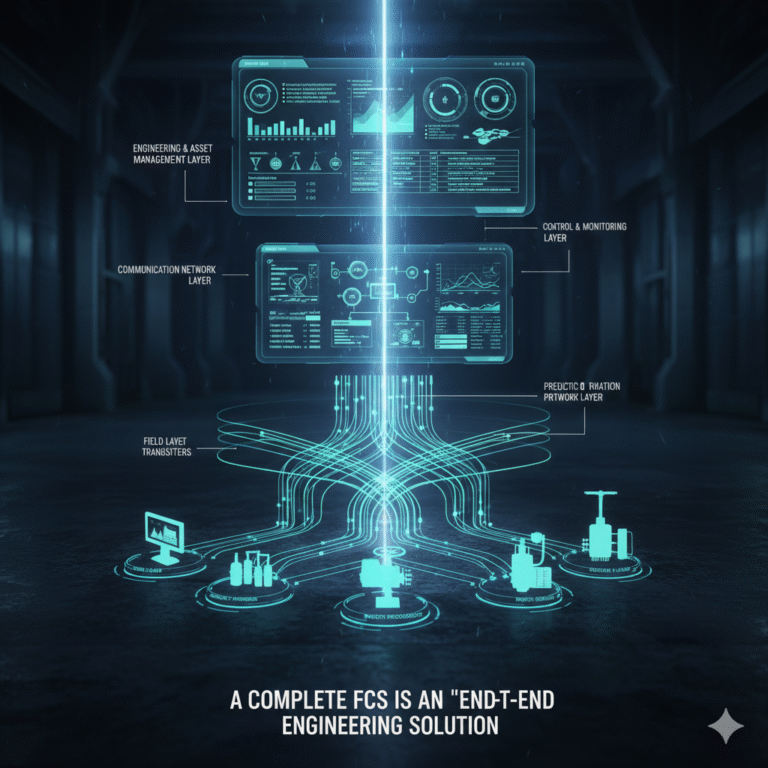
A Complete FCS is an “End-to-End Engineering Solution”
To understand FCS, it’s essential to look at it from a system perspective, not just a communication protocol:
Field Layer: Intelligent transmitters, smart valves, variable frequency drives, motor protectors, remote I/O, etc., all with communication, self-diagnosis, and parameter configuration capabilities.
Communication Network Layer: Fieldbus and industrial Ethernet (e.g., FF, PROFIBUS, PROFINET, Modbus, CAN, EtherCAT), used to connect field devices.
Control & Monitoring Layer: Controllers execute control logic, and HMI/SCADA handles monitoring, alarms, trends, and reports.
Engineering & Asset Management Layer (the core value of FCS): Device auto-identification, centralized parameter management, diagnostic information aggregation, maintenance strategies, and device ledgers.
The real return on investment for many FCS projects often comes from the engineering and asset management layer, not just the communication itself.
Why Does the System Become More Difficult to Use Over Time?
The issues often don’t lie in the control algorithms, but in the lack of a systematic structure at the field layer.
Without a unified architecture at the field level, common issues arise:
The device status is invisible — “only repair when it fails.”
Systems become “untouchable” when staff changes.
Retrofit costs keep increasing.
Automation systems become a burden.
The value of FCS lies in preventing this “system decay.”
Which Projects Benefit from FCS?
When a project has the following characteristics, FCS is often not optional but a necessity:
Large, widely distributed number of devices.
Continuous operation, with high downtime costs.
Limited maintenance personnel.
The system needs long-term expansion and modification.
This is why industries like chemicals, energy, water treatment, and pharmaceuticals are often early adopters of FCS systems.
FCS is Not Just “Connecting Wires and Done”
Many FCS projects fail not because of technology but because of engineering methods. The real determinants of success are:
Whether the network topology and load are reasonable.
Whether power supply, grounding, and shielding are standardized.
Whether multi-vendor equipment has been verified for interoperability.
Whether parameters, versions, and changes are traceable.
Whether fault diagnosis and recovery mechanisms are designed in advance.
In essence, FCS is a system engineering capability, not just a one-time technology choice.

Conclusion
The true limits of automation systems are not in controller performance or communication speed, but in whether the “field layer” is treated as a system that needs long-term management.
The value of FCS is not to complicate systems but to ensure that complex systems remain manageable over the long term.