
A Common Engineering Misunderstanding in Atmospheric and Low-Pressure Storage Tanks
In the petroleum, chemical, energy, and pharmaceutical industries, atmospheric and low-pressure storage tanks are among the most widely used process equipment.
Unlike pressure vessels, the safety of these tanks does not rely on shell strength, but instead depends heavily on the effectiveness of their venting systems.
Although most engineers are familiar with breather valves, in many projects they are still treated as secondary accessories. Their selection, sizing, and operating condition often receive far less attention than their actual risk level warrants.
In practice, atmospheric and low-pressure tanks are frequently grouped under the simplified label of “non-pressure vessels.” This administrative simplification, however, conceals a critical engineering reality: these tanks are extremely sensitive to pressure imbalance and depend fundamentally on proper pressure-relief mechanisms during normal operation.

1. Atmospheric vs. Low-Pressure Storage Tanks
From a standards and engineering-assumption perspective, atmospheric and low-pressure tanks are not merely different in name — they are designed based on different operating boundaries.
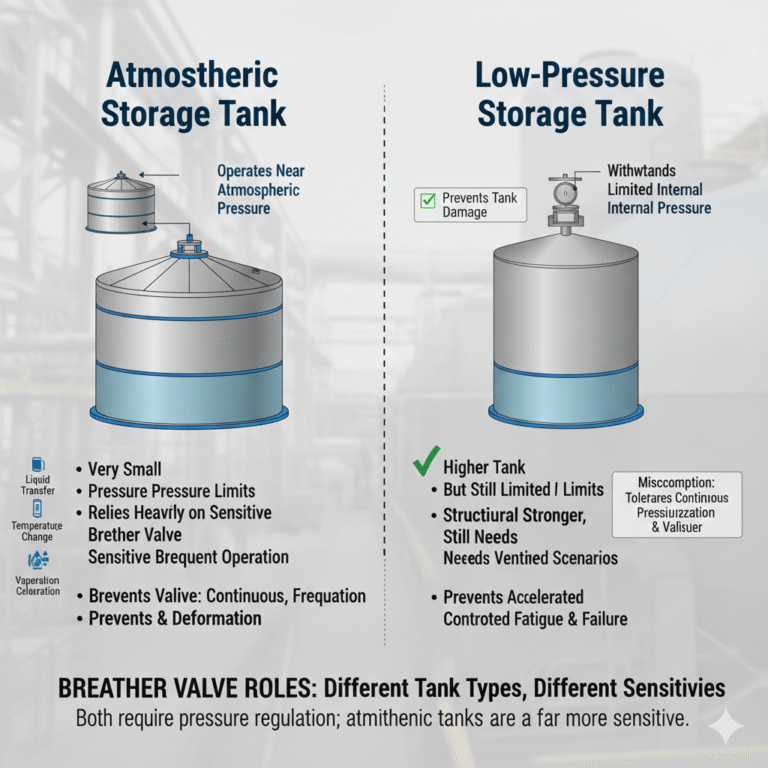
Atmospheric storage tanks are designed to operate at or near atmospheric pressure, allowing only very small positive or negative pressures. Their shell thickness, weld details, and stability calculations all assume that internal pressure is continuously relieved through the venting system.
Low-pressure storage tanks are permitted to withstand limited internal or external pressure, typically higher than atmospheric tanks but still far below pressure-vessel design limits. Although structurally stronger, they are not intended for sustained pressurized operation and still rely heavily on venting devices to maintain safe conditions.
From an engineering standpoint, both tank types share a key characteristic:
neither can safely absorb pressure fluctuations through structural strength alone. Pressure must be regulated through breather valves.
2. What Is a Breather Valve — in Engineering Terms
A breather valve is a pressure-regulating device installed on the vapor space of atmospheric or low-pressure tanks. It allows gas to flow in or out automatically when internal pressure deviates from ambient conditions, preventing excessive overpressure or vacuum.
According to API 2000, breather valves and related venting devices are intended to handle normal and reasonably expected operating conditions, not extreme accident scenarios. Their primary purpose is to continuously maintain pressure balance during routine operation.
Similarly, GB/T 5907 evaluates breather valve performance based on set pressure accuracy, repeatability, and rated venting capacity — not ultimate emergency relief capability.
Both standards clearly convey the same engineering principle:
a breather valve is an operational control device, not an emergency safety valve.

3. Relationship Between Breather Valves and Tank Structural Design
The structural design of atmospheric and low-pressure tanks does not assume sustained internal pressure. Standards such as API 650 explicitly rely on the assumption that pressure fluctuations will be promptly relieved by the venting system.
For atmospheric tanks, this assumption is particularly critical. Because allowable pressure limits are extremely small, these tanks depend even more on the sensitivity and capacity of breather valves than low-pressure tanks.
When breather valve set pressures are configured too close to the tank’s allowable pressure limits, the tank may operate outside its intended “near-atmospheric” condition during routine filling, emptying, or thermal expansion.
This deviation may not immediately cause catastrophic failure, but it increases weld stress cycling, raises the risk of local buckling, and accelerates fatigue damage — gradually eroding structural safety margins.
From a system engineering perspective, breather valves do not compensate for insufficient tank strength; they exist to ensure that the original structural design assumptions remain valid.
4. Different Roles of Breather Valves in Atmospheric and Low-Pressure Tanks
In atmospheric tanks, breather valves provide continuous and essential pressure regulation. Pressure changes mainly arise from:
Liquid transfer operations
Thermal breathing due to daily and seasonal temperature changes
Vaporization of volatile products
These are not abnormal events but routine operating conditions. Therefore, atmospheric tank breather valves must be capable of frequent, stable, and repeatable operation.
When venting capacity is insufficient or set pressures are too high, early warning signs often appear not as overpressure alarms, but as roof leakage, floating roof irregularities, or localized deformation.
Low-pressure tanks nominally “allow pressure,” but only within strict and limited boundaries. Their design pressure applies to specific operating scenarios, limited durations, and controlled conditions.
A common engineering misconception is assuming that low-pressure tanks can tolerate continuous pressurization, leading to undersized or poorly configured breather valves. This practice forces tanks to operate near their design limits, accelerating fatigue and accessory failures.
5. Common Breather Valve Selection Mistakes
Field experience shows that breather valve misuse typically falls into three categories:
Treating breather valves like safety valves, with the belief that “the less they open, the better.” This ignores their role as continuous pressure-balancing devices.
Relying solely on nominal size, rather than evaluating venting capacity against actual pressure change rates. API 2000 requires separate evaluation of filling, emptying, thermal breathing, and combined scenarios.
Overemphasizing static tightness. GB/T 5907 does not require zero leakage under all conditions; it prioritizes stable and repeatable operation near set pressures.
Within environmental, fire-protection, and product-loss constraints, a responsive and repeatable breather valve often provides greater operational safety than a perfectly sealed valve with delayed action.
6. Systemic Risks of Flame-Arresting Breather Valves
For flammable service, flame-arresting breather valves are often treated as default safety upgrades. However, fire-protection standards emphasize system-level design, not simple equipment stacking.
API guidance clearly states that any additional resistance in the vent path must be included in venting capacity calculations. In real incidents, failures more often result from blocked or fouled flame arresters than from flame transmission.
Therefore, flame-arresting breather valves represent a redesign of the venting system, not a simple safety add-on.

7. Operational and Maintenance Indicators
Even without complete design documentation, operating behavior can reveal venting system health. During high-rate transfers or significant temperature changes, breather valves should exhibit smooth and proportional movement.
Tank leakage, abnormal noise, or cyclic deformation combined with minimal valve movement often indicate excessive set pressure or inadequate capacity. Conversely, violent or continuous valve chatter may signal process conditions exceeding design assumptions.
Maintenance should focus on restoring designed operating characteristics, not merely replacing components. Valve discs, seats, springs, and flame arresters must be evaluated based on their impact on set-point accuracy and venting capacity.
8. Breather Valve Management as an Operational Signal
In well-managed facilities, breather valves are not treated as isolated components. Their activity frequency, stability, and maintenance history provide valuable insight into overall tank operation.
A “silent” breather valve does not necessarily indicate stable conditions, while sudden behavioral changes often signal altered process conditions or violated design assumptions.

9. Conclusion
The safety of atmospheric and low-pressure storage tanks is not determined solely by shell strength, but by the combined performance of structural design and venting systems.
Breather valves derive their engineering value not from extreme accident scenarios, but from continuous maintenance of pressure boundaries during everyday operation.
Only when breather valves are understood as operational boundary-control devices rather than passive safety accessories can storage tank risks be managed within predictable engineering limits.