
Consider a factory using superheated steam for industrial heating.
A vortex flow meter was originally configured for the following operating conditions:
- Steam pressure: 6 bar(g)
- Steam temperature: 200°C
- Fluid: Superheated steam
- Measurement requirement: Mass flow rate in kg/h
The system operated normally until a process adjustment reduced the steam pressure to 5 bar(g), while the temperature remained at approximately 200°C.
The vortex flow meter continued measuring the steam’s actual volumetric flow. However, if its mass flow calculation still used the original fixed steam density, the indicated mass flow would no longer represent the actual mass passing through the pipeline.
Using an ideal-gas approximation, this pressure change could produce a mass flow overestimation of approximately 16.7% relative to the true mass flow.
The flow meter itself might not be damaged or incorrectly calibrated. The problem would be the density value used to convert volumetric flow into mass flow.
This illustrates an important principle:
For steam and gas applications, measuring volumetric flow accurately does not automatically guarantee accurate mass flow measurement.
Temperature and pressure compensation helps solve this problem.
1. How Does a Vortex Flow Meter Measure Flow?
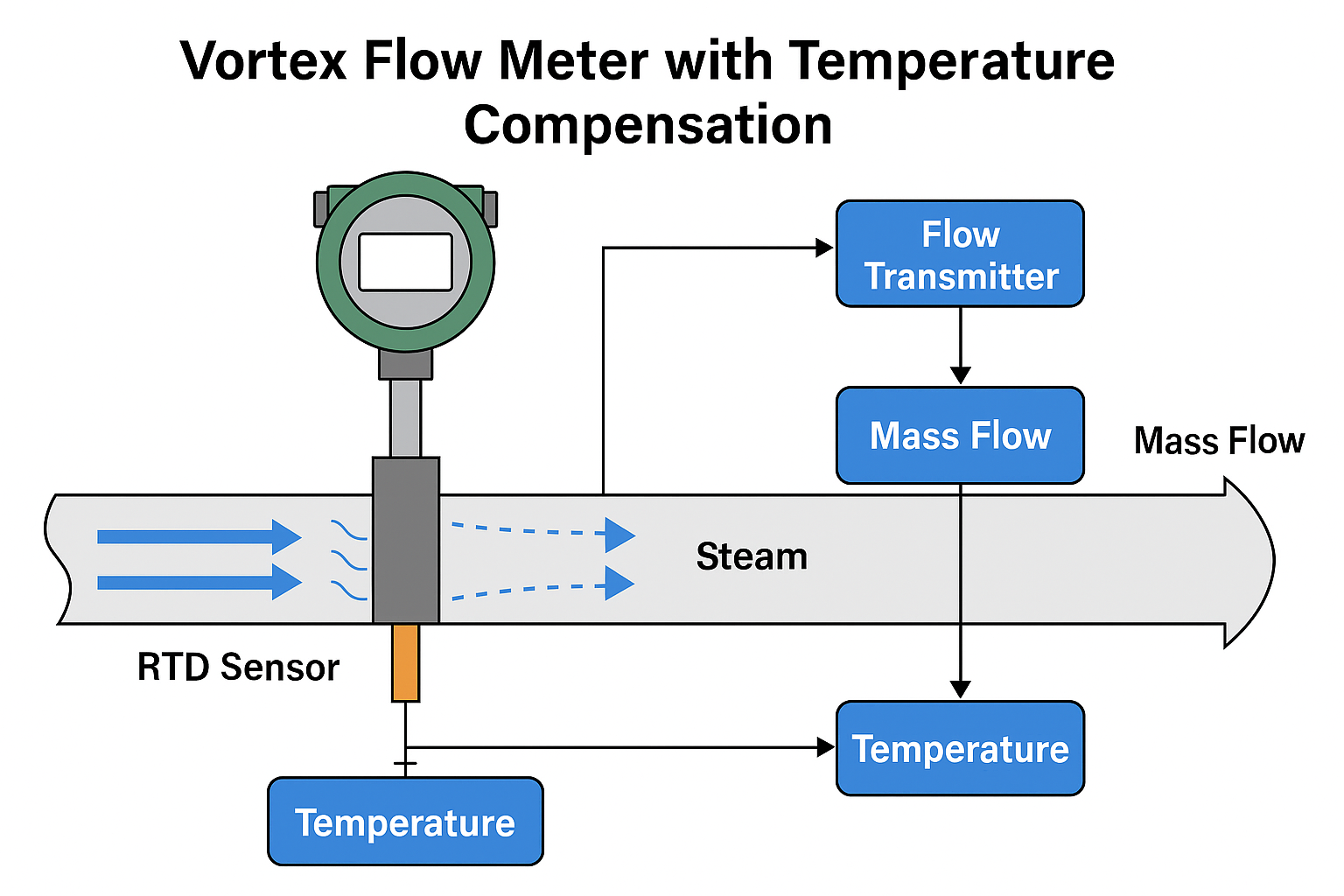
A vortex flow meter operates according to the Kármán vortex street principle.
When fluid flows around a bluff body installed inside a pipe, alternating vortices are generated downstream. Within the instrument’s specified operating range, the frequency of these vortices is proportional to the flow velocity.
The relationship is commonly expressed as:
[
f=\frac{St\times v}{d}
]
Where:
- f = Vortex shedding frequency (Hz)
- St = Strouhal number
- v = Fluid velocity (m/s)
- d = Characteristic width of the bluff body (m)
By detecting vortex frequency, the flow meter determines the fluid velocity and calculates the actual volumetric flow rate.
[
Q_v=v\times A
]
Where:
- Qv = Actual volumetric flow rate (m³/h, with consistent units)
- A = Internal cross-sectional area of the pipe (m²)
The fundamental measured variable is therefore related to fluid velocity and operating volumetric flow.
For liquids with relatively stable density, volumetric flow measurement is often sufficient.
However, gases and steam behave differently. Their densities can change considerably with temperature and pressure.
To calculate mass flow, the instrument must apply the relationship:
[
Q_m=Q_v\times\rho
]
Where:
- Qm = Mass flow rate (kg/h)
- Qv = Actual volumetric flow rate (m³/h)
- ρ = Fluid density at operating conditions (kg/m³)
This equation is the foundation of temperature and pressure compensation.
Importantly, a compensated vortex flow meter calculates mass flow using volumetric flow and density. It does not directly measure mass flow in the same way as a Coriolis mass flow meter.
2. Why Temperature and Pressure Changes Cause Measurement Errors
Gas and steam density is not constant.
For gases that can be approximated by the ideal gas law:
[
\rho=\frac{P\times M}{R\times T}
]
Where:
- P = Absolute pressure
- M = Molar mass
- R = Universal gas constant
- T = Absolute temperature (K)
This relationship demonstrates two important effects.
Pressure effect: At a constant temperature, gas density generally increases as absolute pressure increases.
Temperature effect: At a constant pressure, gas density generally decreases as temperature increases.
For real gases, particularly at elevated pressures, the compressibility factor must also be considered:
[
\rho=\frac{P\times M}{Z\times R\times T}
]
Where Z represents the gas compressibility factor.
Steam requires a more detailed thermodynamic relationship because its properties may depart significantly from ideal-gas behavior.
Example: Pressure Changes in a Superheated Steam Pipeline
Return to the earlier example:
| Parameter | Original condition | New condition |
|---|---|---|
| Gauge pressure | 6 bar(g) | 5 bar(g) |
| Approximate absolute pressure | 7 bar(a) | 6 bar(a) |
| Temperature | 200°C | 200°C |
| Mass flow calculation | Original density | Requires updated density |
Under an ideal-gas approximation:
[
\frac{\rho_2}{\rho_1}\approx\frac{6}{7}=0.857
]
The new density is approximately 85.7% of the original density.
If the actual volumetric flow remains unchanged but the instrument continues using the original density, the relative mass flow overestimation becomes:
[
\text{Error}=\left(\frac{7}{6}-1\right)\times100%
]
[
\text{Error}\approx16.7%
]
This calculation is illustrative. For an actual steam installation, accurate density values should be obtained from an appropriate steam property formulation, such as IAPWS-IF97.
The example also assumes unchanged actual volumetric flow and an unchanged conversion configuration. Real process conditions may affect flow velocity and volumetric throughput.
The engineering lesson is that fixed-density mass flow calculations become unreliable when operating pressure or temperature differs significantly from the assumed conditions.
3. What Is Temperature and Pressure Compensation?
Temperature and pressure compensation is the process of adjusting flow calculations according to the fluid’s actual operating conditions.
A compensated measurement system typically uses three inputs:
- Actual volumetric flow from the vortex flow meter.
- Fluid temperature from a temperature sensor, such as a Pt100 or Pt1000 RTD.
- Fluid pressure from a pressure transmitter or integrated pressure sensor.
The system calculates the operating density using a suitable fluid property model.
The calculated density is then multiplied by the measured volumetric flow to determine mass flow.
For gas applications, the system may also calculate standard or normal volumetric flow.
[
Q_n=\frac{Q_v\times\rho_{\mathrm{operating}}}{\rho_n}
]
Where:
- Qn = Volumetric flow at specified reference conditions
- ρoperating = Density at actual operating conditions
- ρn = Density at the defined reference conditions
A reference condition must always be specified when reporting flow in Nm³/h or Sm³/h.
Different countries, industries and contracts may use different reference temperatures and pressures. These values should never be assumed without confirmation.
4. External vs. Integrated Temperature and Pressure Compensation
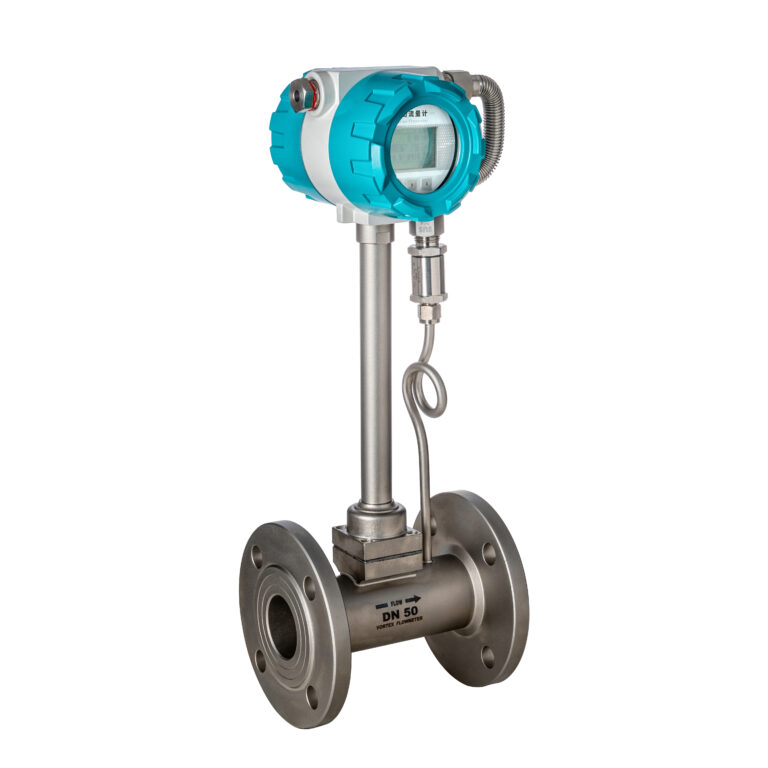
Industrial vortex flow measurement has evolved from simple volumetric flow measurement toward integrated instruments capable of calculating mass flow and other derived process variables.
Historically, temperature and pressure compensation often required separate field instruments and a flow computer.
Modern vortex flow meters may integrate temperature sensing, pressure sensing and compensation calculations into a compact assembly.
Both approaches remain useful today.
4.1 External Temperature and Pressure Compensation
A traditional arrangement usually includes:
- A vortex flow meter
- A separate temperature sensor and transmitter
- A pressure transmitter
- A flow computer, PLC or flow totalizer
- Signal cables and associated installation accessories
The flow computer collects the measurement signals and calculates density and compensated flow.
This arrangement provides considerable flexibility.
For example, temperature and pressure instruments can be selected independently to meet special accuracy, temperature, maintenance or process-connection requirements.
External compensation is particularly useful when existing instrumentation is already installed or when a dedicated flow computer is required.
However, it normally involves additional wiring, installation work and maintenance points.
4.2 Integrated Temperature and Pressure Compensation
An integrated vortex flow meter combines several measurement functions within one instrument or compact assembly.
Depending on the model and configuration, it may include:
- Vortex flow sensing
- Built-in temperature sensing
- Integrated or connected pressure measurement
- Density calculation
- Mass flow and normalized volume calculation
- Steam energy calculations
The principal advantage is a simplified measurement arrangement.
It can reduce the number of separately installed field devices and help minimize installation and wiring work.
Integrated pressure and temperature compensation may also improve measurement consistency by locating the temperature and pressure measurements closer to the vortex flow measurement point.
Nevertheless, integrated instruments do not automatically provide better accuracy under every condition.
The total measurement uncertainty still depends on flow sensor performance, temperature and pressure measurement accuracy, the density calculation model, installation and operating conditions.
Comparison of the Two Methods
| Feature | External compensation | Integrated compensation |
|---|---|---|
| Installation | Multiple devices | More compact |
| Wiring | More extensive | Usually simpler |
| Sensor flexibility | High | Model-dependent |
| Independent calibration | Generally convenient | Design-dependent |
| Maintenance | Multiple instruments | Fewer external devices |
| Measurement accuracy | System-dependent | System-dependent |
| Best suited for | Complex or specialized systems | General utility and process applications |
Neither solution should be selected solely on instrument purchase price. Installation, commissioning, maintenance and lifecycle costs should also be evaluated.
5. Saturated Steam vs. Superheated Steam: Why Compensation Methods Differ
Not all steam measurement applications require exactly the same compensation approach.
The thermodynamic condition of the steam determines what information is necessary to calculate its density.
5.1 Dry Saturated Steam
Dry saturated steam exists at the saturation temperature corresponding to its pressure.
For pure dry saturated steam, pressure and temperature are thermodynamically related.
Consequently, the steam density can be determined from either its saturation pressure or saturation temperature, provided the steam is confirmed to be in the dry saturated state.
Some vortex flow meters therefore provide temperature-based saturated-steam mass flow compensation without requiring a separate pressure sensor.
This can simplify measurements in stable steam distribution systems.
However, the method assumes the steam remains within the intended thermodynamic condition.
5.2 Superheated Steam
Superheated steam has a temperature above the saturation temperature at the same pressure.
Unlike saturated steam, superheated steam pressure and temperature are independent operating variables.
Both must generally be measured to calculate density accurately when conditions vary.
For example, at 200°C, steam density at 6 bar(a) differs from steam density at 7 bar(a).
A fixed-temperature compensation method cannot account for this pressure change unless pressure information is also available.
For superheated steam applications, integrated temperature and pressure compensation or an equivalent external calculation arrangement is therefore recommended.
5.3 Wet Steam
Wet steam contains both vapor and entrained liquid water.
This creates a more complex measurement challenge.
Standard vortex flow meters are generally calibrated for single-phase flow conditions.
When liquid droplets are present, the vortex signal and the relationship between volumetric flow and total mass flow may be affected.
Temperature and pressure measurements alone usually cannot determine the steam quality, also called dryness fraction.
Therefore, conventional temperature and pressure compensation cannot fully correct wet-steam measurement errors.
Applications with significant moisture content may require additional steam quality measurement, moisture separation or a specialized wet-steam measurement solution.
Temperature and pressure compensation corrects density calculations. It does not automatically eliminate errors caused by two-phase flow.
6. The Role of Steam Property Calculations
Reliable steam mass flow measurement requires an appropriate method for determining steam density.
One widely recognized industrial reference is the IAPWS Industrial Formulation 1997, commonly known as IAPWS-IF97.
This formulation provides thermodynamic properties of water and steam over defined pressure and temperature ranges.
It can be used to calculate:
- Density and specific volume
- Enthalpy
- Entropy
- Saturation temperature
- Other thermodynamic properties
For compensated vortex flow meters, density is essential for converting operating volumetric flow into mass flow.
Enthalpy may also be needed for steam energy calculations.
However, not every flow meter uses the same property equations or supports the same functions.
Some instruments use built-in steam tables, while others use dedicated industrial algorithms or external flow computers.
For gas measurement, the calculation method must be appropriate for the actual gas composition and operating conditions.
When evaluating a compensated vortex flow meter, engineers should confirm which density model is supported and whether it is suitable for the intended application.
7. How Integrated Compensation Has Evolved
Temperature and pressure compensation has developed alongside improvements in industrial electronics, sensor technology and embedded processing.
Early vortex flow measurement systems generally relied on separate instruments to provide the temperature and pressure values required for density calculations.
As electronic transmitters became more capable, manufacturers began integrating additional measurement functions into vortex flow meters.
Later developments included two-wire transmitters with advanced digital processing, built-in temperature sensing, optional integrated pressure measurement and embedded flow computers.
Modern products can provide several calculated quantities directly, reducing the need for separate processing equipment.
For example, selected industrial vortex flow meters can calculate mass flow, normalized gas volume, steam energy and compressed-air-related quantities.
Advanced signal processing and diagnostic functions have also improved the ability of instruments to handle demanding process environments.
The most important development is not simply the integration of more sensors into one housing.
It is the integration of measurement, fluid property calculation, signal processing and diagnostics into a coordinated system.
However, the actual functions vary significantly between manufacturers and configurations.
Engineers should verify whether pressure compensation is included as standard, available as an option or provided through an external input.
8. Practical Application: Natural Gas Flow Measurement in a Glass Factory
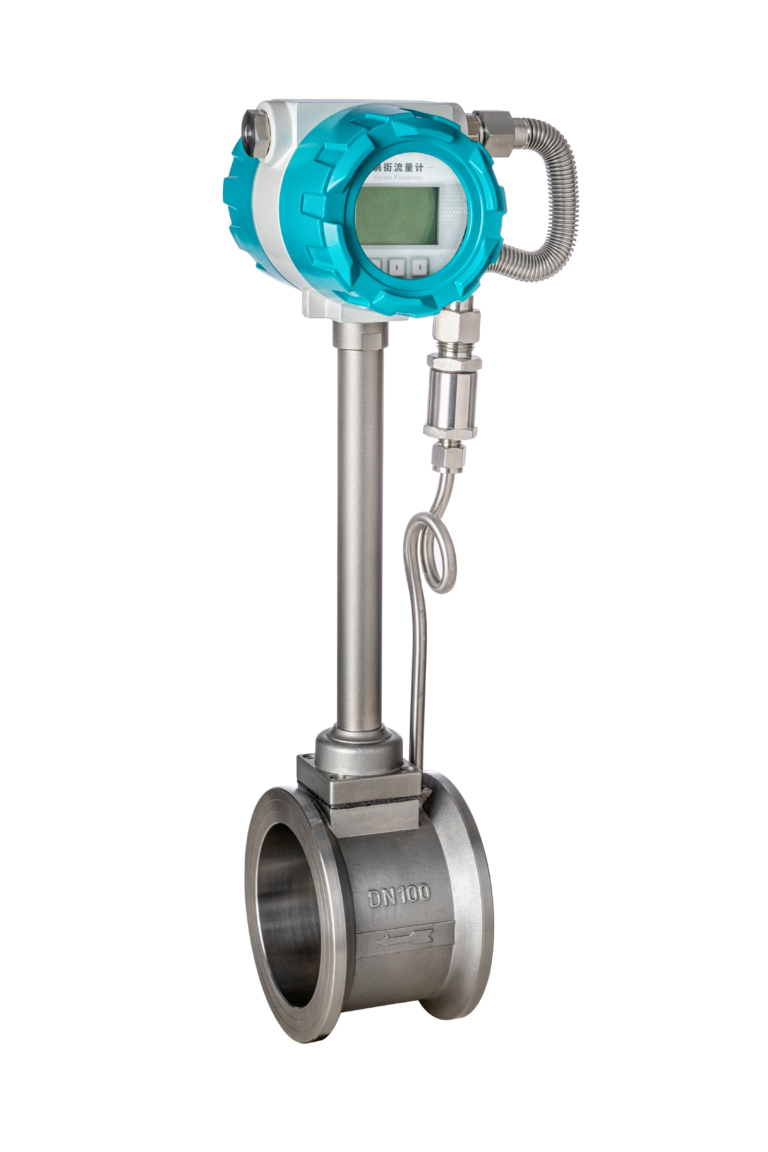
Consider a glass manufacturing facility using natural gas to supply several industrial furnaces.
Reliable gas flow measurement helps the plant monitor energy consumption, compare furnace performance and identify abnormal operating conditions.
The operating conditions might include:
- Medium: Natural gas
- Pressure: 4–8 bar(g)
- Temperature: 15–30°C
- Flow measurement requirement: Standard volumetric flow
- Application: Furnace gas consumption monitoring
Because both pressure and temperature can vary, a vortex flow meter without suitable compensation may produce inaccurate standard volume calculations when using fixed density assumptions.
An integrated temperature and pressure compensated vortex flow meter can use measured operating conditions to calculate gas density and convert actual volumetric flow into standard volumetric flow.
This allows the plant to compare consumption data on a consistent reference basis.
Engineering Considerations
Flow meter sizing
The nominal diameter must be selected according to the actual flow range for each individual pipeline.
A plant-wide total flow range should not be used directly to select the diameter of every branch flow meter.
Minimum and maximum operating flow, gas density, pressure, temperature, allowable pressure loss and Reynolds number should all be evaluated.
Gas composition
Natural gas composition can vary.
The compensation model must be appropriate for the specified gas composition, particularly when accurate standard volume calculation is required.
Pressure monitoring
Where pressure is also used for process alarms, the alarm setpoint must be established from the actual operating limits of the relevant furnace or gas supply branch.
A pressure threshold should not be selected arbitrarily from the overall network pressure range.
Installation
Adequate straight pipe lengths, appropriate mounting orientation and suitable upstream piping conditions are essential for reliable vortex flow measurement.
The actual requirements depend on the flow meter design and the disturbances present in the piping system.
This type of application demonstrates how compensated flow measurement can support energy monitoring.
However, the actual measurement performance must be established through correct sizing, installation and commissioning rather than assumed from the presence of temperature and pressure sensors alone.
9. Common Engineering Mistakes in Temperature and Pressure Compensation
Several installation and configuration errors can significantly affect measurement results.
Mistake 1: Confusing Gauge Pressure with Absolute Pressure
Density calculations require absolute pressure.
For example, a reading of 6 bar(g) corresponds to approximately 7 bar(a) when atmospheric pressure is about 1 bar.
Using gauge pressure directly in the density equation can introduce a major calculation error.
Mistake 2: Using Fixed Density for Variable Gas Conditions
Fixed-density calculations may be acceptable when process conditions are sufficiently stable and the required uncertainty permits them.
However, they become unsuitable when temperature and pressure variations introduce unacceptable mass or standard-volume errors.
Mistake 3: Assuming Temperature Compensation Alone Is Sufficient
Temperature-only compensation may be suitable for confirmed dry saturated steam.
It is not generally sufficient for variable-pressure superheated steam or gas applications.
Mistake 4: Ignoring Gas Composition and Compressibility
For accurate gas density calculations, fluid composition and compressibility may be important.
A simple ideal-gas model is not always sufficient, particularly in high-pressure or high-accuracy applications.
Mistake 5: Ignoring Low-Flow Limitations
Vortex flow meters require adequate vortex formation and a detectable vortex signal.
At low flow rates, measurement performance can deteriorate as velocity and Reynolds number fall below the specified operating range.
Adding temperature and pressure compensation does not extend the basic vortex sensor’s usable flow range.
Mistake 6: Assuming Compensation Corrects Installation Errors
Poor upstream piping conditions, excessive vibration, flow pulsation and unsuitable mounting arrangements can affect vortex signal quality.
Temperature and pressure compensation cannot correct these mechanical and hydraulic problems.
Mistake 7: Confusing Mass Flow Accuracy with Sensor Accuracy
A vortex flow meter may have a specified volumetric flow accuracy, but calculated mass flow also depends on density determination.
The complete measurement uncertainty must account for the entire calculation chain.
10. How to Select a Temperature and Pressure Compensated Vortex Flow Meter
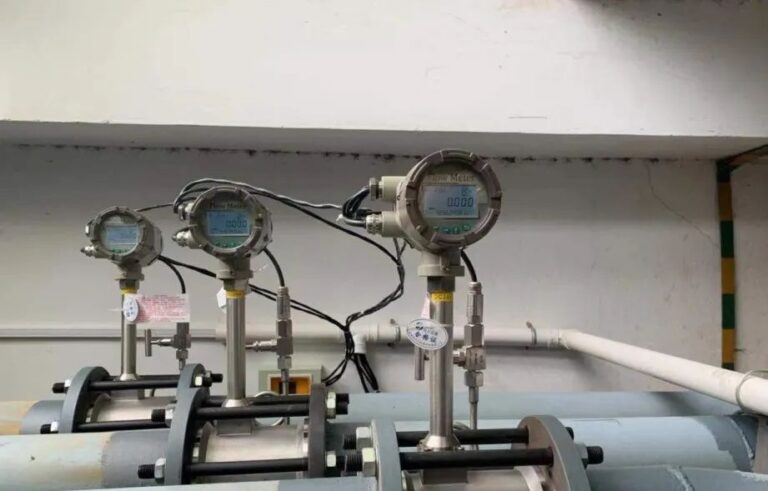
Before selecting an instrument, engineers should confirm the following information.
| Selection parameter | Information required |
|---|---|
| Medium | Saturated steam, superheated steam, gas or liquid |
| Operating pressure | Minimum, normal and maximum |
| Operating temperature | Minimum, normal and maximum |
| Flow range | Minimum, normal and maximum |
| Measurement output | Actual volume, standard volume, mass or energy |
| Pipeline | Nominal diameter, schedule and material |
| Process connection | Flanged, wafer or other |
| Required accuracy | Application-specific uncertainty requirement |
| Power supply | 24 VDC, two-wire loop or other |
| Communication | 4–20 mA, pulse, HART, RS485/Modbus, etc. |
| Installation conditions | Straight runs, vibration, orientation and available space |
| Special requirements | Explosion protection, temperature rating and certificates |
For steam applications, it is particularly important to confirm whether the process uses dry saturated steam, superheated steam or potentially wet steam.
For gas applications, engineers should confirm gas composition, reference conditions and required density calculation methods.
The instrument should be selected according to the complete application rather than simply choosing a model with an integrated temperature and pressure sensor.
11. Does Integrated Compensation Always Reduce Measurement Costs?
Integrated compensation often simplifies installation and reduces the number of separate devices.
This can lower the cost of wiring, mounting accessories, commissioning and maintenance.
However, total cost savings depend on project conditions.
If a facility already has suitable pressure and temperature measurements connected to a control system, external compensation may be economically attractive.
Conversely, a new installation with limited space or a requirement for simplified commissioning may benefit from an integrated arrangement.
Some manufacturers report substantial installation cost reductions for specific integrated designs compared with conventional multi-instrument systems.
These figures should be treated as application-specific comparisons, not universal guarantees.
The same principle applies to accuracy.
A compensated vortex flow meter may offer high measurement performance under specified reference conditions, but actual uncertainty depends on operating range, sensor specifications and installation.
The best solution is the one that meets the application’s measurement requirements with the lowest practical lifecycle cost.
Conclusion
Temperature and pressure compensation is essential when steam or gas flow measurements must remain reliable despite changes in operating conditions.
A conventional vortex flow meter measures actual volumetric flow. To calculate mass flow or normalized volumetric flow, the system must determine the appropriate fluid density.
External compensation systems achieve this through separate pressure and temperature instruments connected to a flow computer.
Integrated compensation systems combine these functions into a more compact arrangement, potentially simplifying installation and maintenance.
For dry saturated steam, a suitable single-property compensation method may be sufficient. For superheated steam and gases with variable operating conditions, both pressure and temperature measurements are generally required.
Wet steam, gas composition changes, installation disturbances and low-flow limitations must be addressed separately.
Ultimately, accurate flow measurement depends not merely on selecting a compensated instrument, but on understanding the fluid, calculating density correctly, sizing the meter properly and ensuring suitable installation conditions.
For engineers responsible for steam distribution, natural gas consumption or compressed air monitoring, understanding these principles is an important step toward more reliable measurement and better energy management.