
Industrial alarms are designed to help operators recognize abnormal conditions and take corrective action before they develop into equipment damage, production losses, or safety incidents.
But more alarms do not necessarily make a plant safer.
Consider two common situations:
- A batch reactor completes its reaction stage, but the temperature continues to deviate from the previous setpoint, causing a persistent alarm.
- A process variable crosses an alarm threshold and returns to normal within one or two seconds, generating hundreds of short-duration alarms.
Both are signs of ineffective alarm configuration.
When operators are continuously exposed to unnecessary alarms, they may become desensitized and fail to recognize the few alarms that actually require immediate action.
This is why alarm management is not simply a DCS configuration task. It is an important part of process safety and operational reliability.
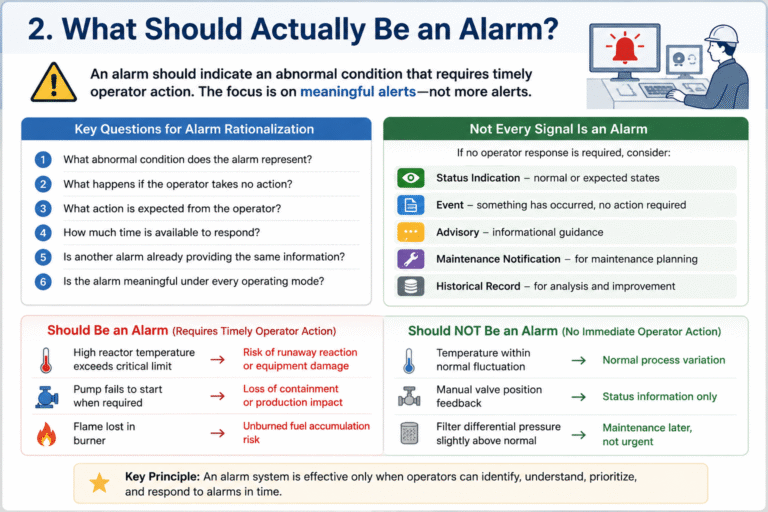
1. What Should Actually Be an Alarm?
The fundamental principle of alarm management is simple:
An alarm should indicate an abnormal condition that requires timely operator action.
Not every process deviation, equipment status, or instrument signal should become an alarm.
During alarm rationalization, engineers should ask:
- What abnormal condition does the alarm represent?
- What happens if the operator takes no action?
- What action is expected?
- How much time is available to respond?
- Is another alarm already providing the same information?
- Is the alarm meaningful under every operating mode?
If no operator response is required, the information may be better classified as a status indication, event, advisory, or maintenance notification.
This distinction is critical. When everything becomes an alarm, important alarms lose their significance.
2. Why Alarm Floods Are Dangerous
An alarm flood occurs when alarms arrive faster than an operator can effectively understand, prioritize, and respond to them.
Common consequences include:
- delayed response;
- critical alarms being overlooked;
- alarm fatigue;
- incorrect prioritization;
- loss of situational awareness;
- unnecessary process intervention.
Major industrial incidents have demonstrated how ineffective alarm systems can contribute to poor operator awareness during abnormal conditions.
The 2005 BP Texas City refinery accident is a widely discussed example. During the period preceding the explosion, operators were exposed to a large number of alarms while attempting to understand a rapidly deteriorating process condition.
The objective of alarm management is therefore not to eliminate alarms.
It is to ensure that operators receive the right alarm at the right time, with enough information and enough time to respond.
3. Common Types of Problem Alarms
Before optimizing an alarm system, it is useful to identify the type of problem.
Nuisance Alarms
Alarms that occur frequently but provide little useful information.
Typical causes include poorly selected alarm limits, process fluctuations, instrument drift, electrical interference, or inappropriate configuration.
Chattering Alarms
Alarms that repeatedly switch between active and normal states because the process variable fluctuates around the alarm threshold.
For example:
Alarm → Normal → Alarm → Normal → Alarm
Standing Alarms
Alarms that remain active for extended periods without meaningful operator action.
A standing alarm should prompt a simple question:
If nobody is expected to respond to it, should it still be an alarm?
Duplicate and Consequential Alarms
A single event may generate multiple alarms.
For example, stopping a pump may trigger:
- Pump Stopped
- Low Flow
- Low Discharge Pressure
- Low Downstream Pressure
The operator may be dealing with only one event while the control system presents four alarms.
Mode-Dependent Alarms
Some alarms are meaningful during normal operation but unnecessary during startup, shutdown, cleaning, maintenance, or other operating states.
These alarms are major contributors to alarm floods during plant transitions.
4. Alarm Management Standards
Modern alarm management follows a lifecycle approach rather than treating alarms as one-time DCS settings.
Three widely referenced international documents are:
IEC 62682 — Management of Alarm Systems for the Process Industries
Provides a lifecycle framework covering alarm philosophy, identification, rationalization, design, implementation, operation, maintenance, monitoring, management of change, and auditing.
ANSI/ISA-18.2 — Management of Alarm Systems for the Process Industries
Provides widely adopted practices for alarm rationalization, prioritization, nuisance alarm reduction, shelving, suppression, performance monitoring, and auditing.
EEMUA 191 — Alarm Systems
A long-established industry guideline covering alarm-system design, operator alarm loading, prioritization, performance, and human-machine interface considerations.
For projects in China, relevant standards and specifications also include:
- GB/T 41261-2022 — Management of Alarm Systems for the Process Industries
- AQ/T 3034-2022 — Guidelines for Chemical Process Safety Management
- GB 45673-2025 — General Specification for Work Safety Standardization of Hazardous Chemical Enterprises
- GB 17681-2024 — Technical Specification for Safety Monitoring of Major Hazard Installations for Hazardous Chemicals
- SH/T 3245-2025 — Design Specification for Alarm Management Systems in Petrochemical Industry
These requirements reflect an important shift:
Alarm management has become part of process safety management, not merely an automation engineering issue.
5. Alarm Rationalization: The Foundation of Optimization
Alarm optimization should not begin by randomly changing limits or adding delays.
The first step is alarm rationalization.
A multidisciplinary team should typically include personnel from:
- process engineering;
- instrumentation;
- automation/control;
- operations;
- equipment and maintenance;
- process safety.
For each alarm, the team should determine:
- Why is this alarm required?
- What consequence could occur if no action is taken?
- What should the operator do?
- How much response time is available?
- What priority should be assigned?
- What alarm limit is appropriate?
- Is deadband or delay required?
- Is the alarm valid in every operating state?
- Is another alarm already covering the same abnormal condition?
This process removes unnecessary alarms before detailed configuration optimization begins.

6. Alarm Priority: Not Everything Can Be Critical
One of the most common alarm-management problems is excessive use of high-priority alarms.
If everything is critical, nothing is critical.
Alarm priority should generally reflect two factors:
Consequence Severity × Available Operator Response Time
Depending on the plant’s alarm philosophy, alarms may be classified into three or four priority levels, such as:
Critical/Emergency — potentially severe consequences requiring very rapid response.
High — serious process deviations or significant equipment, production, or safety consequences.
Medium — abnormal conditions requiring timely operator intervention.
Low — lower-consequence abnormalities requiring attention but usually not immediate action.
Priority should be established through rationalization and risk assessment rather than individual preference.
7. Four Key Techniques for Reducing Nuisance Alarms
Once alarm rationalization is complete, several configuration techniques can significantly improve alarm performance.
7.1 Deadband
Suppose a high-temperature alarm activates at:
100°C
If temperature fluctuates:
99.9 → 100.1 → 99.8 → 100.2°C
the alarm may continuously activate and clear.
A deadband can prevent this.
For example:
Alarm activation: ≥100°C
Alarm reset: <98°C
The alarm therefore remains active until the process variable has moved sufficiently away from the alarm threshold.
Deadband should be selected according to process variability, measurement accuracy, instrument noise, and process dynamics.
7.2 Alarm Delay
Some process variables briefly cross an alarm threshold and immediately return to normal.
Where justified by process risk and dynamics, a short delay can filter these transient events.
For example:
Pressure > High Limit continuously for 3 seconds → Generate Alarm
instead of:
Pressure > High Limit → Generate Alarm Immediately
However, delay should never be applied blindly, especially to safety-critical conditions.
7.3 State-Based Alarm Suppression
Some alarms should only be active when the associated equipment is operating.
Consider a pump.
When running:
Low Flow → Enabled
Low Discharge Pressure → Enabled
When intentionally stopped:
Low Flow → Suppressed
Low Discharge Pressure → Suppressed
The same principle can be applied during startup, shutdown, cleaning, maintenance, and other operating modes.
State-based alarming is one of the most effective methods for reducing alarm floods during process transitions.
7.4 Dynamic Alarm Limits
A single alarm limit may not be appropriate for every operating condition.
For example, a reactor temperature that is abnormal during one batch phase may be perfectly acceptable during another.
Dynamic alarm management can adjust alarm limits or availability according to:
- production phase;
- recipe;
- process load;
- startup or shutdown state;
- equipment operating mode.
This is particularly useful for batch and highly variable processes.
8. Shelving, Suppression, and Disabling Are Not the Same
These functions should be clearly distinguished.
Automatic Suppression
The control system automatically suppresses an alarm according to predefined equipment or process states.
Shelving
An operator temporarily removes an alarm from normal presentation because it is known to be temporarily irrelevant or problematic.
Shelving should normally have:
- a documented reason;
- a defined duration;
- operator identification;
- automatic return after expiration.
Permanent Disablement
Permanently disabling an alarm is fundamentally different and should be strictly controlled.
A problematic alarm should be investigated and corrected rather than simply hidden.
9. Do Not Ignore the Instrumentation
Not every nuisance alarm is caused by DCS configuration.
An unstable measurement may result from:
- transmitter drift;
- poor calibration;
- damaged sensors;
- grounding problems;
- electromagnetic interference;
- unstable power supply;
- poor cable shielding;
- impulse-line problems;
- intermittent wiring faults.
Increasing the deadband may reduce alarms from an unstable transmitter, but it does not fix the transmitter.
Effective alarm optimization therefore requires both:
Alarm Configuration + Instrumentation Maintenance
10. Alarm Performance and Management of Change
Alarm optimization is not complete when the new settings are downloaded to the DCS.
Plants should continuously monitor indicators such as:
- average alarm rate;
- peak alarm rate;
- alarm floods;
- chattering alarms;
- standing alarms;
- frequently occurring alarms;
- alarm acknowledgement time;
- shelved and suppressed alarms.
Some organizations use approximately six alarms per operator per hour or less as a performance benchmark, but this should not be treated as a universal limit.
The appropriate target depends on process complexity, operating state, control-room organization, operator workload, and the site’s alarm philosophy.
At the same time, changes to alarm limits, priorities, deadbands, delays, or suppression logic should be controlled through an appropriate Management of Change (MOC) process.
Without change control, an optimized alarm system can gradually return to its previous condition.
11. Two Practical Alarm Problems
Case 1: Batch Reactor Temperature Alarm Remains Active After Reaction Completion
Suppose a reactor operates at a temperature setpoint of:
120°C
During the reaction phase, a deviation alarm monitors whether actual temperature moves too far from this setpoint.
When the reaction finishes, however, the reactor enters cooling or discharge.
Temperature naturally moves away from 120°C.
If the original deviation alarm remains enabled, the DCS may continuously generate an alarm even though the process is behaving normally.
The first response should not be simply widening the alarm limit.
Instead, determine whether the alarm remains meaningful during the new operating phase.
Possible solutions include:
- state-based suppression;
- phase-dependent alarm logic;
- recipe-dependent alarm limits;
- dynamic alarm limits.
The principle is simple:
An alarm should only be active when the abnormal condition it represents is meaningful.
Case 2: Alarm Appears and Clears Within One Second
If an alarm repeatedly appears and disappears within seconds, check the root cause systematically:
Process — Is the process variable genuinely unstable?
Alarm Limit — Is the threshold too close to the normal operating range?
Deadband — Is the hysteresis insufficient?
Instrument — Is the transmitter output unstable?
Signal — Could electrical interference, grounding, or shielding be involved?
Delay — Would a short, technically justified delay eliminate meaningless transient alarms?
The correct solution depends on the cause.
Simply increasing the alarm limit or disabling the alarm may hide a genuine process or instrumentation problem.
12. A Practical Alarm Optimization Workflow
A structured optimization program can follow this sequence:
Step 1 — Collect Alarm History
Export historical alarm data from the DCS or alarm management system.
Step 2 — Identify Bad Actors
Find the small number of alarm points responsible for a large proportion of total alarm activity.
Step 3 — Classify the Problems
Identify chattering, standing, duplicate, nuisance, consequential, and mode-dependent alarms.
Step 4 — Rationalize
Define the purpose, consequence, operator action, response time, priority, and configuration requirements for each alarm.
Step 5 — Correct Instrumentation Problems
Repair unstable measurements, wiring problems, signal interference, and instrument faults.
Step 6 — Optimize Configuration
Review alarm limits, priorities, deadbands, delays, suppression logic, and operating-state logic.
Step 7 — Apply Management of Change
Document, review, and approve modifications.
Step 8 — Monitor Performance
Track alarm KPIs and identify recurring bad actors.
Step 9 — Review Regularly
Repeat the process after significant process changes and at defined intervals.

Conclusion
A good alarm system is not the one that generates the most alarms.
It is the one that helps the operator recognize abnormal conditions and take the correct action before those conditions become serious.
Nuisance alarms are noise. Effective alarms are signals.
Deadband, delay, shelving, suppression, and dynamic alarm limits are useful tools, but they are not substitutes for proper alarm rationalization.
The most effective approach combines:
Alarm Rationalization + Correct Configuration + Reliable Instrumentation + Management of Change + Continuous Performance Monitoring
When these elements work together, the alarm system becomes what it was originally intended to be:
a decision-support tool for operators, rather than another source of distraction.