
In modern industrial and home automation, relays play a crucial role by responding to electrical signals to open and close contacts, thus enabling the control of electrical circuits. Relays are essential components that ensure the smooth operation of complex systems, providing safety, efficiency, and reliability. For anyone working in automation systems, understanding the various types of relays and their applications is vital.
In this article, we will explore the different types of relays commonly used in automation, their working principles, and the significance of each in the automation field.
1. What is a Relay?
A relay is an electrically operated switch that allows a low-power signal to control high-power devices, providing an interface between the control system and electrical circuits. It works by using an electromagnet to mechanically control the opening and closing of contacts inside the relay. There are various types of relays, each designed for specific applications and operating conditions, including motor control, lighting systems, heating elements, and more.
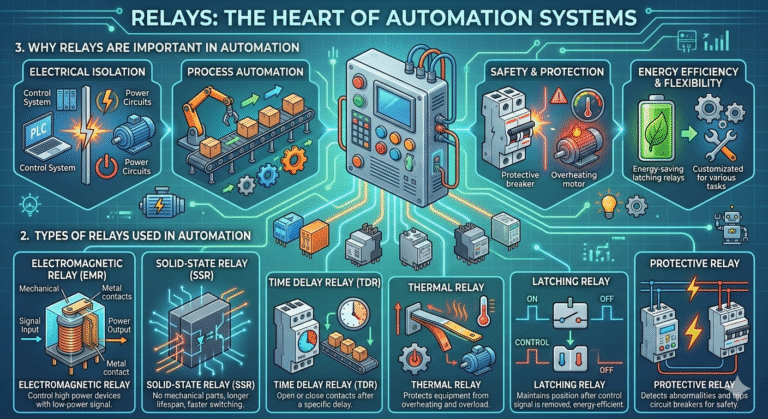
2. Types of Relays Used in Automation Systems
1. Electromagnetic Relays (EMR)
Electromagnetic relays are the most basic and widely used type of relays in automation systems. They work based on electromagnetic principles. When current flows through a coil, a magnetic field is generated, which drives the switch action to open or close contacts. These relays are commonly used in low-voltage control circuits to manage higher-voltage systems, such as motor control circuits, distribution systems, or HVAC (heating, ventilation, and air conditioning) systems.
Advantages: Simple design, reliable operation, capable of handling high current and voltage ratings.
Disadvantages: Mechanical parts wear out over time, slower response compared to solid-state relays.
2. Solid-State Relays (SSR)
Unlike electromagnetic relays, solid-state relays have no moving parts. They use semiconductor switching elements such as transistors, diodes, or thyristors to perform the switching function. Because there are no mechanical components, SSRs are more durable and can operate at faster switching speeds. They are used in industrial automation systems, electronic devices, and temperature control systems.
Advantages: Longer lifespan due to the absence of mechanical wear, quieter operation, faster response time.
Disadvantages: More expensive than electromagnetic relays, heat dissipation can be a concern in high-power applications.
3. Time Delay Relays (TDR)
Time delay relays are designed to open or close contacts after a specified delay, making them ideal for applications requiring delayed actions. These relays are commonly used in automation systems where timing is critical, such as sequential operations or processes that need a specific delay between tasks. They are used in conveyor systems, sequential motor start-up systems, and lighting controls.
Advantages: Precise control over timed operations, customizable for specific delay times.
Disadvantages: Limited application in high-speed automation systems.
4. Thermal Relays
Thermal relays use temperature as the primary control factor. They typically use a bimetallic strip, which bends when heated to open or close contacts. These relays are commonly used for overload protection in motors and other electrical devices.
Advantages: Effective in protecting equipment from overheating, simple and reliable design.
Disadvantages: Limited to temperature-based control applications, slower response time compared to other relays.
5. Latching Relays
Latching relays, also known as bistable relays, are designed to maintain their position even after the control signal is removed. A short pulse is required to change their state, and they will hold that state until another pulse is received. This makes them energy-efficient, as they do not require continuous power to maintain their position. These relays are commonly used in lighting control systems, memory functions in control systems, and circuit breakers.
Advantages: Energy-efficient since they don’t require continuous power to maintain their state, suitable for memory-related applications.
Disadvantages: More complex than standard relays.
6. Protective Relays
Protective relays are crucial for ensuring the safety of power systems. They detect abnormalities such as overcurrent, undercurrent, or voltage imbalance and activate circuit breakers to isolate the faulty part of the system. These relays are key in preventing equipment damage and ensuring the safe operation of electrical systems. They are used in distribution systems, high-voltage grids, and industrial safety systems.
Advantages: Improves system reliability and safety, fast response to faults.
Disadvantages: Requires calibration for accurate protection, more expensive than simpler relays.
3. Why Relays Are Important in Automation
Relays are fundamental components in automation systems for several reasons:
Isolation Between Control and Power Circuits
Relays provide electrical isolation between low-power control circuits and high-power load circuits. This isolation ensures that sensitive control elements are protected from high-voltage or current surges, preventing system damage.Process Automation
Relays enable the automation of complex processes by simultaneously controlling multiple devices. With relays, systems can be programmed to perform a series of actions without manual intervention, improving efficiency and reducing the potential for human error.Safety and Protection
Many relays, such as thermal and protective relays, are designed to protect equipment by detecting abnormal conditions and disconnecting power to prevent damage. This function is essential in industrial environments, where equipment failure can lead to costly downtime or dangerous situations.Energy Efficiency
Latching relays and similar types require minimal power to maintain their state, contributing to energy-efficient system designs. They are especially useful in battery-powered or energy-limited systems.Customization and Flexibility
Different types of relays provide high customization in automation systems. Whether the need is for precise timing (using time delay relays) or overload protection (using thermal relays), there is a suitable relay for almost every requirement.

4. Conclusion
Relays are indispensable in the world of automation. Whether used for simple on-off control, protection, or time-based operations, they enable systems to run safely and efficiently. By understanding the various types of relays—such as electromagnetic, solid-state, time delay, thermal, latching, and protective relays—automation professionals can design more reliable and responsive systems. As technology advances, the role of relays continues to expand, integrating with modern digital control systems and playing a key role in automation across industries worldwide.