
The HART (Highway Addressable Remote Transducer) protocol is a hybrid communication standard widely used in industrial automation. By combining analog and digital communication, HART enables seamless integration between smart devices and traditional control systems. This article explores the working principle of the HART protocol, its advantages, limitations, and its application across industries.
1. Working Principle of HART Protocol
The HART protocol was developed to enhance the functionality of the widely used 4-20mA current loop, a standard communication method in industrial automation. The core principles are:
Dual Signal Transmission
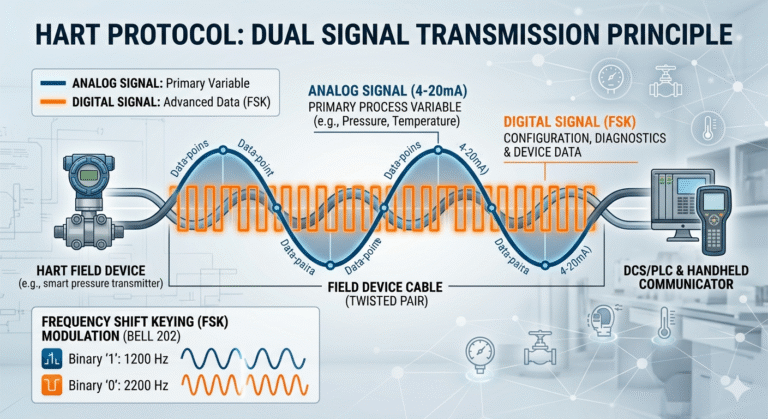
HART allows two signals to be transmitted simultaneously on the same 4-20mA loop:Analog Signal (4-20mA): Represents the primary process variable (e.g., pressure, temperature) used by traditional systems.
Digital Signal: Modulated via Frequency Shift Keying (FSK) and superimposed on the analog signal, carrying additional device data like configuration parameters, diagnostics, and status information.
This dual-mode operation provides advanced functionality while maintaining backward compatibility with older systems.
Frequency Shift Keying (FSK) Modulation
HART uses FSK modulation based on the Bell 202 standard:1200 Hz represents binary “1.”
2200 Hz represents binary “0.”
The digital signal is superimposed on the analog current loop, ensuring that the main process variable remains unaffected by the digital data.
Communication Modes
HART supports two communication modes:Point-to-Point Mode: A single master station (e.g., control system, handheld device) communicates with one slave device (e.g., sensor, actuator).
Multidrop Mode: A master station communicates with multiple slave devices, reducing wiring complexity in installations with numerous devices. In this mode, all devices operate at a fixed 4mA current.
Master-Slave Architecture
HART follows a master-slave communication structure:Master: Control systems, handheld communicators, or host computers.
Slave: Field devices, such as pressure transmitters, valve controllers, or radar level transmitters.
The master initiates communication, and the slave responds, ensuring orderly and reliable data exchange.
2. Advantages of HART Protocol
Backward Compatibility
HART can operate on existing 4-20mA infrastructures, enabling upgrades without rewiring, thus offering cost efficiency.Digital Communication Capabilities
Besides primary process variables, HART transmits valuable data such as advanced diagnostics, configuration, and device monitoring.Reliable and Stable
FSK modulation offers strong noise immunity, ensuring stable communication even in harsh industrial environments.Low Implementation Cost
Utilizing existing wiring and infrastructure significantly reduces the cost of device installation and system upgrades.Easy Configuration and Diagnostics
Engineers can use HART-compatible handheld devices or software tools to configure field devices remotely, minimizing downtime and maintenance costs.
3. Limitations of HART Protocol
Limited Data Rate
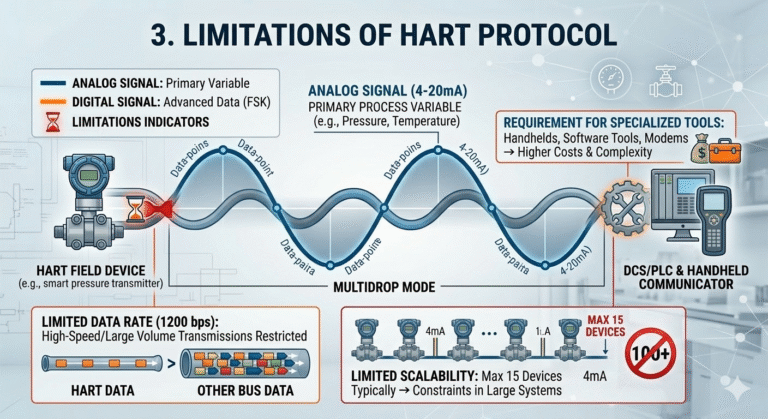
HART’s data transmission rate is 1200 bits per second, which is sufficient for most applications but unsuitable for high-speed or large data volume transmissions.Multidrop Mode Restrictions
In multidrop mode, the number of devices is typically limited to 15, restricting scalability in large systems.Requirement for Specialized Tools
Configuration and troubleshooting often require specialized HART tools or software, which can incur additional costs and complexity.
4. Applications of HART Protocol
Process Control
HART is widely used to monitor and control process variables such as pressure, temperature, flow, and level. Analog signals provide real-time data to control systems, while digital signals deliver advanced diagnostic information.Predictive Maintenance
By transmitting diagnostic data from field devices, HART supports predictive maintenance. Engineers can detect issues (e.g., sensor drift or valve wear) before they lead to system failures.Field Device Configuration
HART simplifies field device configuration, such as setting sensor ranges or adjusting valve parameters, all without manual intervention.Calibration and Testing
Technicians can use HART handheld communicators or software tools to calibrate and test equipment on-site, ensuring accuracy and reliability.
5. Industry Applications
Oil & Gas
Monitoring pressure and temperature in pipelines.
Remote configuration of devices in hazardous environments.Chemical Processing
Monitoring and controlling reactor conditions.
Continuous diagnostics to ensure safe operation.Water & Wastewater
Flow and level measurement.
Efficient pump and valve management.Power Generation
Boiler condition monitoring.
Ensuring turbine reliability through equipment diagnostics.

6. The Future of HART Protocol
While HART remains a trusted protocol in industrial automation, new technologies such as WirelessHART and IoT-based solutions are evolving to meet changing industry demands. For example, WirelessHART eliminates wiring constraints, providing higher flexibility and scalability for industrial networks.
7. Conclusion
HART strikes a balance between legacy system compatibility and modern digital communication, making it a versatile solution in industrial automation. Its ability to transmit rich data over existing infrastructure not only reduces costs but also enhances operational efficiency. Despite its limitations, HART remains a critical tool for ensuring reliable and efficient process control across various industries.