
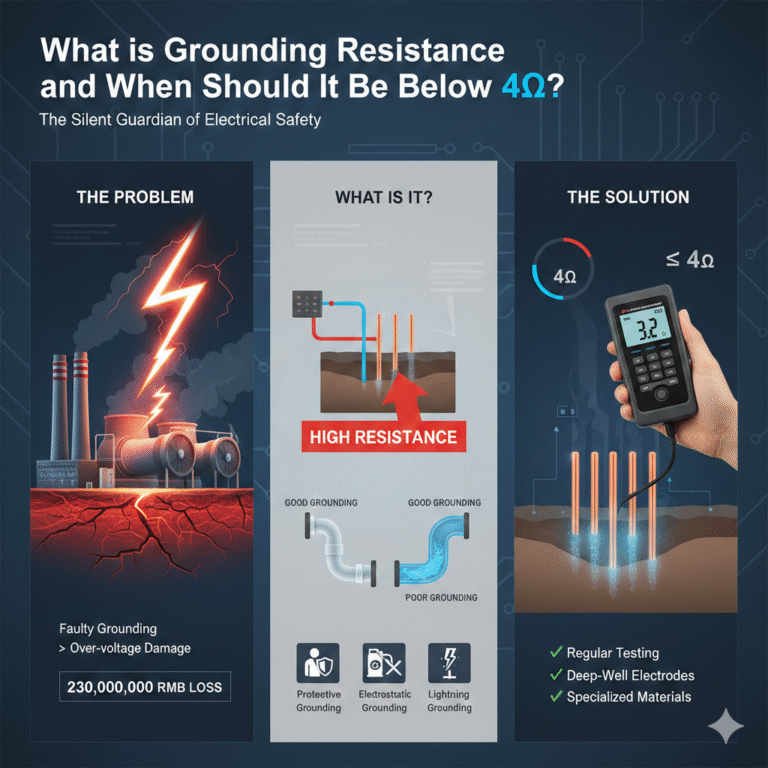
A lightning strike recently caused a 230 million RMB power generation unit to fail instantly—this was not a movie effect, but a real incident at a thermal power plant in Guangdong in 2023. In Dongguan alone, there were seven incidents of lightning strikes on power generation equipment, with a single loss of up to 820,000 RMB. Initially, people believed the lightning was too powerful, but further investigation revealed the problem wasn’t with the equipment itself, but with grounding resistance that significantly exceeded safe limits. The lightning current could not be effectively dissipated, leading to over-voltage damage.
Such incidents are not rare. Issues like unstable signals in equipment rooms, electrical enclosures carrying stray voltages, and frequent failure to pass acceptance checks often trace back to one fundamental cause—poor grounding resistance.
So, what exactly is grounding resistance? What level is acceptable, and what should be done when it exceeds the limit? This article explains it all.
1. What is Grounding Resistance?
Simply put, grounding resistance refers to the resistance encountered when electrical current flows from a grounding system into the earth, and then spreads to another grounding system or further away. When electrical equipment experiences leakage, a short circuit, or a lightning strike, the current needs to flow through the grounding system into the earth. If the “resistance” of this path is too high, the current cannot flow smoothly, creating hazardous voltages on the equipment or the human body.
You can think of it like a drainage pipe: the more open the pipe, the faster the water flows; the more blocked the pipe, the higher the risk of water accumulation. The lower the grounding resistance, the better the dissipation capability; the higher the resistance, the greater the safety risk.
Grounding resistance is mainly classified into three types: protective grounding, electrostatic grounding, and lightning grounding. The value of grounding resistance directly reflects how well an electrical system connects to the earth, and it also reflects the scale of the grounding network.
Protective Grounding: This grounding method is designed to protect human safety. It connects non-electrified but potentially energized parts of electrical equipment (such as metal casings of electrical devices, distribution equipment frames, and utility poles) to the grounding system, preventing electric shocks and equipment damage.
Electrostatic Grounding: This type aims to eliminate the potential threat of static electricity to flammable and explosive materials (e.g., fuels, natural gas) and sensitive electronic devices. Grounding can effectively prevent static charge accumulation and discharge, ensuring the safety and stability of production environments.
Lightning Grounding: This grounding method connects lightning protection devices (e.g., lightning rods) to the earth to direct lightning over-voltage into the ground, protecting electrical equipment from lightning damage and reducing the risk of fires, explosions, and other accidents caused by lightning.
The key factors that affect grounding resistance include soil resistivity, the material of the grounding body, installation depth, the area of the grounding body, and construction quality. Among these, soil conditions are often the most critical factor.
In the early stages of installation, grounding systems typically have low resistance values. However, over time, due to corrosion from the surrounding soil, the resistance may increase. Therefore, regular inspection and maintenance of the grounding system are crucial.
2. Hazards of Non-Compliance with Grounding Resistance Standards
Increased Risk of Electric Shock:
If a transformer experiences insulation failure, high grounding resistance can cause the equipment casing to carry voltage, posing a serious risk of electric shock to personnel.Increased Likelihood of Equipment Damage:
Poor neutral-point grounding can lead to voltage imbalance, causing over-voltage conditions that can damage sensitive equipment like variable frequency drives and servers. Additionally, lightning or surge currents that cannot dissipate quickly may cause lightning arresters or transformers to burn out.System Instability:
Poor grounding may cause relay protection devices to malfunction, leading to signal interference, malfunctions, or control system abnormalities.Failure to Pass Inspections:
Grounding resistance is a required check during safety inspections, including fire safety and electrical system assessments. If grounding resistance is found to be non-compliant, the cost of rectification is usually much higher than ensuring compliance during installation.

3. Common Grounding Resistance Standards
Operational Grounding: Resistance ≤ 4Ω
Protective Grounding: Resistance ≤ 4Ω (up to 10Ω for neutral point grounding)
Repeated Grounding: Resistance ≤ 10Ω
Lightning Grounding: Resistance ≤ 10Ω
Electrostatic Grounding: Resistance ≤ 100Ω
Combined Lightning and Protective Grounding: Resistance ≤ 1Ω
Electronic Information System Grounding (e.g., server rooms): Resistance ≤ 1Ω
Transformer Grounding:
For transformers above 100 kVA: Grounding resistance should not exceed 4Ω.
For transformers ≤ 100 kVA: Grounding resistance should not exceed 10Ω.
In areas with soil resistivity greater than 1000Ω·m, the grounding resistance can be relaxed to ≤ 30Ω, but precautions must ensure that step voltage and touch voltage remain within safe limits.

4. Reasons for Grounding Resistance Exceeding the Limit
The most common reasons for excessive grounding resistance include:
High Soil Resistivity: Areas with sandy or rocky soils typically have higher resistivity, leading to increased grounding resistance.
Corrosion of Grounding Systems: Over time, the grounding body can corrode, reducing its conductivity.
Inadequate Grounding System Design: Insufficient number of grounding electrodes or poor welding quality during construction can contribute to high resistance.
Environmental Factors: Dry seasons can lower the moisture content in the soil, increasing the resistance.
Lack of Regular Re-testing: Many systems are only tested for grounding resistance during initial installation, and are not re-tested over the years, which leads to hidden risks.
5. How to Properly Measure Grounding Resistance
Common methods for testing grounding resistance include:
Three-Electrode Method: Suitable for measuring independent grounding systems, widely used.
Four-Electrode Method: Often used for measuring soil resistivity.
Clamp-on Grounding Resistance Testers: Ideal for quickly testing multi-point grounding systems.
It is recommended to test grounding resistance at least once a year, and especially before the rainy season. For critical locations, it is essential to establish a regular testing schedule and maintain records.
6. How to Rectify Excessive Grounding Resistance
If excessive grounding resistance is detected, corrective measures should not be taken lightly and must be based on the specific circumstances. Common rectification methods include:
Increasing the Number of Grounding Electrodes: Adding more grounding electrodes can lower resistance.
Extending the Length of Grounding Electrodes: A longer grounding electrode increases the effective grounding area.
Using Deep-Well Grounding: In areas where surface grounding is ineffective, deep-well grounding may provide a solution.
Using Approved Grounding Materials: Specialized materials can help lower resistance while maintaining durability.
Avoid Quick Fixes: While adding salt or other chemicals might lower resistance temporarily, they accelerate the corrosion of the grounding system, posing a greater risk in the long term.
Rectification should follow a professional design, comply with regulations, and undergo re-testing to ensure effectiveness.

7. Conclusion
Grounding resistance, though seemingly just a number, is the last line of defense for electrical safety. It operates quietly in the background but can have severe consequences if it fails. While equipment can be upgraded and systems optimized, poor grounding compromises the long-term stability of even the most advanced equipment.
It is strongly recommended that all companies prioritize grounding resistance testing and maintenance, eliminating risks during the early stages to ensure the safety and stability of their operations.