
Introduction
In industrial piping systems, strainers are rarely the most expensive components, nor are they usually the focus during the design stage. However, in actual operation, many problems that appear to be incidental—such as abnormal pump wear, control valve sticking, or gradual deterioration of heat exchanger performance—can often be traced back to insufficient filtration or improper strainer selection.
From engineering practice, the value of a pipeline strainer does not lie in its structural complexity, but in its ability to block solid contaminants at the very front of the system. By preventing impurities from entering critical equipment, a properly selected strainer can stop minor issues from being amplified throughout the system.
Therefore, understanding the application limits of different types of pipeline strainers and establishing a rational selection approach is a fundamental step toward improving long-term system reliability.
1. Sources of Contaminants in Piping Systems
Under ideal conditions, process fluids are often assumed to be “clean.” In reality, whether the medium is water, oil, or chemical fluid, solid particles are almost always present.
These contaminants typically originate from:
Impurities carried within the fluid itself
Rust and scale generated inside carbon steel pipelines
Welding residues and installation debris
Wear particles produced during long-term equipment operation
Once these solids enter the system, they may cause erosion, blockage, or deposition in components with tight tolerances or high rotational speeds. Without effective interception, such damage accumulates gradually and may eventually lead to system-wide failures.
The fundamental engineering role of a pipeline strainer is therefore to establish a controllable and maintainable barrier at the system inlet.
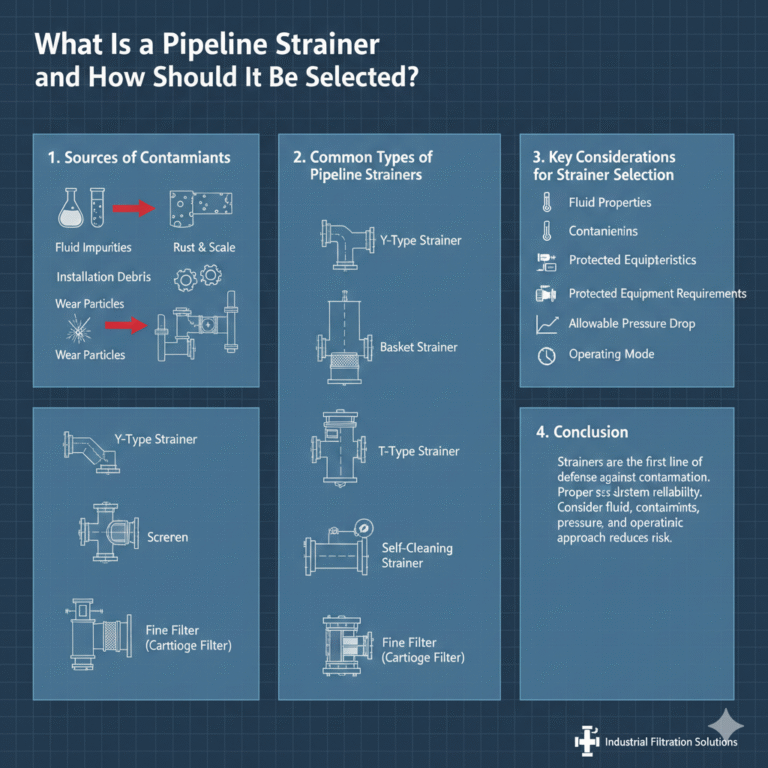
2. Common Types of Pipeline Strainers
Y-Type Strainer
The Y-type strainer is one of the most widely used basic filtration devices in industrial piping. Its structure consists of an inclined branch installed on the main pipeline, with a screen element positioned inside to capture coarse particles.
Due to its compact structure, low pressure loss, and relatively low cost, Y-type strainers are commonly used in water supply systems, HVAC installations, and general industrial services.
From an application perspective, Y-type strainers are suitable for systems with relatively low contamination levels and where filtration is primarily intended for equipment protection. In applications with heavy solid loading or strict continuity requirements, their limited dirt-holding capacity often becomes a constraint.
Basket Strainer
Compared with Y-type strainers, basket strainers significantly increase the filtration area, thereby reducing face velocity through the screen. This design greatly improves dirt-holding capacity.
Dirt-holding capacity refers to the amount of contaminants a strainer can accumulate before a noticeable increase in pressure drop occurs. This parameter directly affects cleaning frequency and system operating stability.
For this reason, basket strainers are widely used in circulating water systems, cooling systems, and petrochemical applications involving large flow rates. Their engineering value lies in maintaining filtration performance while controlling pressure loss growth over time.
T-Type Strainer
The T-type strainer is a structural variation of the basket strainer. Its key advantage is that the screen can be withdrawn horizontally, reducing the vertical clearance required for maintenance.
This feature makes T-type strainers particularly suitable for pipe racks or installations where vertical space is limited.
Without changing the basic filtration principle, the improved maintenance accessibility significantly reduces inspection difficulty, which contributes positively to long-term system reliability.
Self-Cleaning Strainer
In systems where shutdowns are not acceptable or manual maintenance is difficult, self-cleaning strainers provide a more practical engineering solution.
These strainers monitor differential pressure or operate based on preset time intervals. When fouling reaches a defined level, the cleaning mechanism is activated automatically, restoring screen permeability without interrupting system operation.
For continuous-process systems and highly automated plants, self-cleaning strainers substantially reduce maintenance workload and minimize the risk of unplanned downtime caused by blockage.
Fine Filter (Cartridge Filter)
When filtration objectives shift from equipment protection to strict fluid cleanliness control, fine filters become essential.
These filters typically use cartridge-type elements and can achieve micron-level filtration accuracy. They are commonly applied in pharmaceutical, food and beverage, electronics, and fine chemical processes.
In most cases, fine filters are installed as the final stage of a multi-level filtration system. Upstream coarse filtration is necessary to reduce contaminant loading and maintain reasonable service life of the filter elements.

3. Key Considerations for Strainer Selection
In practice, strainer selection is often simplified to matching nominal pipe size. However, this approach overlooks several critical engineering factors.
A rational selection process should consider the following aspects:
Fluid properties
Including temperature, pressure, corrosion characteristics, and chemical compatibility, which determine body and screen materials.Contaminant characteristics
Particle size, concentration, and source should be evaluated to determine appropriate filtration rating.Protected equipment requirements
Filtration accuracy should be based on the tolerance limits of downstream equipment, not on excessive safety margins.Allowable pressure drop
In high-flow systems, increasing filtration area is often more economical than operating under high differential pressure.Operating mode
For continuous systems, duplex or self-cleaning strainers should be considered during the design stage to ensure uninterrupted operation.
Over-specifying filtration accuracy may improve cleanliness but often leads to increased pressure loss and maintenance frequency. Balanced system design is therefore essential.

4. Conclusion
From a system-level engineering perspective, pipeline strainers may appear simple, but their role in ensuring long-term operational stability is fundamental.
In many projects, it is not the most expensive core equipment that determines system reliability, but rather these seemingly minor components that serve as the first line of defense against contamination.
By understanding the functional boundaries of different strainer types and applying a systematic selection methodology during the design phase, engineers can significantly reduce operational risk while achieving reliable performance at relatively low cost.