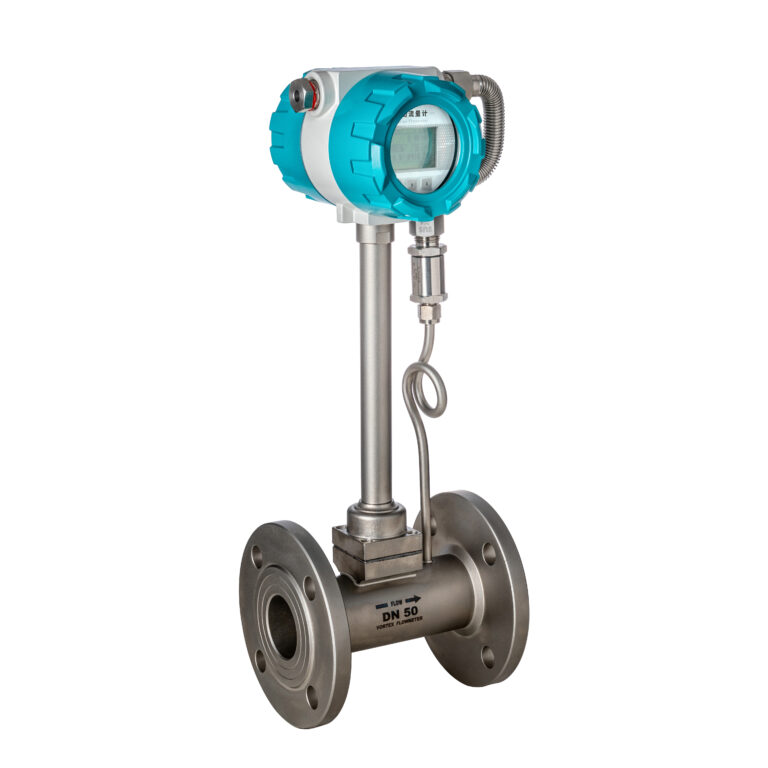
1. Issue: Display of the 8800D Saturated Steam Flowmeter Shows Low Readings
Fault Diagnosis: This was a newly installed meter. Upon rechecking the settings, it was found that the flow measurement unit was set incorrectly— the range upper limit of 16,000 kg/h was mistakenly set to 16,000 m³/h.
Fault Resolution: After correcting the range upper limit from 16,000 m³/h to 16,000 kg/h, the display returned to normal.
Repair Summary: When setting up a vortex flowmeter, it is essential to conduct a trial run to confirm whether the parameters are correctly configured. This trial run helps verify if the output variables and hardware settings are accurate, as well as to identify any potential issues before full operation. In this case, the failure occurred because the trial run step was skipped, leading to the unit’s incorrect settings.
2. Issue: Vortex Flowmeter Display Suddenly Drops from 120 kg/h to 15 kg/h
Fault Diagnosis: The self-diagnosis message displayed “NO communication,” indicating a potential problem with the transmitter.
Fault Resolution: After replacing the transmitter, the configuration could not be completed. Reinstalling the original transmitter, however, restored normal operation.
Repair Summary: The self-diagnosis message “NO communication” typically indicates a failure in reading the signal or a response issue from the transmitter. Initially, the transmitter was suspected to be faulty, so it was replaced. However, due to mismatched specifications, the reconfiguration failed. After reinstalling the original transmitter, the device functioned normally, which suggested that the issue was due to poor wiring connections. Previous checks showed a voltage drop to 10V, and the display suddenly dropped, both of which are linked to bad connections. While troubleshooting, only the transmitter fault was considered, leading to unnecessary delays in the repair process.
Key Takeaways:
Always perform trial runs after configuring new equipment to ensure all settings are correct and functioning properly.
During fault diagnosis, remember to consider all possible issues, such as poor wiring connections or power supply issues, and not just the primary suspected fault (e.g., the transmitter).