
Key Factors for Thermocouple Selection (Prioritized)
Temperature Range (Primary Consideration)
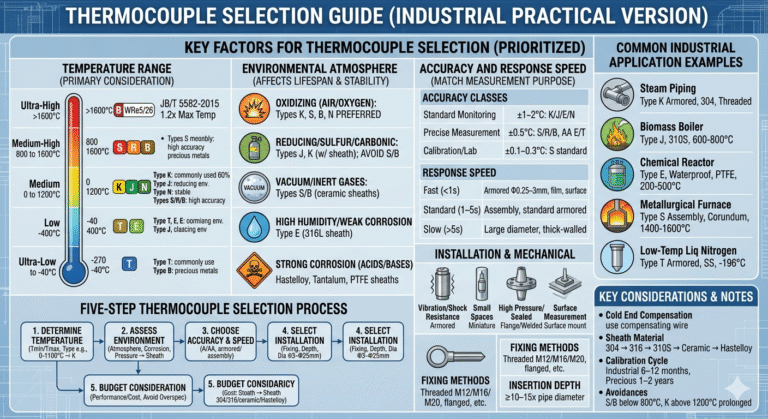
The temperature range determines the selection of the thermocouple type. The type should cover 1.2 times the maximum temperature (JB/T 5582-2015):
Ultra-Low Temperature (-270 to -40°C): Type T (Copper-Copper Nickel), high precision for low temperatures.
Low Temperature (-40 to 400°C): Type T (stable) and Type E (high sensitivity).
Medium Temperature (0 to 1200°C): Type K (Nickel-Chromium-Nickel-Silicon, most commonly used, covering 60% of applications), Type J (Iron-Copper Nickel, resistant to reducing environments), Type N (more stable than K, an alternative).
Medium-High Temperature (800 to 1600°C): Type S (Platinum-Rhodium 10-Platinum, high accuracy), Type R (Platinum-Rhodium 13-Platinum), Type B (Platinum-Rhodium 30-Platinum-Rhodium 6, for temperatures above 1700°C).
Ultra-High Temperature (>1600°C): Type B, Tungsten-Rhenium series (WRe5/26).
Environmental Atmosphere (Affects Lifespan and Stability)
Oxidizing Atmosphere (Air/Oxygen): Types K, S, B, and N are preferred.
Reducing/Sulfur/Carbonic Environments: Types J and K (with protective sheaths); avoid Types S/B (susceptible to embrittlement).
Vacuum/Inert Gases: Types S/B with ceramic sheaths.
High Humidity/Weak Corrosion: Type E with 316L protective sheath.
Strong Corrosion (Acids/Bases/Hydrofluoric Acid): Hastelloy, Tantalum, PTFE protective sheaths.
Accuracy and Response Speed (Match Measurement Purpose)
Accuracy Classes:
Standard Monitoring (±1~2°C): Types K/J/E/N (industrial grade).
Precise Measurement (±0.5°C): Types S/R/B (precious metals), AA-grade E/T.
Calibration/Laboratory (±0.1~0.3°C): Type S (standard grade).
Response Speed:
Fast (<1s): Armored (Φ0.25–3mm), film type, surface mount.
Standard (1–5s): Assembly type, standard armored.
Slow (>5s): Large diameter, thick-walled protection (for durability).
Installation and Mechanical Requirements
Structural Types:
Vibration/Shock Resistance: Armored (flexible, shock-resistant).
Small Spaces: Miniature, spring-loaded, threaded types.
High Pressure/Sealed: Flange, welded types, high-pressure protective sheaths.
Surface Temperature Measurement: Surface mount, clamp-on, surface thermocouples.
Fixing Methods: Threaded (M12/M16/M20), flanged, clamped, welded, spring-loaded.
Insertion Depth: ≥10–15 times the pipe diameter, covering the core temperature measurement area.
Cost and Lifespan (Balance Between Performance and Cost)
Low Cost (General Use): Types K/J/E/N (base metals, high cost-performance ratio).
Medium Cost (Stable): Type N, K with protective sheath.
High Cost (High Temperature/High Precision): Types S/R/B (precious metals, long lifespan, low maintenance).

Five-Step Thermocouple Selection Process
Determine Temperature: Define Tmin/Tmax, and select the thermocouple type (e.g., 0-1100°C → Type K).
Assess the Environment: Consider the atmosphere, corrosion, and pressure to select the sheath material (304/316/ceramic/Hastelloy).
Choose Accuracy and Response Speed: Select the desired accuracy level (A/AA) and structure (armored/assembly).
Select Installation Type: Fixing method, insertion depth, and pipe diameter (Φ3–Φ25mm).
Budget Consideration: Balance performance and cost, avoiding overspecification for basic applications.
Common Industrial Application Examples
Steam Piping (200–400°C): Type K armored, 304 protective sheath, threaded installation.
Biomass Boilers (600–800°C, Reducing Environment): Type J, 310S protective sheath.
Chemical Reactors (200–500°C, High Humidity): Type E, waterproof, PTFE protective sheath.
Metallurgical Furnace (1400–1600°C): Type S assembly, corundum protective sheath.
Low-Temperature Liquid Nitrogen (-196°C): Type T armored, stainless steel protective sheath.
Key Considerations & Notes
Cold End Compensation: Always use a compensating wire (same type as the thermocouple) or an electronic compensator to avoid large errors.
Sheath Material Selection: As temperature and corrosion increase, so must the material grade (304 → 316 → 310S → Ceramic → Hastelloy).
Calibration Cycle: Industrial applications require calibration every 6–12 months; precious metals (S/B types) can extend to 1–2 years.
Avoidances: Do not use S/B types below 800°C (low thermoelectric potential, large errors); avoid using Type K for prolonged use above 1200°C.