
Thermocouples are among the most widely used temperature sensors in industrial measurement systems. From power plant boilers to gasification furnaces and petrochemical reactors, thermocouples provide reliable temperature monitoring in environments ranging from –200°C to above 1800°C.
Understanding how thermocouples work, how to select the correct type, and how material degradation affects long-term accuracy is essential for ensuring stable process control.
1. Working Principle of Thermocouple – The Seebeck Effect
A thermocouple operates based on the Seebeck Effect.
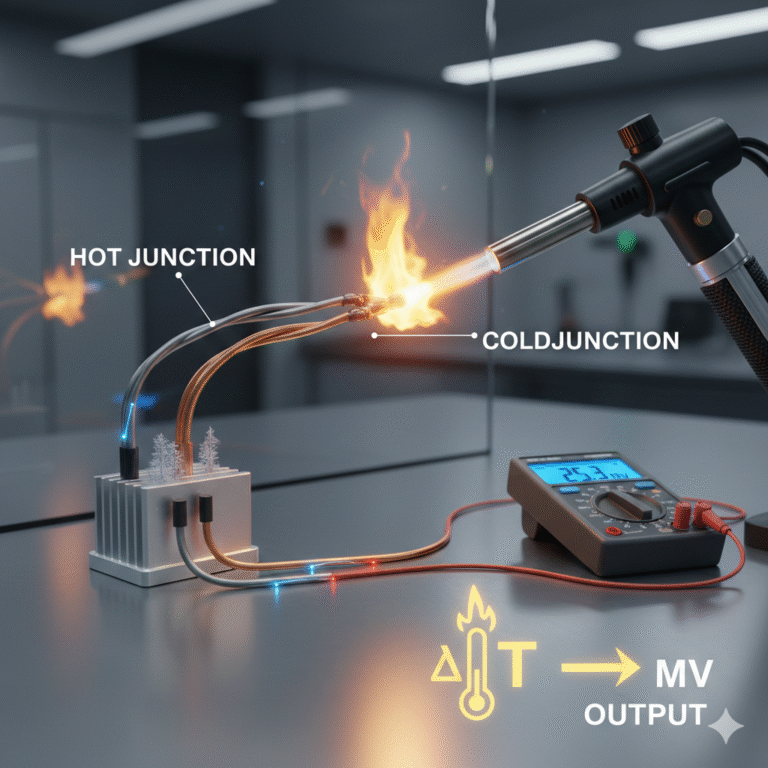
When two dissimilar metal conductors are joined at one end (hot junction) and exposed to different temperatures at the other end (cold junction), a small electromotive force (EMF) is generated. This voltage is proportional to the temperature difference between the two junctions.
Key relationship:
Temperature difference (ΔT) → Thermoelectric voltage (mV output)
The measured millivolt signal, combined with cold junction compensation, allows accurate determination of process temperature.
Main components:
Hot junction (measuring end)
Cold junction (reference end)
Thermoelectric circuit
Signal conditioning / transmitter
2. Common Thermocouple Types and Selection Guide
Thermocouples are divided into two major categories:
Base metal thermocouples (K, N, E, J, T)
Noble metal thermocouples (S, R, B)
Below are the most commonly used types in industrial applications.
K Type Thermocouple
Material: Nickel-Chromium / Nickel-Silicon
Temperature range: –200°C to +1300°C
Atmosphere: Oxidizing and inert environments
Advantages:
Most widely used
Good linearity
High sensitivity
Cost-effective
Limitations:
Not suitable for strong reducing atmosphere
Sensitive to sulfur contamination
Long-term instability at 300–500°C and around 800°C
K type thermocouple remains the standard choice for general industrial temperature measurement.
N Type Thermocouple
Material: Nicrosil / Nisil
Temperature range: –200°C to +1300°C
Atmosphere: Oxidizing and inert environments
Advantages:
Improved high-temperature stability compared to K type
Better resistance to oxidation
Better resistance to nuclear radiation
Reduced drift over long-term use
N type thermocouple was developed specifically to overcome K type instability issues.
For high-temperature furnaces and boilers, N type is often the better long-term investment.
J Type Thermocouple
Material: Iron / Constantan
Temperature range: –200°C to +950°C
Advantages:
Good sensitivity
Suitable for vacuum or mildly reducing atmosphere
Limitations:
Iron oxidizes rapidly at high temperature
Not suitable for sulfur environments
T Type Thermocouple
Material: Copper / Constantan
Temperature range: –200°C to +350°C
Best for:
Low temperature applications
Refrigeration systems
Cryogenic measurement
S, R and B Type Thermocouples (Noble Metal)
These platinum-rhodium thermocouples are used for very high temperature applications.
Temperature range:
S / R: up to 1600°C
B: up to 1800°C
Advantages:
Excellent accuracy
Outstanding long-term stability
Suitable for laboratory and high-precision control
Limitations:
Very expensive
Sensitive to contamination
Low output voltage

3. How to Select the Right Thermocouple
When selecting a thermocouple, consider the following factors:
1. Temperature Range
Ensure the operating temperature is within safe limits and leave sufficient safety margin.
2. Process Atmosphere
This is critical for thermocouple life.
Oxidizing atmosphere → K, N, S, R, B types suitable
Reducing atmosphere → Avoid K type
Sulfur-containing environment → Special protection required
Vacuum → J type may be considered
Incorrect atmosphere selection leads to rapid sensor drift and failure.
3. Mechanical Protection
In harsh industrial conditions:
Use ceramic protection tubes for gasification furnaces
Use high-chromium or carbide-coated protection tubes for circulating fluidized bed boilers
Consider armored (mineral insulated) thermocouples for fast response
4. Accuracy Requirement
General industrial control → K or N type
High precision control → S or R type
5. Cost and Maintenance Cycle
Total cost includes:
Sensor price
Replacement frequency
Downtime cost
In many cases, choosing N type instead of K type reduces long-term drift and maintenance frequency.

4. Thermocouple Drift and Seebeck Coefficient Degradation
Thermocouple accuracy degradation is primarily caused by changes in the Seebeck coefficient over time.
At high temperatures, the thermoelement materials undergo:
Oxidation
Grain growth
Chemical contamination
Structural transformation
These changes cause thermoelectric drift.
Typical examples:
K type instability at 300–500°C
Accelerated degradation in reducing atmosphere
Contamination of platinum thermocouples
Regular calibration every 6–12 months is recommended for critical control points.
When drift exceeds tolerance limits, replacement is required.

5. Thermocouples in Boiler and Gasification Furnace Applications
Boiler (Especially Circulating Fluidized Bed)
Challenges:
Severe abrasion
High temperature oxidation
Sulfur corrosion
Recommended solution:
N type thermocouple preferred
Heavy-duty wear-resistant protection tube
Periodic inspection of sheath thickness
Gasification Furnace
Challenges:
Strong reducing atmosphere (CO, H₂)
Possible sulfur presence
Thermal shock
Recommended solution:
N type thermocouple for base metal option
S or R type for extreme high temperature
High purity alumina ceramic protection tube mandatory
Proper material selection at the beginning is far more important than post-failure maintenance.

6. Conclusion
A complete understanding of thermocouple working principles, material characteristics, atmosphere compatibility, and degradation mechanisms is essential for reliable temperature measurement.
In high-temperature industrial processes such as boilers and gasification furnaces, correct thermocouple selection determines measurement stability, maintenance frequency, and overall operating cost.
If you require technical assistance in selecting thermocouples for high-temperature or harsh industrial environments, professional consultation can help optimize performance and extend service life.