
This seemingly simple question has caused confusion for many companies and designers. Some choose to install cut-off valves, while others don’t, with practices varying widely. But what do the standards say? Are there clear requirements in the regulations? In this article, we will clarify the principles for the installation of cut-off valves in safety valve pipelines based on authoritative standards and help you avoid design mistakes.
To Install or Not to Install?
According to national standards and regulations, the installation of cut-off and bypass valves in the inlet and outlet pipelines of safety valves must follow specific guidelines:
1. Installation Requirements for Cut-off Valves in Safety Valve Pipelines
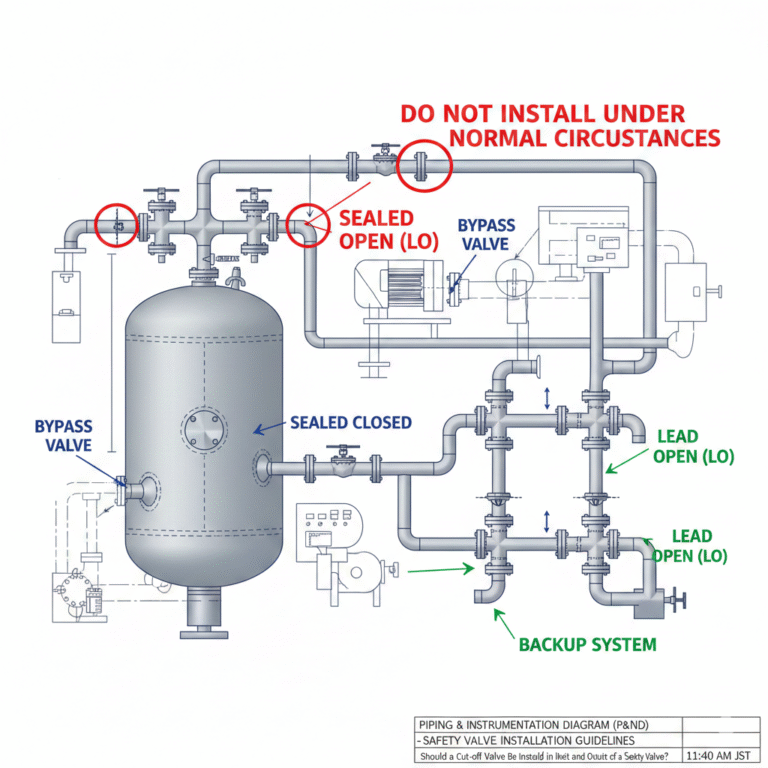
Generally, cut-off valves should not be installed in the inlet and outlet pipelines of safety valves. If installation is necessary, the following conditions must be met:
Installation Conditions: Cut-off valves may be installed between the safety valve and pressure vessel only when the vessel contains highly toxic, flammable, corrosive, viscous, or valuable media, and if approved by the safety management personnel of the operating unit, along with reliable preventive measures.
Operational Requirements: During normal operation, the cut-off valve must remain fully open and should be sealed with lead or locked.
Valve Selection: A gate valve should be selected for the cut-off valve, with the valve stem installed horizontally, and the valve should be sealed open (CSO) or locked open (LO) to prevent accidents caused by gate detachment.
Nominal Diameter Requirements: The nominal diameter of the cut-off valve’s inlet and outlet must not be smaller than that of the safety valve’s flanged connections. The pressure rating should match that of the safety valve’s inlet and outlet pipelines.
2. Installation Requirements for Bypass Valves on Safety Valves
The installation of bypass valves on safety valves is not mandatory and is only allowed under specific circumstances.
Process Requirements: Bypass valves can be installed in the inlet and outlet pipelines of safety valves only when other means are not available to prevent system overpressure during safety valve calibration, or when it is necessary to discharge material through the safety valve’s bypass during startup or shutdown.
Operational Requirements: When a bypass valve is installed, it must remain sealed closed (CSC) or locked closed (LC). The bypass valve should only be temporarily opened during safety valve calibration or maintenance, and must never be opened during normal operation.
Installation Location: The bypass valve should be installed on the external side of the cut-off valve in the pipeline, typically the same size as the inlet pipeline.
3. Backup Safety Valve Installation Requirements
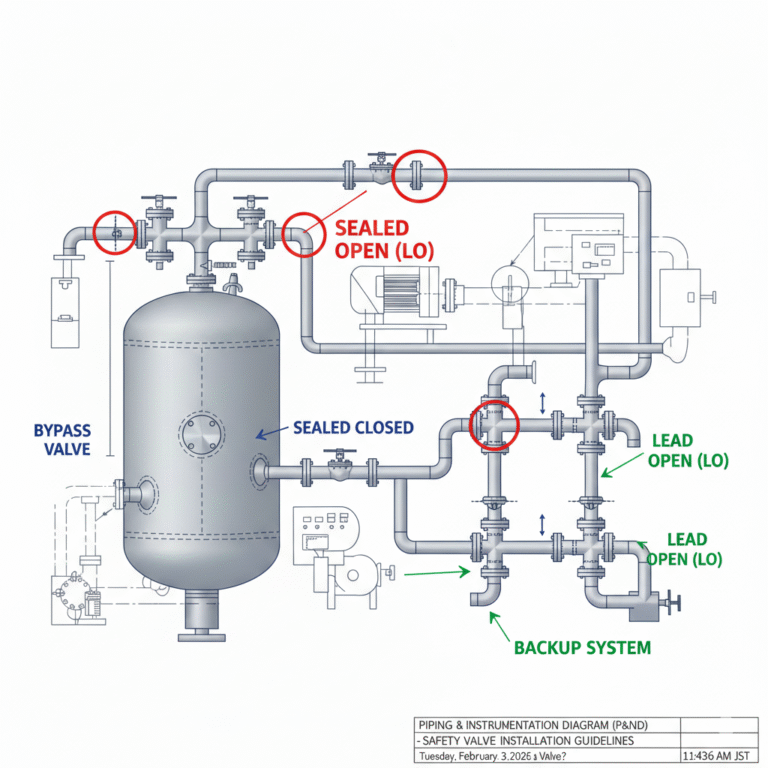
For equipment that needs to operate continuously for more than one year and where other measures can ensure the system does not overpressure during safety valve calibration, only one safety valve is required. A cut-off valve must be installed before and after the safety valve.
For Pressure Storage Tanks: A backup safety valve and a bypass line should be installed, with a full-diameter cut-off valve installed before and after each safety valve. These installations should be marked on design drawings with “LO” (Lead Open).
For Liquefied Hydrocarbon Storage Tanks: Tanks with a capacity of 100 cubic meters or more should have two sets of safety valves, and each set should be capable of ensuring safety venting.
4. Standards and Regulations: Do They Provide Clear Requirements?
Several standards and regulations provide guidance on whether cut-off valves should be installed:
Fixed Pressure Vessel Safety Technical Supervision Regulations (TSG 21-2016): Conclusion: Do not install, except under special conditions, and in such cases, lead seal open.
Industrial Pipeline Safety Technical Regulations (TSG 31-2025): Conclusion: Do not install, except under special circumstances.
Industrial Metal Pipeline Design Code (GB 50316-2000): Conclusion: Do not install, unless special requirements apply, and in such cases, install a bypass valve and local pressure gauge.
Safety Valve Installation and Selection (HG/T 20570.2-1995): Conclusion: Do not install, except in special cases, and if necessary, ensure the valve is lead-sealed open.
Safety Valve Technical Supervision Regulations (TSG ZF001-2006): Conclusion: Do not install, unless necessary, and if installed, ensure the valve is lead-sealed open.
Pressure Pipeline Code, Part 1: Industrial Pipelines (GB/T 20801.1-2025): Conclusion: Do not install, except in special cases, and if necessary, ensure the valve is lead-sealed open.
Pressure Vessel, Part 1: General Requirements (GB/T 150.1-2024): Conclusion: Installation is not recommended.

Conclusion:
The general consensus across various standards and regulations is clear: cut-off valves should not be installed in safety valve pipelines under normal circumstances. Only in cases involving special media, processes, or operational requirements may installation be permitted, and it must meet strict additional conditions.