
In industrial automation, the comparison between PROFIBUS and PROFINET has been discussed for decades.
Both communication technologies are defined and maintained by PI (PROFIBUS & PROFINET International) and belong to the same IEC standard family. While they share continuity in engineering philosophy and configuration concepts, their technical architectures represent two different generations of industrial communication systems.
Rather than competing technologies, PROFIBUS and PROFINET reflect the evolution of industrial networks from traditional fieldbus systems to industrial Ethernet.
1. Technical Positioning of PROFINET
PROFINET (Process Field Net) is an industrial Ethernet communication standard introduced by PI in the early 2000s. Its development was driven by the industry’s transition from classical fieldbus architectures toward Ethernet-based automation systems.
Technically, PROFINET is built upon the standard IEEE 802.3 Ethernet physical layer. On top of this foundation, PI defined industrial-specific mechanisms including real-time communication, device models, engineering configuration rules, diagnostics, and safety extensions.
This architecture allows PROFINET to combine the openness and bandwidth advantages of Ethernet with the determinism and synchronization required for industrial control applications.
From a system perspective, PROFINET is not a simple upgrade of PROFIBUS, but a comprehensive solution designed specifically for the industrial Ethernet era.
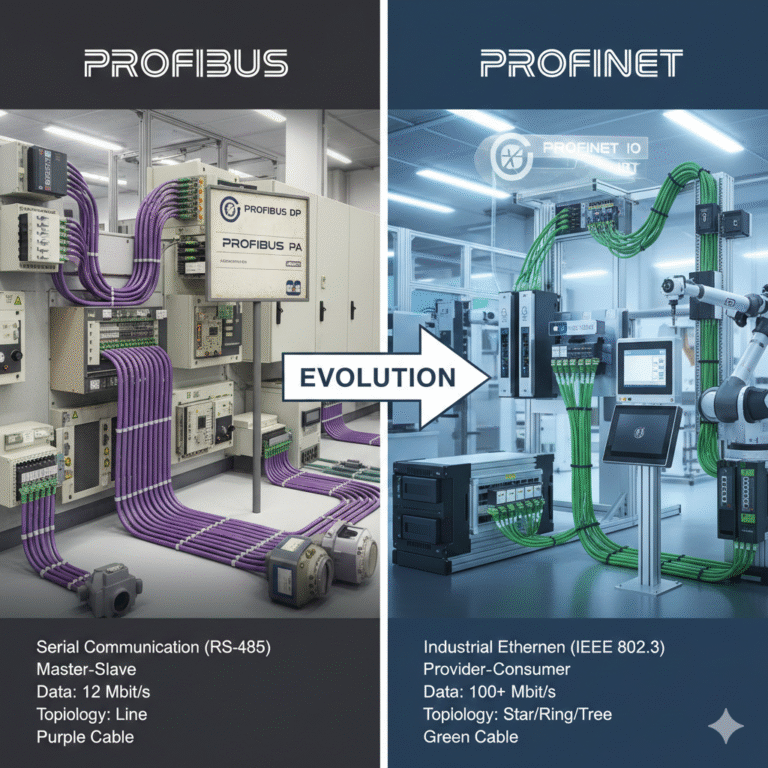
PROFINET typically uses standard RJ45 Ethernet interfaces together with industrial-grade Ethernet cables. In most installations, PROFINET cables are identified by a green outer jacket. Although standard Ethernet cables may function in some environments, industrial applications normally require dedicated PROFINET cables to ensure sufficient shielding and mechanical robustness.
In typical systems, PROFINET operates at 100 Mbit/s with a maximum copper cable length of 100 meters per segment.
Thanks to its high communication speed and cycle times below 1 millisecond, PROFINET is suitable for fast I/O updates and motion control applications. Standard Ethernet switches can be used to build line, star, tree, or ring topologies, providing significant flexibility in network design and system expansion.
2. Origin and Characteristics of PROFIBUS
PROFIBUS was officially introduced in 1989 and quickly became one of the most widely adopted fieldbus standards worldwide during the 1990s. It has been extensively proven in discrete manufacturing, process automation, and hybrid industrial systems.
The primary objective of PROFIBUS was to replace conventional point-to-point wiring by enabling centralized communication with distributed field devices through serial bus technology.
PROFIBUS is based on RS-485 serial communication. A typical PROFIBUS network consists of a master station (PLC, PAC, or DCS) and multiple slave devices, with all communication initiated and scheduled by the master.
Common PROFIBUS devices include drives, motors, remote I/O modules, sensors, actuators, and field instruments.
Depending on the application, PROFIBUS is divided into two main variants:
PROFIBUS DP – designed for high-speed discrete I/O and drive control
PROFIBUS PA – based on the MBP (Manchester Bus Powered) physical layer, suitable for intrinsically safe process automation environments
This architecture has demonstrated excellent reliability in systems with moderate device counts and limited data volumes.
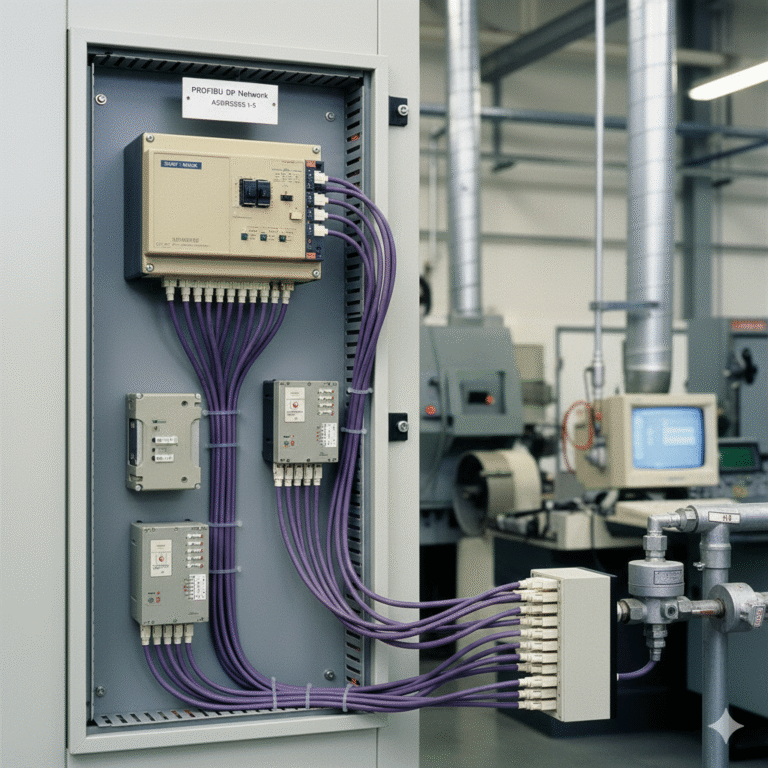
PROFIBUS cables are typically identified by a purple outer jacket, which allows easy visual recognition in industrial installations.
PROFIBUS networks are commonly wired in a daisy-chain (line) topology, where devices are connected sequentially. Proper termination resistors must be enabled at both physical ends of the bus. Incorrect termination configuration remains one of the most frequent causes of PROFIBUS communication failures.
Each PROFIBUS device must be assigned a unique address within the range of 1 to 127. Address configuration may be performed through engineering software such as STEP 7 or TIA Portal, or via hardware switches on the device itself.
The typical PROFIBUS communication speed ranges from 9.6 kbit/s up to 12 Mbit/s. At lower baud rates, cable lengths of up to 1000 meters are possible, while higher speeds require shorter cable distances.
3. Differences in Communication Performance and System Scale
One of the fundamental differences between PROFIBUS and PROFINET lies in device identification.
PROFIBUS relies solely on device addresses.
PROFINET devices, in contrast, use three identification elements:
MAC address (unique Ethernet identifier)
IP address (network communication)
Device name (PROFINET-specific identification)
During system commissioning, engineers mainly use the device name and IP address to assign devices within the PROFINET network, while the MAC address serves as a lower-level hardware identifier.
From an engineering perspective, the difference between PROFIBUS and PROFINET is not limited to transmission speed. It represents a fundamental difference in system capability:
PROFIBUS is well suited for fixed, clearly structured fieldbus systems
PROFINET provides greater flexibility for large networks, high data volumes, and complex topologies
As a result, both technologies continue to coexist in modern industrial plants.

4. Data Exchange Models
PROFIBUS uses a classical master-slave communication model. All data exchanges are initiated by the master, and slave devices respond only when requested. This approach offers clear communication control but limits bandwidth utilization and flexibility.
PROFINET adopts a provider-consumer communication model. Controllers and I/O devices can simultaneously act as data providers and consumers, fully leveraging the full-duplex characteristics of Ethernet.
In this model, controllers transmit output data to devices while receiving input data in parallel, enabling efficient bidirectional communication and supporting large-scale data exchange.
5. Proxy Mechanism and System Integration
In multi-network automation systems, interconnection between different fieldbus technologies is often required.
Traditional PROFIBUS systems typically rely on protocol gateways for network integration. PROFINET, however, defines a standardized proxy mechanism within its specification.
Through PROFINET proxies, various fieldbus systems such as PROFIBUS DP, PROFIBUS PA, AS-Interface, IO-Link, CANopen, Modbus, HART, Foundation Fieldbus, and others can be integrated into a PROFINET network with unified engineering, diagnostics, and maintenance concepts.
This significantly improves system integration capability and long-term scalability.
6. Industry Adoption and Installed Base
From an industry perspective, PROFIBUS maintains a larger installed base due to its earlier introduction. PROFINET, however, has shown continuous growth and has become the dominant choice in newly designed automation systems.
The PI standard framework ensures engineering continuity, allowing existing PROFIBUS systems to be gradually integrated into Ethernet-based architectures without sacrificing investment protection.

7. Conclusion
PROFIBUS and PROFINET represent two major stages in the evolution of industrial communication technology.
PROFIBUS established the foundation of fieldbus-based automation systems, while PROFINET extends industrial communication capabilities within an Ethernet architecture.
In modern industrial environments, both technologies will continue to coexist for many years, each serving different system scales, performance requirements, and lifecycle stages.