
Instrument calibration refers to using a reference standard to compare and verify the performance of a field instrument.
Both devices measure the same process parameter, and the difference between the readings is used to determine whether the instrument falls within the allowable error range.
Typical instruments that can be calibrated in the field include:
pressure and differential pressure transmitters, valve positioners, safety barriers, and control valves.
1️⃣ Calibration of Smart Transmitters
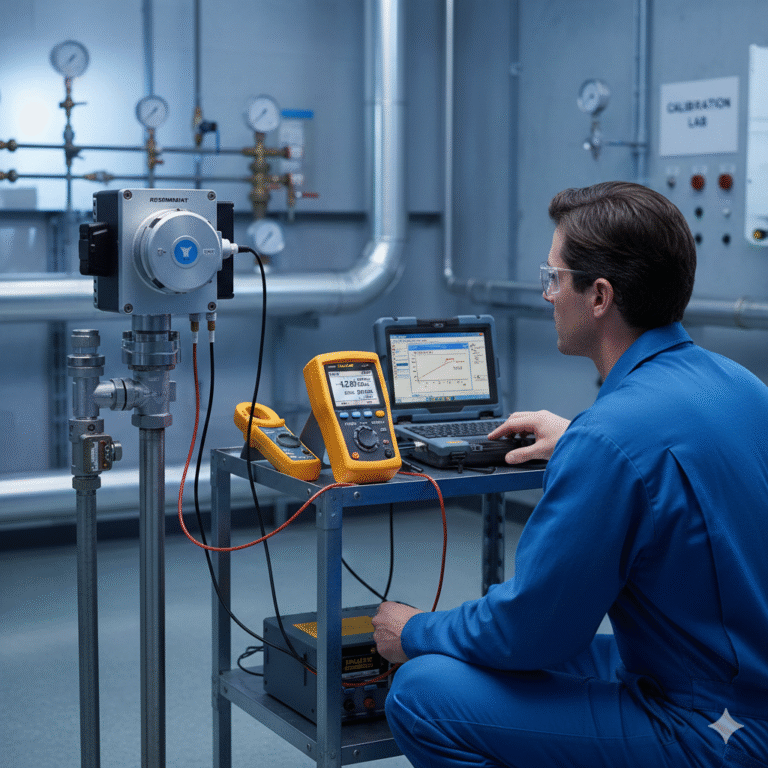
A simplified wiring arrangement for calibrating a smart pressure or DP transmitter is shown in Figure 1.
The calibration procedure generally consists of three steps:
① Range Setting
Configure the 4 mA and 20 mA points as the lower and upper range limits.
This may be completed using:
A handheld programmer (HART communicator),
A pressure source together with the communicator, or
A pressure source plus the transmitter’s zero and span keys.
② Sensor Trim
Perform a fine adjustment on the measurement sensor.
Apply zero pressure using the equalizing valve to trim the zero point.
Apply the lower and upper calibration pressures to complete the full-span trim.
③ Analog Output Trim
Verify and adjust the 4–20 mA analog output to ensure that it matches the reading of the control system or reference measurement loop.
2️⃣ Using a Process Calibrator for Instrument Calibration
A process calibrator is a multifunction device capable of sourcing and measuring:
DC voltage
DC current
Resistance
Thermocouple and RTD signals
Frequency signals
It can also directly power a transmitter with a built-in 24 V DC supply, eliminating the need for an external power source in many cases.
With suitable pressure modules attached, the calibrator can be used to check and adjust pressure and differential pressure transmitters as well.
Advantages:
High accuracy
Replaces multiple tools (potentiometer, resistance box, voltage and current meters)
Acts simultaneously as a signal source and a measurement reference
Simple wiring and field operation
The calibration principle is the same as traditional methods—compare the device under test against a known standard.
Users only need to follow the operating procedures outlined in the calibrator manual.
🎯 Summary
Whether using a transmitter communicator or a multifunction process calibrator, proper calibration ensures:
Measurement accuracy
Reliable control performance
Compliance with operational standards
Regular calibration is essential for safe and stable industrial process operation.