Properly setting alarm values can prevent safety accidents. So, how should we set these alarm values? For example, consider a tank with a level control limit of 80%. What would be the appropriate alarm value? 70%? 75%? Or 78%?
To correctly set alarm values, we first need to understand one key concept: response time. The alarm value must be set so that operators have enough time to take appropriate action, preventing unexpected incidents. This core concept is response time.
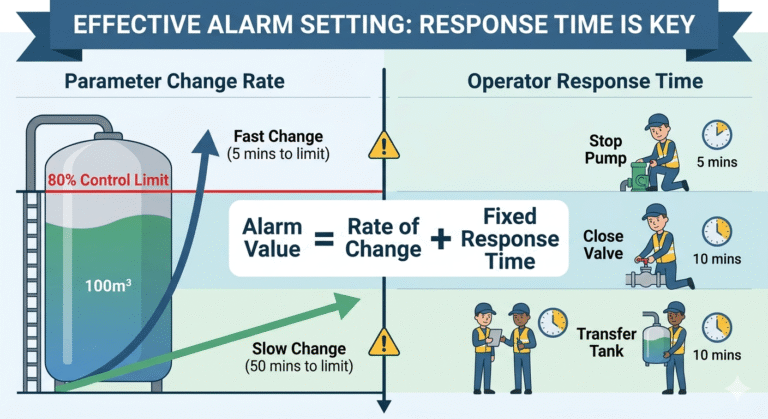
Different operating conditions require different response times. For example, for a 100m³ tank, with a normal flow rate entering the tank, the liquid level will rise from 75% to 80% in just about 5 minutes. If the alarm is set at 75%, operators won’t have enough time to stop the pump, close the valve, and transfer the tank—making such a setting ineffective. However, for a 100,000m³ tank, it might take 50 minutes for the liquid level to rise from 75% to 80%. With the alarm set at 75%, operators would have more than enough time to act. In this case, the alarm value is set too low.
This example illustrates the core point: the rate of change of the parameter and the operator’s emergency response time are the basis for setting alarm values. The response time is generally fixed, while the rate of change varies. Setting alarm values based on the rate of change is the most scientific and rational approach.
For example, drivers know that when traveling at 100 km/h, an alert will be triggered if the car gets too close to the vehicle ahead—typically around 40 meters. However, if driving at 20 km/h, the same alert won’t trigger until much closer (5 meters). This is similar to alarm systems: with an appropriate rate of change formula integrated into the Distributed Control System (DCS), alarms are activated at the correct times.
Alarm Classification
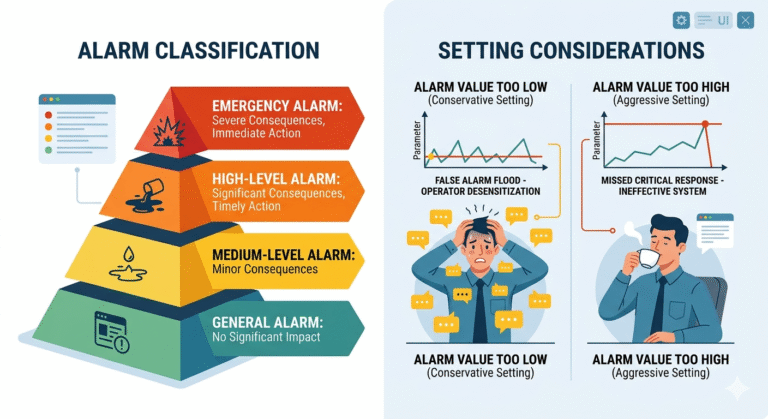
Alarm values should be classified into different levels based on their potential consequences. For example:
Emergency Alarm: Severe consequences, requires immediate action.
It’s important not to set alarms for all parameters. Only parameters that affect safety, environmental impact, or quality should have alarms set. Other parameters, based on operator needs or habits, may or may not have alarms set.
Alarm Value Settings – Too High or Too Low?
Is it always better to set alarm values conservatively for more safety? Not necessarily. Setting alarm values too low may cause too many false alarms, leading operators to become desensitized. When a real emergency arises, they might miss critical response opportunities, as the alarm could be ignored due to frequent non-urgent triggers.
Have you ever encountered an annoying “false alarm” or a situation where an important alarm was missed? Was it because the liquid level reached its max before you could reach the site, or was it a misreported alarm? Feel free to share your experiences in the comments!