
Components of Process Control Instruments
Transmitter Unit
The transmitter unit converts measured parameters (such as set parameters in an automatic control system) into standardized signals for indication, recording, or control. Common types of transmitters include pressure transmitters, differential pressure transmitters, flow transmitters, temperature transmitters, differential temperature transmitters, and level transmitters.
Transmitters can be categorized into two types based on their working principles:
Structural Type: These transmitters utilize force balance principles. The measurement elements, such as diaphragms, capsules, or bellows, convert the measured parameters into force, which is balanced through a vector mechanism and electromagnetic feedback. The result is output as a standardized current signal (4–20mA).
Physical Type: These transmitters use the physical property changes of components to measure parameters. For example, a measurement element made from a diffused silicon chip directly converts pressure or differential pressure signals into electrical signals. These transmitters have simple structures, high accuracy, and good stability.
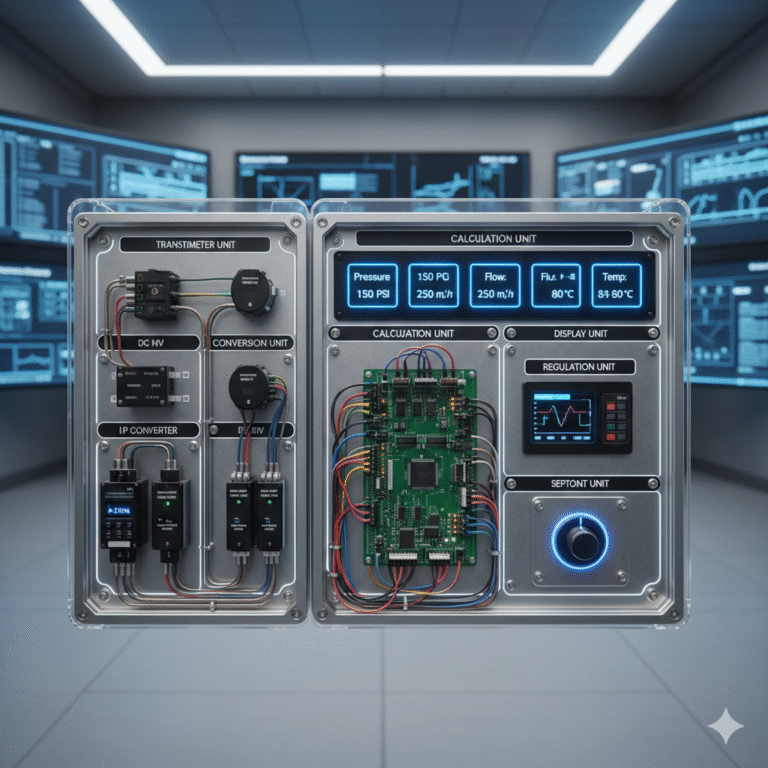
Transmitters are typically installed near the measured or controlled object, requiring excellent environmental adaptability, such as moisture resistance, corrosion resistance, and vibration resistance. In explosive environments, explosion-proof transmitters may be used.
Conversion Unit
The conversion unit acts as a bridge between the electric units and other types of instruments. It converts the voltage, frequency, or other signals from various instruments into standardized signals (e.g., 4–20mA) or between different standardized signals, ensuring compatibility within the same control system. Common conversion units include DC millivolt converters, frequency converters, impedance converters, electric-to-air converters, and air-to-electric converters.Calculation Unit
The calculation unit performs arithmetic operations such as addition, subtraction, multiplication, division, square roots, and squaring on standardized signals. It is widely used for multi-parameter integrated regulation. For instance, it can correct flow signals based on temperature and pressure. Adders, for example, can perform addition and subtraction on multiple standardized signals.Display Unit
The display unit is responsible for indicating, recording, and accumulating the calculated measured parameters, enabling operators to monitor and adjust the system effectively.Setpoint Unit
The setpoint unit outputs standardized signals, representing the set values for the controlled variables, which are sent to the control unit to achieve setpoint control. Additionally, the output of the setpoint unit can be used as a reference for other instruments.Regulation Unit
The regulation unit compares the deviation between the measured signal and the setpoint, then calculates a control signal based on a regulation rule (such as proportional, integral, or derivative control) and sends it to the actuator to adjust the system automatically. Regulation units are categorized into PID controllers, feedforward controllers, and nonlinear controllers, among others.
Control Section: Includes input circuits, proportional-differential circuits, proportional-integral circuits, output circuits, and manual operation circuits.
Indication Section: Includes the indication circuits for the measurement signal and the setpoint signal.
PID controllers are well-developed analog controllers, capable of meeting the needs of various production process controls and adjustments.