
1. Comparison of the Performance Advantages and Disadvantages of the Top Ten Types of Control Valves
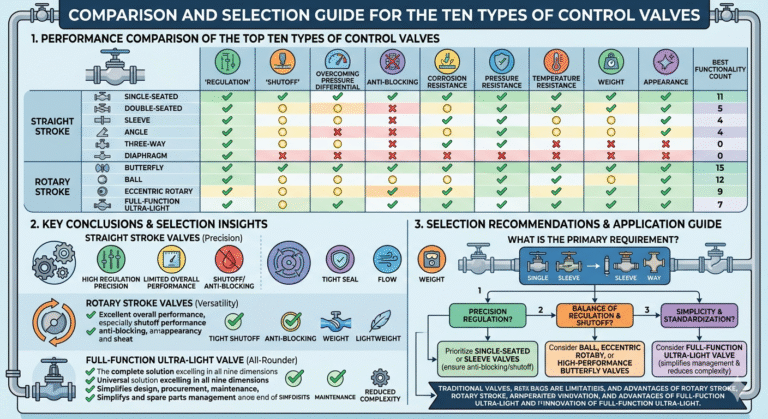
Control valves can be categorized into ten main types. How do the nine key functional aspects compare across these types? To streamline the information, the following table summarizes the performance scores for the common types of control valves based on nine dimensions: regulation, shutoff, overcoming pressure differential, anti-blocking, corrosion resistance, pressure resistance, temperature resistance, weight, and appearance. A “best functionality count” is also provided as a key reference for valve selection.
| Valve Type | Regulation | Shutoff | Pressure Differential | Anti-blocking | Corrosion Resistance | Pressure Resistance | Temperature Resistance | Weight | Appearance | Best Functionality Count |
|---|---|---|---|---|---|---|---|---|---|---|
| Straight Stroke | ||||||||||
| Single-Seated Valve | ✓ | × | × | × | ✓ | ✓ | × | × | 4 | |
| Double-Seated Valve | ✓ | ○ | × | × | ✓ | ✓ | × | × | 4 | |
| Sleeve Valve | ✓ | × | ✓ | × | ✓ | ✓ | ✓ | × | 4 | |
| Angle Valve | ✓ | × | × | ○ | ✓ | ✓ | × | × | 4 | |
| Three-Way Valve | ✓ | ○ | × | × | × | × | × | × | 3 | |
| Diaphragm Valve | × | ✓ | × | ✓ | ✓ | × | × | × | 2 | |
| Rotary Stroke | ||||||||||
| Butterfly Valve | ✓ | ✓ | × | ✓ | ✓ | ○ | ✓ | ✓ | ✓ | 7 |
| Ball Valve | ✓ | ✓ | ✓ | ✓ | ✓ | ✓ | ✓ | ✓ | ✓ | 7 |
| Eccentric Rotary Valve | ✓ | ✓ | ✓ | ✓ | ✓ | ✓ | ✓ | ✓ | ✓ | 7 |
| Full-Function Ultra-Light Valve | ✓ | ✓ | ✓ | ✓ | ✓ | ✓ | ✓ | ✓ | ✓ | 9 |
2. Key Conclusions and Selection Insights
Straight Stroke Valves: High Regulation Precision, but Limited Overall Performance
Single-seated, Double-seated, and Sleeve Valves: These valves excel in regulation performance (✓), making them the preferred choice for precise control. However, their shutoff capabilities are generally poor (×/○), and their anti-blocking performance is inadequate (×), making them less ideal for applications involving impurities or strict shutoff requirements.
Diaphragm Valves: These valves offer good shutoff and anti-blocking capabilities (✓), but lack regulation performance (×), making them more suitable for on/off control in corrosive media rather than continuous regulation.
Rotary Stroke Valves: Excellent Overall Performance and Versatility
Butterfly, Ball, and Eccentric Rotary Valves: These valves perform well across multiple dimensions, including regulation, shutoff, anti-blocking, temperature resistance, weight, and appearance, with the “shutoff capability” far exceeding that of straight stroke valves. They are ideal for applications where both regulation and shutoff are required.
High-performance butterfly valves (e.g., sealed shutoff or eccentric butterfly valves) are being developed to overcome the leakage issues of regular butterfly valves.
Full-Function Ultra-Light Control Valve: The All-Round Performer
This valve type is the only one that achieves “best” functionality across all nine dimensions (✓), making it a complete solution. It greatly simplifies valve selection, reducing the complexity of managing hundreds of varieties, thousands of series, and tens of thousands of specifications, leading to easier design, procurement, maintenance, and spare parts management.
3. Selection Recommendations
For Precision Regulation: Prioritize single-seated or sleeve valves (straight stroke valves), while ensuring adequate anti-blocking and shutoff measures are in place.
For a Balance of Regulation and Shutoff: Consider ball valves, eccentric rotary valves, or high-performance butterfly valves, which offer superior overall performance.
For Simplicity and Standardization: If conditions allow, consider the full-function ultra-light valve, which simplifies the entire valve management system and reduces complexity in procurement and maintenance.
4. Conclusion
Limitations of Traditional Straight Stroke Valves: While straight stroke valves (single-seated, double-seated, sleeve valves) excel in regulation precision, they perform poorly in shutoff and anti-blocking functionalities, limiting their performance in complex working conditions.
Advantages of Rotary Stroke Valves: Butterfly valves, ball valves, and eccentric rotary valves offer better overall performance, with seven “best” functionalities, especially in terms of shutoff, lightweight design, and appearance. These features make them suitable for a wider range of applications. High-performance butterfly valves have been developed to reduce leakage issues.
The Innovation of Full-Function Ultra-Light Control Valves: These valves are the only ones that excel in all nine key functionalities, greatly simplifying valve selection and standardizing the traditionally complex valve lineup, making maintenance and spare parts management more efficient.