
Electrical components are the fundamental building blocks of any electronic circuit. Each component serves a specific function to ensure the proper operation of the system. Understanding the most common electrical components and their roles is crucial for anyone interested in electronics, engineering, or automation. Below, we will introduce some of the most widely used electrical components, their functions, and how they contribute to the operation of the entire electrical system.
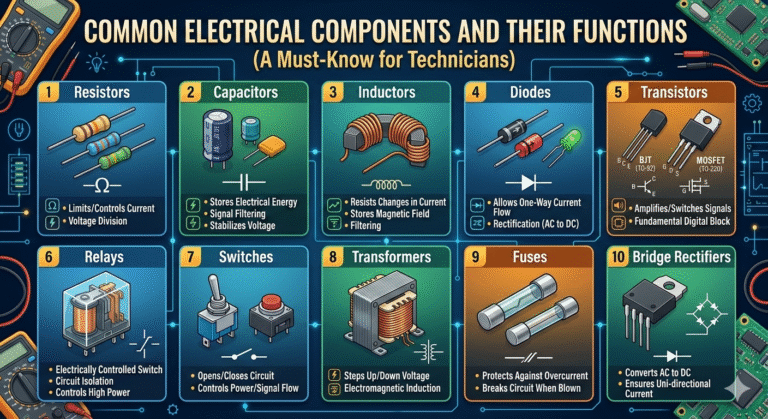
1. Resistors
A resistor is one of the most basic electrical components. It impedes the flow of electric current and is used to limit or control the amount of current passing through a circuit.
Function: Resistors primarily control voltage and current levels in a circuit. They dissipate energy in the form of heat and help protect sensitive components from damage due to excessive current.
Types:
Fixed Resistors: Have a fixed resistance that cannot be changed.
Variable Resistors (Potentiometer): Allow for the adjustment of resistance.
Thermistors: Resistance varies with temperature.
Applications: Voltage division, current limiting, and signal regulation.

2. Capacitors
A capacitor is a device that stores electrical energy in an electric field. It can temporarily store charge and release it when needed.
Function: Capacitors are used for energy storage, signal filtering, and stabilizing voltage and power flow. They smooth out fluctuations in electrical signals and provide filtering to eliminate unwanted noise from power supplies.
Types:
Ceramic Capacitors: Small, non-polarized, used in high-frequency circuits.
Electrolytic Capacitors: Larger, polarized, commonly used for power supply filtering.
Film Capacitors: Highly stable, used in precise applications.
Applications: Power supplies, audio systems, and signal coupling or decoupling in circuits.
3. Inductors
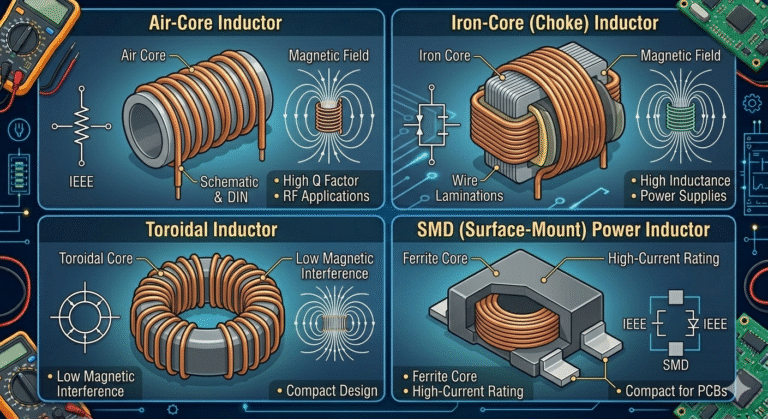
An inductor is a passive component that stores energy in the form of a magnetic field when current passes through it.
Function: Inductors resist changes in current, making them useful for filtering high-frequency signals or storing energy in devices like transformers and motors. They smooth out ripple in power supply circuits and often work alongside capacitors to form tuning circuits.
Types:
Air-core Inductors: Simple structure, low cost, used in RF circuits.
Iron-core Inductors: Provide higher inductance, used in power applications.
Applications: Power supplies, radios, and transformers.
4. Diodes
A diode is a semiconductor device that allows current to flow in one direction only, blocking reverse current.
Function: Diodes are primarily used for rectification, converting alternating current (AC) to direct current (DC). They also protect circuits by preventing reverse current from damaging sensitive components.
Types:
Standard Diodes: Allow current to flow in one direction.
Light Emitting Diodes (LEDs): Emit light when current passes through them.
Zener Diodes: Allow reverse current flow when a specific voltage is reached, used for voltage regulation.
Schottky Diodes: Fast switching speed with lower forward voltage drop.
Applications: Power rectification, signal detection, and LED displays.
5. Transistors
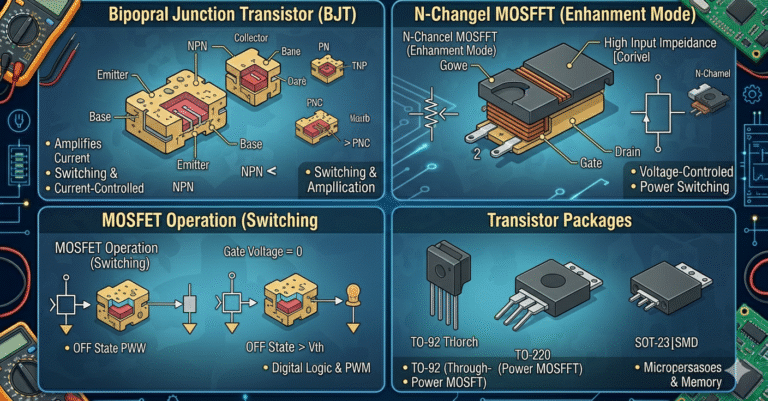
A transistor is a semiconductor device used to amplify or switch electronic signals.
Function: Transistors can act as electronic switches in digital circuits or as amplifiers to control current flow. They are the fundamental building blocks of all modern electronic devices, including computers, smartphones, and other digital systems.
Types:
Bipolar Junction Transistors (BJT): Consist of an emitter, base, and collector and are used for amplification and switching.
Field-Effect Transistors (FET): Use an electric field to control current flow and have high input impedance, suitable for sensitive circuits.
MOSFET (Metal-Oxide-Semiconductor FET): A high-efficiency FET widely used in power electronics.
Applications: Amplification, switching circuits, and signal processing.
6. Relays
A relay is an electrically controlled switch that uses a small current to control a larger current in another circuit, providing indirect control between two circuits.
Function: Relays are often used for electrical isolation between high- and low-voltage circuits. They can safely control high-power loads, which ordinary switches may not be able to handle.
Types:
Electromagnetic Relays: Operate using a mechanical action driven by an electromagnet.
Solid-State Relays: Use semiconductor components to switch without moving parts.
Applications: Automotive systems, household appliances, and industrial controls.
7. Switches
A switch is a simple device used to control the on/off status of a circuit.
Function: Switches allow or block current flow in a circuit. They can be manually or automatically operated and are found in nearly all electronic devices to control power or signal flow.
Types:
Toggle Switches: Manually operated by flipping a lever.
Pushbutton Switches: Activated by pressing a button.
Rotary Switches: Activated by rotating a knob to change connections.
Applications: Household appliances, industrial machinery, and consumer electronics.
8. Transformers
A transformer is a device that transfers electrical energy between two or more circuits through electromagnetic induction. It is mainly used to step-up or step-down voltage levels.
Function: Transformers play a crucial role in power transmission, ensuring that electrical energy is efficiently transmitted over long distances. They also provide electrical isolation between circuits to ensure safety.
Types:
Step-Up Transformers: Increase voltage from primary to secondary side.
Step-Down Transformers: Reduce voltage for use in low-voltage circuits.
Applications: Power distribution systems, electrical isolation, and audio systems.

9. Fuses
A fuse is a safety device that protects a circuit from overcurrent by melting and breaking the circuit when the current exceeds a safe level.
Function: Fuses are essential for preventing electrical components from damage and reducing the risk of fires due to overheating. When a fuse blows, it interrupts the circuit to prevent further damage until it is replaced.
Types:
Glass Fuses: Small and transparent, allowing easy inspection.
Ceramic Fuses: Better heat dissipation, used in high-power applications.
Applications: Household appliances, automotive systems, and industrial equipment overcurrent protection.
10. Bridge Rectifiers
A bridge rectifier is a circuit made of four diodes arranged in a bridge configuration to convert AC to DC.
Function: The bridge rectifier ensures that the current flows in one direction only, effectively converting AC to DC. It is a crucial component in many power supply circuits.
Applications: Power supplies, converting AC input into stable DC output.

Conclusion
Each of these electrical components plays a unique and vital role in the operation of electronic devices and systems. From using resistors to control current, to converting AC into DC through rectifiers, these components work together to form complex circuits, powering everything from smartphones to industrial machinery. Understanding these components’ functions and applications is essential for anyone working in electronics or electrical engineering.