
In the chemical industry, measuring the liquid level in sodium hydroxide (caustic soda) storage tanks has long been a challenging issue. Due to its strong corrosiveness, tendency to crystallize, and steam emissions, traditional instruments often “fail” in such conditions. In this article, we’ll explore how to address this challenge.
Key Physical Parameters for Monitoring Sodium Hydroxide Storage Tanks:
Level: Accurate level measurement controls inventory, prevents overflow or emptying, and is crucial for trade settlements and safety.
Temperature: Sodium hydroxide generates heat during dissolution or storage. Temperature affects concentration, crystallization points, corrosion, and tank safety (e.g., cooling system control).
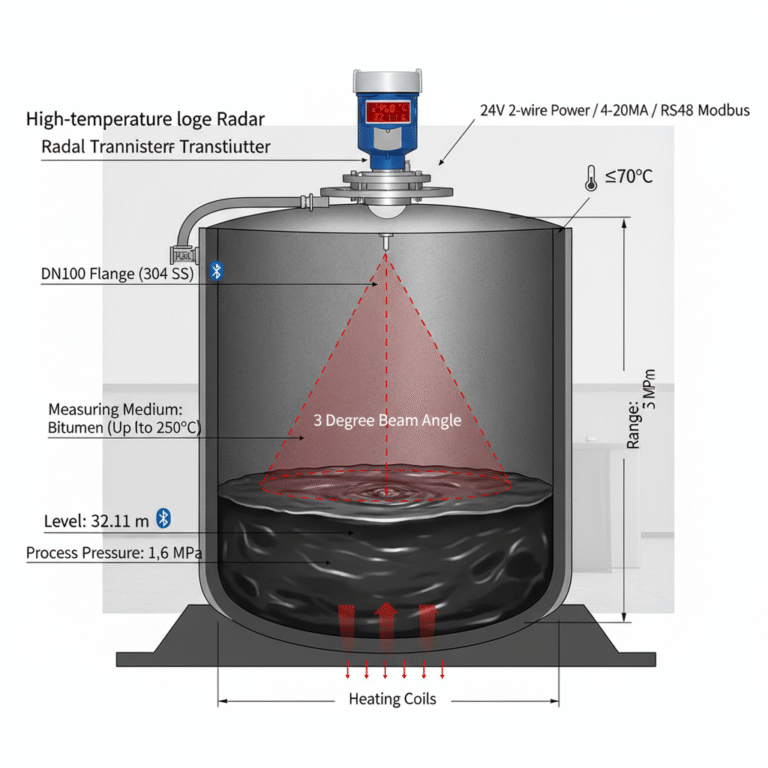
How to Achieve Accurate Level Measurement for Sodium Hydroxide Tanks?
Radar level meters act as the “eyes” of the tank, enabling non-contact, high-precision continuous level measurement.
Key Selection Criteria: Preferably choose 80 GHz frequency radar, equipped with PTFE/PEEK-sealed antenna covers (horn or planar antennas) to handle steam and crystallization.
Installation Considerations: The installation location should avoid feed ports, agitators, and internal components to ensure a clear beam path. For dome tanks, consider placing the radar at the center of the tank top.
Advantages: Completely non-contact, highly corrosion-resistant, nearly maintenance-free, unaffected by density or temperature variations, and highly accurate.
Output Signals: Typically 4-20 mA, HART, or other digital signals, easily integrated with DCS/PLC for display, alarms, and interlock control.
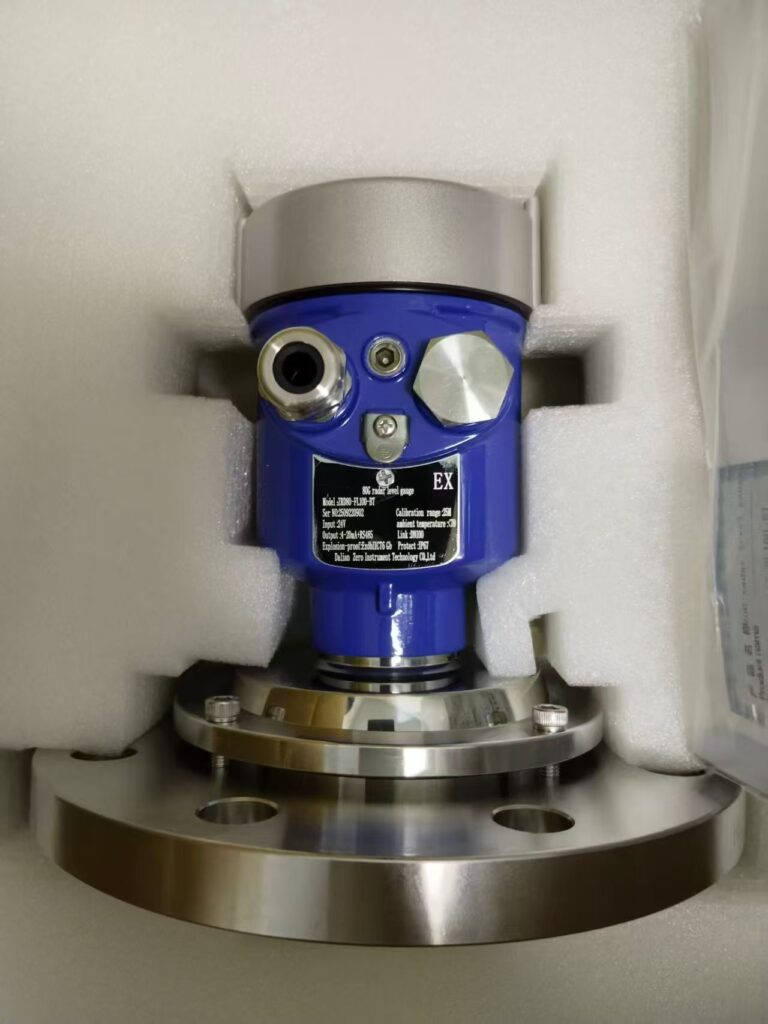
How to Achieve Accurate Temperature Measurement for Sodium Hydroxide Tanks?
Temperature transmitters serve as the “skin” of the tank, sensing the medium’s temperature to provide critical data for process control and safety.
Key Selection Criteria: Integrated temperature transmitters with corrosion-resistant sleeves. The transmitter head, sensor, and protective sleeve are integrated, offering compact installation and robust protection. Ideal for space-constrained environments or when installation simplicity is essential.
Temperature Measurement Points: Choose points that represent the average temperature, typically away from the feed ports or heating/cooling coils. For large or elevated tanks, multiple measurement points at different heights may be necessary to monitor temperature stratification.
Corrosion-Resistant Material Selection (Critical): The material must withstand sodium hydroxide corrosion. Preferred options include Hastelloy C-276, titanium (for specific concentrations/temperatures), and nickel alloys. 316L stainless steel is suitable only for low concentrations and ambient temperatures, with high risks. PTFE-coated stainless steel can significantly enhance corrosion resistance and prevent scaling. Gaskets at process connections should be made of PTFE or graphite.
Signal and Integration: Modern temperature transmitters are typically smart devices, outputting 4-20 mA + HART/Fieldbus signals. The temperature signal can be integrated with DCS for:
Display & Recording: Real-time temperature monitoring.
Alarming: High or low-temperature alarms to prevent safety hazards or crystallization.
Interlock Control: Automatically activating or deactivating the cooling water system for tank jackets/coils, or controlling the feed/discharge pumps to maintain the process temperature.
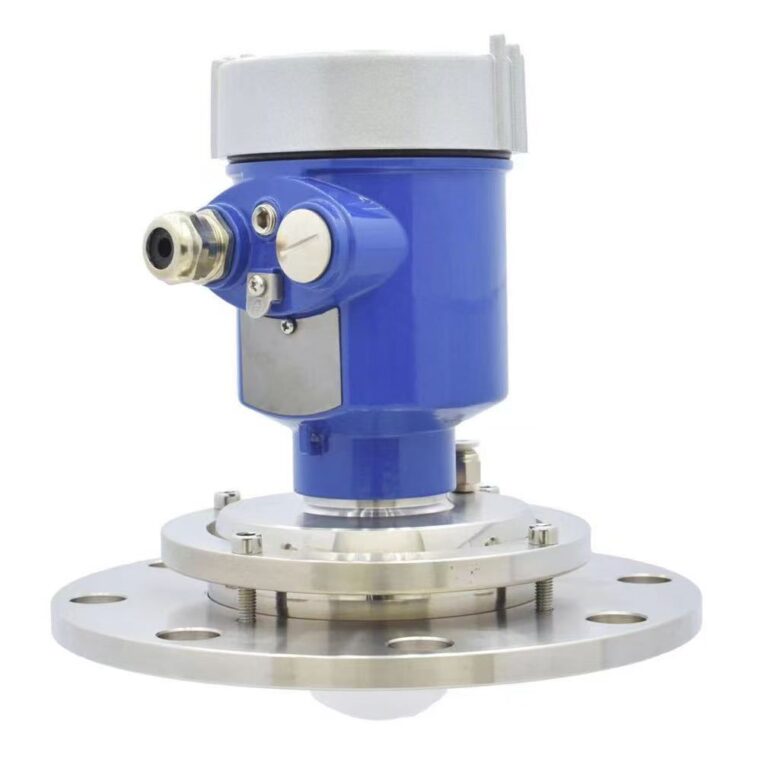
Collaborative Application of Radar Level Meters and Temperature Transmitters
Radar level meters and temperature transmitters do not work in isolation. Together, they collaborate in DCS/PLC systems for enhanced monitoring and optimization.
Safety Interlock: High-level alarms trigger the shutdown of pumps. When the radar level meter detects high liquid levels, an alarm activates, locking out the feed pump to prevent tank overflow. A compound high temperature/high level alarm could indicate escalating risk, triggering a higher-level alarm.
Crystallization Prevention: When the temperature transmitter detects the temperature approaching the crystallization point of sodium hydroxide, the system can proactively start heat tracing or increase the storage temperature to prevent crystallization and blockages in pipes and tanks.
Data Diagnostics: By comparing the radar level meter readings with inferred values derived from differential pressure, temperature, and other parameters, data cross-verification can be conducted. This helps identify instrument malfunctions or process abnormalities early on.

Real-World Application: Zero Instrument’s Solution for Sodium Hydroxide Tanks
A chemical plant chose Zero Instrument’s solutions, where technical staff designed a comprehensive measurement system for sodium hydroxide storage tanks. The configuration included:
Radar Level Meter: 80 GHz radar with sealed antenna covers for non-contact, precise measurement, handling steam and crystallization.
Integrated Temperature Transmitter: Corrosion-resistant, compact, and reliable for continuous temperature monitoring.
Both instruments were integrated into the control system, with alarms and interlock mechanisms set for early detection and prevention of potential issues. By integrating data for concentration analysis and predictive maintenance, the factory achieved intelligent management of sodium hydroxide tanks, ensuring safety, operational continuity, and process optimization.