
The key to effective interference suppression for radar level transmitters is a systematic approach: first, physical obstruction removal; then, precise echo masking; and finally, coordinated parameter optimization. Follow these actionable steps to adapt to typical chemical plant conditions.
Preparation (Essential Steps)
Empty Tank / Low Liquid Level Verification: Interference learning must be performed when the tank is empty or the liquid level is below all internal components (e.g., ladders, coils, mixers) to prevent masking the actual liquid level.
Echo Curve Diagnosis: Open the echo curve through the transmitter’s display, HART communicator, or host system. Record near-field spikes (flanges, hanging materials), fixed interference peaks (internal components), and random noise distribution. This data will serve as the basis for your settings.
Core Setting Steps (Prioritize as Listed)
Near-Field Suppression (Address Near-Field Interference)
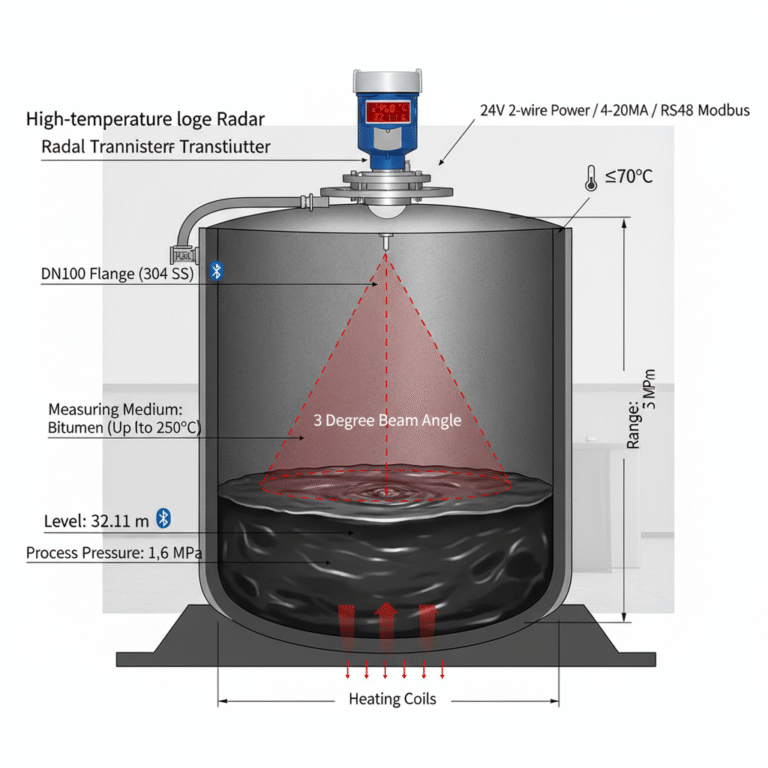
Range Setting: From the flange edge, set to 0.5–1.0 m (use the upper limit if material build-up is severe).
Action: Go to “Near-Field Suppression / Blind Zone Extension” and input the endpoint distance to ensure coverage for material build-up near the antenna and flange reflections.
False Echo Suppression (Address Fixed Interference – Most Critical)
Automatic Learning (Recommended)
Navigate to “False Echo Learning / Teach-in” and create a new learning zone.
Set the learning range: 0 to (empty tank distance – 0.5 m), with a safety margin.
Start learning and wait a few seconds until completed (interface shows OK/ON).
Manual Masking (For Complex Conditions)
Based on the echo curve, record the interference peak distance (e.g., 1.35 m).
Create a suppression zone: start point = 0.1 m before the interference peak, end point = 0.3–0.5 m after the peak (0.5 m for fluctuating peaks).
For multiple interference points, set up separate suppression zones to avoid over-masking.
Signal Threshold & Gain (Address Random Noise)
Echo Threshold: Set to −40 dBm (or relative threshold of 70%-80%) to filter weak noise. Avoid setting it too high, as it may lose real low-dielectric liquid level echoes.
Receiving Gain: Start at 70%-80%. For weak echoes (e.g., light oil, foam), gradually increase until the real echoes stand out clearly from the noise.
Filtering & Damping (Address Fluctuations)
Filter Mode: Enable median filtering + moving average (to suppress pulse interference and random noise); dynamic level filtering with Kalman filter.
Damping Time: For static tanks, set to 0.3–0.8 s; for tanks with agitation or feeding, set to 1–3 s to balance stability and response speed.
Frequency Hopping (Address Electromagnetic Interference)
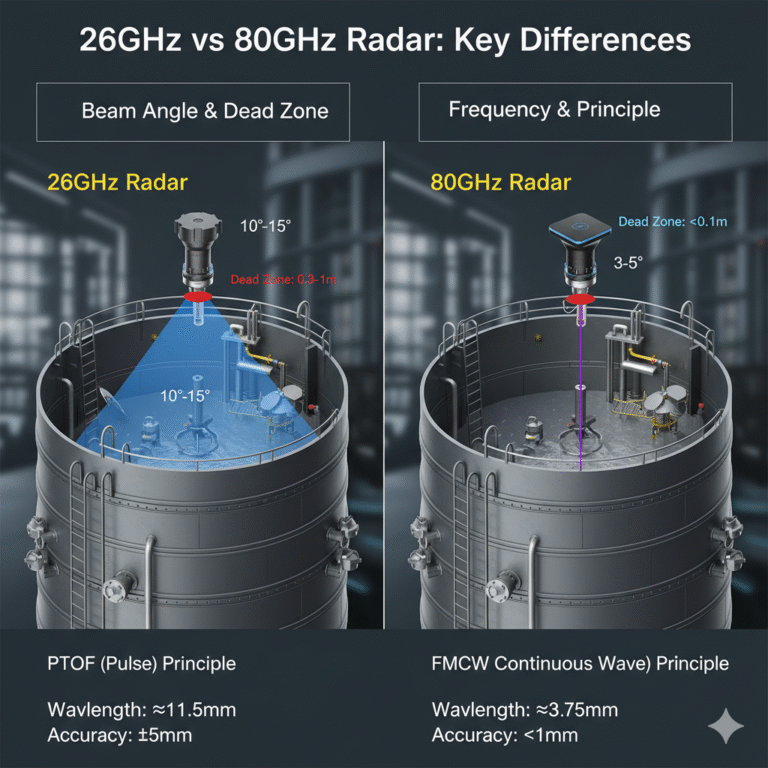
For 26 GHz / 80 GHz FMCW radar, if there’s interference from frequency converters or RF co-frequency interference, enable frequency hopping or manually switch frequencies to avoid interference bands.
Recommended Parameter Table (For General Chemical Applications)
| Parameter | Recommended Value | Application Scenario |
|---|---|---|
| Near-Field Suppression | 0.5–1.0 m | Material build-up, flange reflection |
| False Echo Range | 0 to (empty tank distance – 0.5 m) | Empty tank automatic learning |
| Manual Suppression Margin | 0.3–0.5 m after interference peak | Multiple internal components in complex tanks |
| Echo Threshold | −40 dBm (70%–80%) | General noise filtering |
| Receiving Gain | 70%–80% | Weak echo amplification |
| Damping Time | 0.3–0.8 s (static), 1–3 s (dynamic) | Liquid level fluctuation control |
Optimizing for Special Chemical Conditions
Agitated Tanks: Avoid the beam from the mixer shaft/impeller, enable frequency hopping, set damping to 2–3 s, and add radar anti-vortex baffles if necessary.
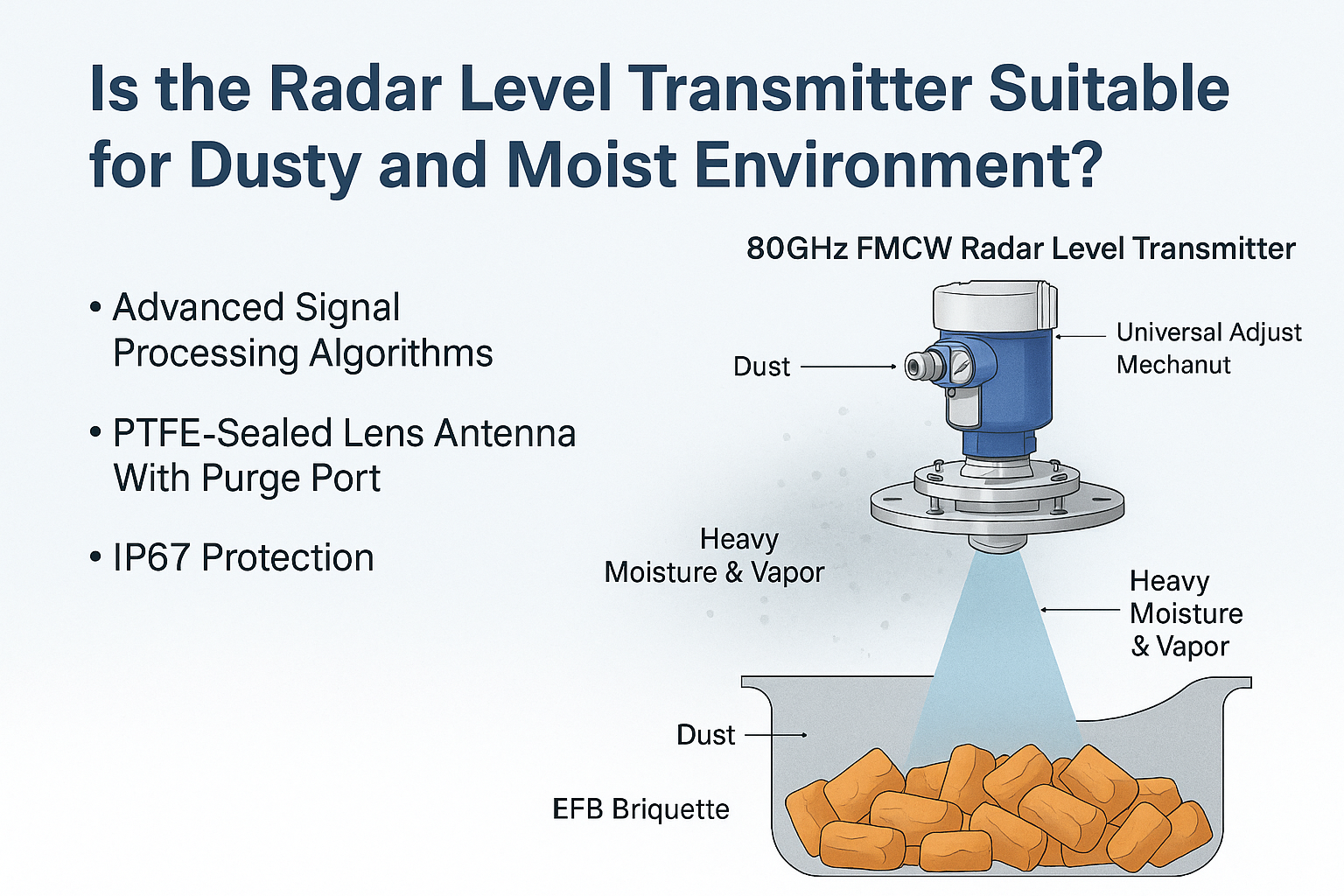
High-Temperature & High-Pressure / Steam: Select antennas with purge ports, enable steam mode, and increase gain to 80%-90%. Slightly lower threshold to −45 dBm.
Foam / Low Dielectric Materials: Use 80 GHz high-frequency radar (narrow beam, good focusing), enable foam mode, and disable strong filtering to capture weak echoes.
Electromagnetic Interference (Nearby Frequency Converters): Use isolation transformers for the radar power supply, shielded twisted pair signal cables with single-ended grounding, and maintain ≥2 m distance from power cables.
Acceptance & Maintenance
Acceptance Criteria:
The true liquid level peak in the echo curve should be stable, with no interference peaks masked.
Liquid level display fluctuation ≤ ±0.5% FS.
No jumps in level when mixing or feeding starts and stops.
Regular Maintenance:
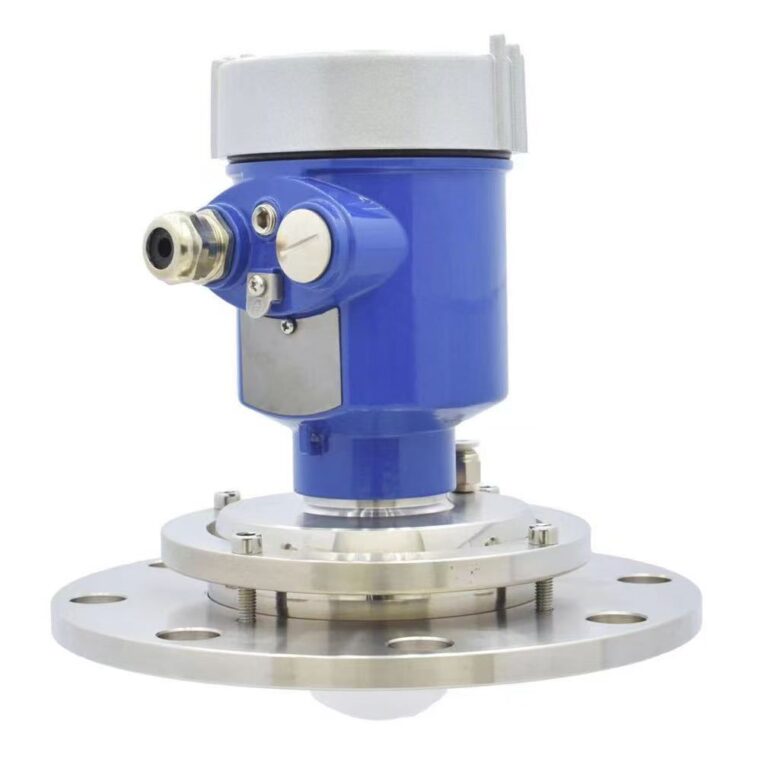
Clean the antenna with ethanol (no water) and wipe the PTFE cover monthly.
Check the echo curve quarterly and update suppression zones if internal components change.
Calibrate threshold and gain every six months.
Pitfall Guide
❌ Do not perform false echo learning with liquid in the tank (this may mask the real liquid level).
❌ Do not set suppression zones too wide (this may prevent detecting low liquid levels).
❌ Do not set damping time too long (this affects control loop response).
❌ Ignore physical installation optimization (e.g., antenna alignment with the mixer shaft cannot be fully compensated by software).