
Introduction
When selecting a control valve, engineers often need to consider its failure position, such as Fail Open (FO) or Fail Close (FC).
For conventional pneumatic control valves, the failure position can usually be selected by changing the actuator action, spring arrangement, or valve configuration.
However, the situation is different for self-operated pressure control valves (self-regulating valves).
The failure position of a self-operated pressure control valve is normally determined by its working principle, valve structure, and application type. It is not freely selectable like a pneumatic control valve.
In general:
- Pressure reducing self-operated valves → Fail Open (FO)
- Back pressure self-operated valves → Fail Close (FC)
The failure mode is an inherent characteristic of the valve design.
1. Failure Position Cannot Be Freely Selected
Unlike pneumatic control valves, self-operated pressure control valves do not use an external energy source such as compressed air.
The driving force comes directly from the process medium pressure, while the spring provides the restoring force.
When the sensing pressure or driving force is lost due to conditions such as:
- diaphragm failure
- impulse line damage
- loss of process pressure
the spring force moves the valve plug to its natural safe position.
Therefore, the final failure position is determined by the valve design.
| Item | Pneumatic Control Valve | Self-Operated Pressure Control Valve |
|---|---|---|
| Energy source | External air supply | Process medium pressure |
| FO / FC selection | Usually selectable | Determined by valve type |
| Adjustment method | Actuator action and valve configuration | Valve structure |
| Failure position | Designed according to process safety requirements | Natural characteristic of the valve |
2. Self-Operated Valve vs Pneumatic Control Valve
A pneumatic control valve normally requires:
- actuator
- positioner
- instrument air supply
- control signal
The failure mode can be configured as:
- Air-to-open → Fail Close
- Air-to-close → Fail Open
For a self-operated pressure control valve, no external control signal or air supply is required.
The valve automatically responds to pressure changes through:
- sensing diaphragm
- spring force
- internal valve plug movement
Therefore, its failure position cannot simply be changed by selecting actuator action.
3. Failure Position of Different Types of Self-Operated Pressure Control Valves
3.1 Pressure Reducing Self-Operated Valve (Downstream Pressure Control)
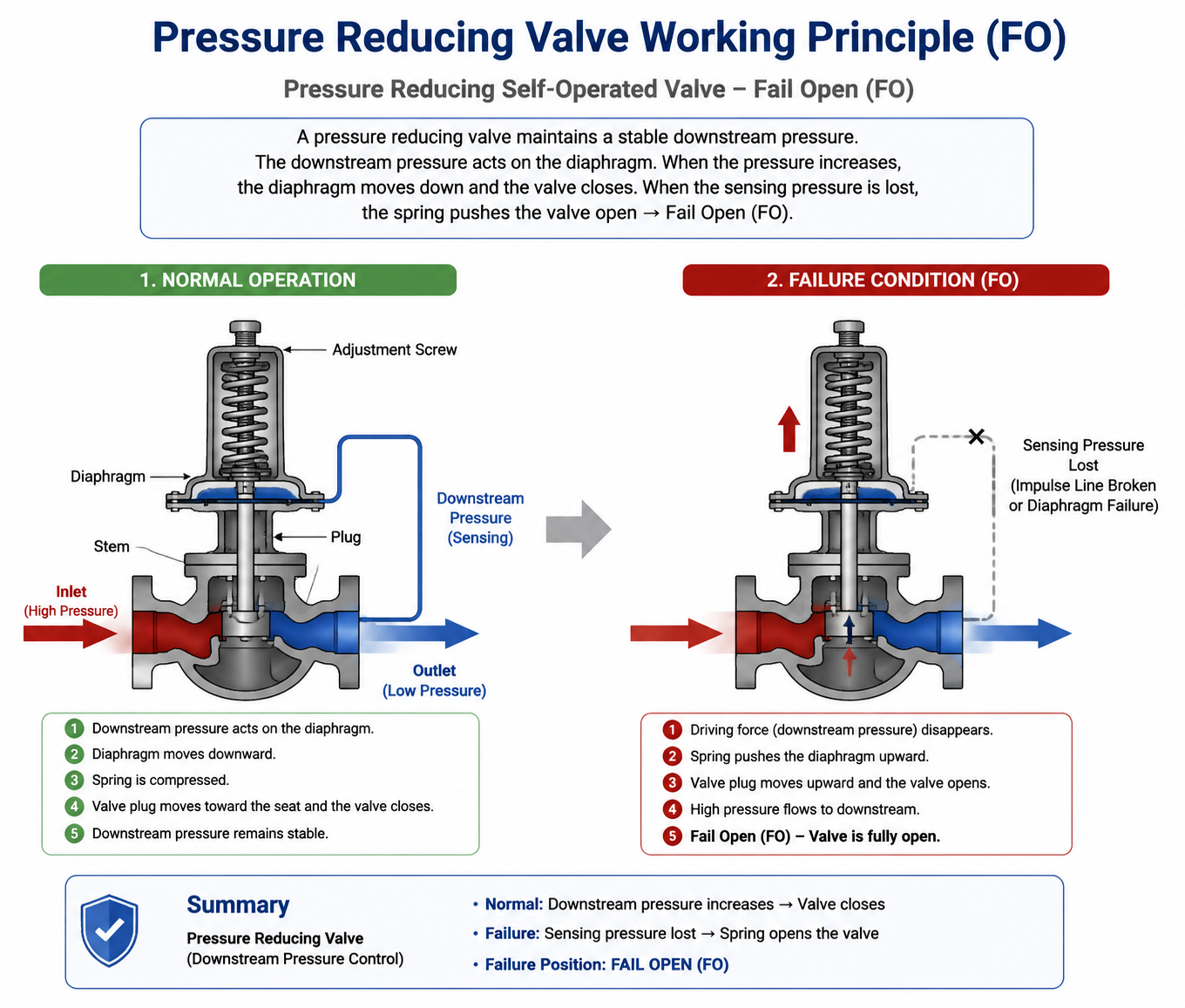
A pressure reducing valve is used to maintain a stable downstream pressure.
Typical applications:
- steam pressure reduction
- nitrogen supply systems
- utility gas pressure control
- cooling water pressure control
Working Principle
During normal operation:
Downstream pressure increases
          ↓
Diaphragm sensing force increases
          ↓
Spring is compressed
          ↓
Valve closes slightly
          ↓
Downstream pressure remains stable
When the sensing pressure is lost:
Driving force disappears
          ↓
Spring returns to original position
          ↓
Valve opens
          ↓
Fail Open (FO)
Therefore:
Pressure reducing self-operated valve = Fail Open (FO)
3.2 Back Pressure Self-Operated Valve (Upstream Pressure Control)
A back pressure valve is used to maintain a stable upstream pressure.
Typical applications:
- tank pressure control
- pressure relief applications
- upstream pressure stabilization
Working Principle
During normal operation:
Upstream pressure increases
          ↓
Diaphragm force increases
          ↓
Valve opens
          ↓
Upstream pressure is released
When the sensing pressure is lost:
Driving force disappears
          ↓
Spring returns
          ↓
Valve closes
          ↓
Fail Close (FC)
Therefore:
Back pressure self-operated valve = Fail Close (FC)

4. Explanation from Engineering Standards
According to SH/T 3180-2016, the failure modes of control valves and self-operated control valves should follow:
- Back pressure control → Fail Close
- Pressure reducing control → Fail Open
API Standard 614 also states:
Unless otherwise specified on the schematics, failure mode for control valves are:
- Backpressure: Fail Closed
- Pressure reducing: Fail Open
These requirements are consistent with the natural characteristics of self-operated pressure control valves.
5. Classification of Self-Operated Pressure Control Valves
| Item | Pressure Reducing Valve | Back Pressure Valve |
|---|---|---|
| Control target | Downstream pressure | Upstream pressure |
| English name | Pressure Reducing Regulator | Back Pressure Regulator |
| Function | Reduce and stabilize downstream pressure | Maintain upstream pressure |
| Valve action | Normally pressure-close type | Normally pressure-open type |
| Failure position | Fail Open (FO) | Fail Close (FC) |
| Pressure sensing point | Downstream side | Upstream side |
| Typical application | Gas supply, nitrogen blanketing | Tank pressure control, pressure release |
6. Important Considerations in Engineering Applications
Because the failure position of a self-operated pressure control valve cannot be freely selected, engineers must select the correct valve type according to process safety requirements.
The selection principle is:
| Safety Requirement | Recommended Valve Type | Failure Position |
|---|---|---|
| Continuous flow required during failure | Pressure reducing valve | FO |
| Media isolation required during failure | Back pressure valve | FC |
| Neither FO nor FC meets the requirement | Use pneumatic control valve | Adjustable |
If the required safety action conflicts with the natural failure position of a self-operated valve, a self-operated valve should not be selected.
7. Application Example: Nitrogen Blanketing System
In nitrogen blanketing systems, both pressure reducing valves and back pressure valves are commonly used.
The pressure reducing valve supplies nitrogen into the tank, while the back pressure valve controls tank pressure and releases excess gas.
A common design consideration:
If the set points of the pressure reducing valve and back pressure valve are too close, nitrogen supply and exhaust functions may counteract each other.
Therefore, the back pressure valve set point should normally be higher than the pressure reducing valve set point to avoid unstable operation.

Conclusion
Self-operated pressure control valves do not have a freely selectable FO or FC failure mode like pneumatic control valves.
Their failure position is determined by:
- valve function
- sensing pressure location
- internal mechanical design
In general:
- Pressure reducing self-operated valve → Fail Open (FO)
- Back pressure self-operated valve → Fail Close (FC)
During engineering design, the correct valve type should be selected according to process safety requirements. If the required failure action does not match the natural characteristic of a self-operated valve, a pneumatic control valve with a configurable failure position should be considered.