
1. Is Faster Industrial Networking Always Better?
In modern industrial automation, communication speed alone is not the most important factor.
What truly matters is whether data can be delivered:
- At the right time
- In the correct sequence
- With stable and deterministic performance
This is where PROFINET demonstrates its real value.
A simple way to understand it:
PROFINET acts like the “nervous system” of an industrial plant.
PLCs are the brain, sensors are the senses, actuators are the muscles, and PROFINET is the network that ensures everything works in coordination.
If this communication system becomes unstable, the entire automation system may suffer:
- Delayed responses
- Incorrect operations
- Unclear system status
- Reduced production efficiency
2. What Problem Does PROFINET Solve?
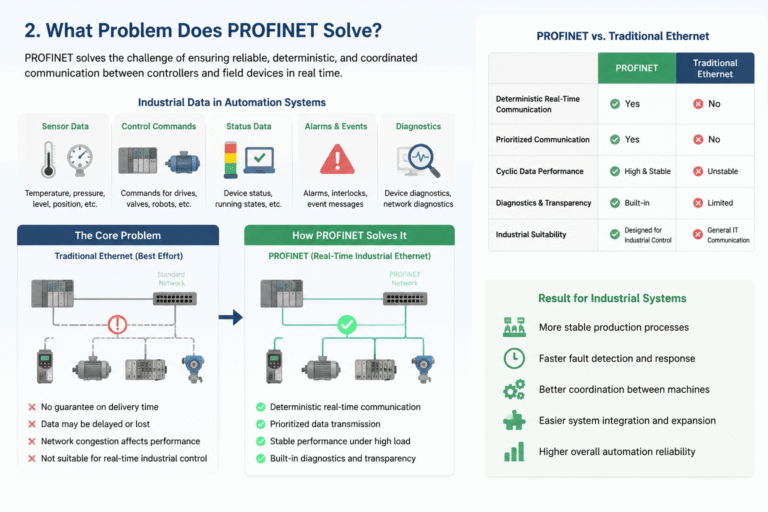
PROFINET is an industrial Ethernet communication standard designed for data exchange between controllers and field devices in automation systems.
In a typical factory environment:
- Sensors transmit temperature, pressure, level, and position data
- Drives, valves, and robots receive control commands
- Control systems collect status, alarms, and diagnostic information
However, not all data has the same priority.
Some data can tolerate delay:
- Historical records
- Maintenance information
- General status data
Some data must be real-time:
- Control commands
- Interlocking signals
- Alarm messages
PROFINET ensures that:
All types of data are transmitted in a structured, prioritized, and deterministic way according to industrial automation requirements.
It is not just about increasing speed—it is about enabling coordinated communication across all devices in one unified system.
3. Key Features of PROFINET
1) Real-Time Communication
Industrial automation systems require predictable communication cycles.
PROFINET supports real-time data exchange, ensuring reliable communication between PLCs and field devices in cyclic control applications.
2) Strong Device Integration
PROFINET supports a wide range of devices within a single network, including:
- PLC controllers
- Remote I/O modules
- Frequency converters
- Servo drives
- Robots
- Sensors and instruments
- HMI systems
It is a multi-vendor, open industrial Ethernet standard designed for system-wide integration.
3) Powerful Diagnostics
One of PROFINET’s strongest advantages is its built-in diagnostic capability.
The system can immediately detect:
- Device status
- Network status
- Communication faults
This allows engineers to quickly identify and troubleshoot issues, significantly reducing downtime.
4) Unified Engineering and Configuration
PROFINET enables centralized configuration through engineering tools.
Users can perform:
- Device configuration
- Network setup
- Parameter management
- System commissioning
This reduces complexity when integrating devices from different manufacturers.
4. Where PROFINET Fits in Automation Architecture
PROFINET mainly connects the control layer and the field layer.
Control Layer:
- PLCs
- Controllers
- Engineering stations
- Supervisory systems
Field Layer:
- I/O modules
- Sensors
- Actuators
- Drives
- Robots
- Instrumentation devices
Through PROFINET, PLCs:
- Read real-time field data
- Send control commands to devices
- Receive status, alarms, and diagnostic feedback
5. Three Types of Industrial Data
PROFINET can be understood as a unified channel for three types of information:
1) Control Data
Used for machine operation and process control.
2) Status Data
Used for monitoring device operating conditions.
3) Diagnostic Data
Used for maintenance, troubleshooting, and system optimization.
In modern smart factories, PROFINET not only connects devices but also enables transparent access to field data.

6. Application Areas of PROFINET
PROFINET is widely used across industrial sectors:
Discrete Manufacturing
- Automotive production
- Electronics manufacturing
- Packaging systems
- Logistics automation
- Robotics systems
Process Industries
- Chemical plants
- Water treatment systems
- Process instrumentation networks
- Control and monitoring systems
Warehousing & Logistics
- Conveyor systems
- Sorting machines
- Barcode scanning systems
- Warehouse control platforms
Energy & Infrastructure
- Power distribution systems
- Monitoring stations
- Utility automation networks
7. Common Mistakes in PROFINET Projects
Even when PROFINET is used, system performance may not always be optimal.
1) Treating PROFINET as a simple Ethernet connection
PROFINET is not just plugging devices into a switch. Proper network design is required.
2) Ignoring communication quality
Connectivity does not guarantee stable real-time performance. Factors like jitter, latency, and network load must be considered.
3) Poor network planning
Late-stage design changes often lead to:
- Improper topology
- Wrong switch selection
- Poor device addressing
- Insufficient diagnostics
4) Separation between automation and networking design
PROFINET requires integrated design of:
- PLC programming
- Network architecture
- Device configuration
- Maintenance strategy
8. Wireless PROFINET Applications
With the rise of flexible manufacturing and mobile equipment, traditional wired networks face limitations.
Typical use cases include:
- AGVs and AMRs
- Mobile control panels
- Temporary measurement points
- Warehouse mobile systems
- Retrofit industrial sites
Wireless PROFINET is not a replacement for wired systems, but a complement.
Recommended architecture:
- Wired PROFINET → Core control and backbone communication
- Wireless extension → Mobile and flexible devices
This approach improves flexibility while maintaining system stability.
9. Future Trends
PROFINET will continue evolving alongside:
- Industrial Ethernet technologies
- Edge computing
- Digital diagnostics
- Industrial 5G
- Smart factory platforms
Wired networks will remain the backbone of industrial automation, while wireless and edge technologies will expand system flexibility and intelligence.

10. Conclusion
The core value of PROFINET is not just device connectivity, but system coordination.
It ensures that:
- PLCs
- Field devices
- Drives
- Robots
- Control systems
all operate under a unified, reliable communication framework.
PROFINET is not only about “connecting devices,” but about:
- Ensuring deterministic data delivery
- Enabling system coordination
- Improving diagnostics and maintenance efficiency
For modern automation projects, proper PROFINET design is essential for system reliability and long-term performance.