In many industrial incidents, the real danger is not the alarm itself — but what happens after the alarm.
Pipelines rupture, yet media continues to leak. Fires break out, but fuel supply is not isolated. Gas detectors trigger alarms, yet gas flow is not stopped.
In these situations, risk escalates rapidly.
Fire, explosion, toxic exposure, equipment damage, and environmental pollution — many of these consequences can be traced back to one root cause:
👉 The hazardous source was not isolated in time.
This is where the Emergency Shutdown Valve (ESV) becomes critical.
What Is an Emergency Shutdown Valve (ESV)?
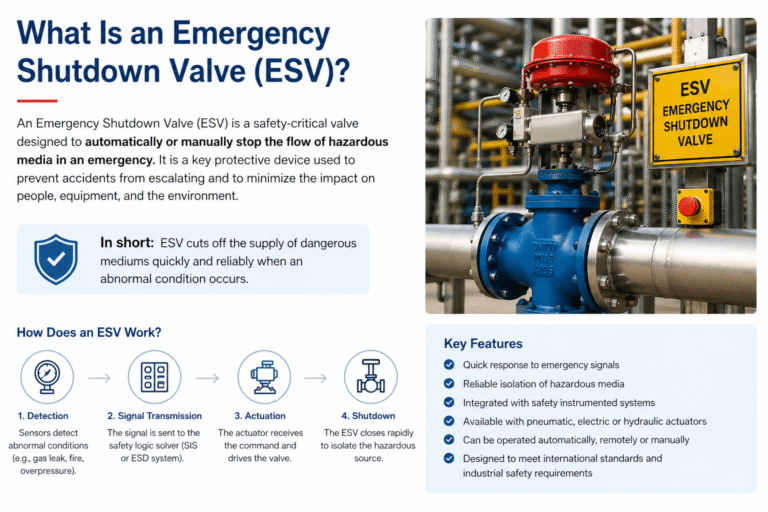
An Emergency Shutdown Valve (ESV) is a safety-critical valve designed to rapidly stop the flow of hazardous media under emergency conditions.
It is typically integrated with:
Fire & gas detection systems
Pressure and temperature monitoring
Emergency shutdown systems (ESD)
Control systems (DCS/PLC)
It can be triggered by:
Automatic signals (gas detection, overpressure, fire alarms)
Remote control from control room
Local emergency push buttons
👉 Its purpose is simple but vital: stop the danger before it spreads.
New Regulation You Must Know (TSG 92—2026)
Starting from July 1, 2026, China’s new regulation TSG 92—2026 “Safety Technical Regulation for Safety Accessories of Pressure Equipment” officially includes ESVs as regulated safety accessories, alongside:
Safety valves
Rupture discs
This means:
Companies must now ensure:
Proper selection and sizing
Correct installation location
Reliable operation and interlock logic
Regular testing and maintenance
Complete documentation and traceability
👉 Having an ESV installed is no longer enough — it must be fully compliant and functional.
Where Should ESV Be Installed?
Correct installation location determines whether the valve can actually stop the hazard in time.
1. Storage Tank Inlet & Outlet
Large inventory = high risk. If pipelines fail and no isolation exists, continuous leakage from tanks can lead to catastrophic incidents.
2. Hazardous Media Pipelines
For flammable, explosive, toxic, or corrosive media:
ESVs should be installed at:
Unit boundaries
Pipe racks
Long-distance pipeline sections
👉 This allows isolation of risk within a controlled zone.
3. Gas & Natural Gas Systems
Gas leakage without isolation = extreme danger.
Critical locations include:
Pressure regulating stations
Distribution stations
Compressor outlets
End-user inlet points
4. Upstream & Downstream of Critical Equipment
Such as:
Reactors
Furnaces
Compressors
Pumps
Heat exchangers
👉 These valves should work together with ESD systems, not as standalone devices.
5 Critical Mistakes That Can Make ESV Fail
❌ 1. Installing Valve Without Interlock Logic
An ESV without proper interlock = useless.
It must be connected to:
Fire detection
Gas detection
Process alarms
👉 And must NOT be bypassed in operation.
❌ 2. Ignoring Manual Shutdown Options
Automatic shutdown is not enough.
You must have:
Control room shutdown
Local emergency push button
On-site manual override
👉 In emergencies, operators cannot enter dangerous zones.
❌ 3. Blindly Pursuing Fast Closing Speed
Faster is not always better.
Too fast closing can cause: 👉 Water hammer effect, leading to:
Pipe damage
Flange failure
Equipment stress
Typical closing time: 👉 3–5 seconds (depending on process conditions)
❌ 4. Mismatched Explosion-Proof Ratings
Even if valve body is correct, accessories may fail:
Solenoid valves
Limit switches
Junction boxes
Actuators
👉 All components must match the hazardous area classification.
❌ 5. No Regular Testing
ESVs may sit idle for years — but must work instantly when needed.
Common hidden failures:
Stuck valve stem
Low air pressure
Solenoid failure
Signal feedback errors
👉 Regular testing is NOT optional.
How to Select the Right ESV
1. Medium First (Most Important)
Media determines:
Material compatibility
Sealing structure
Corrosion resistance
Examples:
Corrosive fluids → special materials
Flammable gas → leakage & explosion-proof
High temperature → sealing durability
2. Pressure & Temperature Conditions
Do not rely only on normal operation data.
You must consider:
Maximum operating pressure
Maximum temperature
Abnormal conditions
👉 High-pressure systems may require ANSI Class 600 or above
3. Actuator Selection Matters
The actuator is the power source of the ESV.
Pneumatic → fast, reliable (preferred in most plants)
Electric → easy control, but check explosion-proof
Hydraulic → high force, suitable for large valves
👉 Must verify:
Can it close under maximum differential pressure?
4. Fail Position Must Be Defined
Common option: 👉 Fail Close (FC)
But not always correct.
Options include:
Fail Close
Fail Open
Fail Last Position
👉 Must be based on process safety analysis
5. Standards & Certifications
Must consider:
API
ISO
CE
Fire-safe certification
Explosion-proof certification
👉 And now also: TSG 92—2026 compliance
Final Thought
An Emergency Shutdown Valve is not just a valve.
👉 It is the last barrier between a controllable incident and a major accident.
Incorrect selection, poor installation, or lack of testing can turn a safety device into a false sense of security.