
Industrial automation is evolving at a rapid pace, sometimes faster than the updates on your smartphone. So, what exactly is APL? How does it differ from traditional instrumentation? And why are more and more factories adopting this new technology?
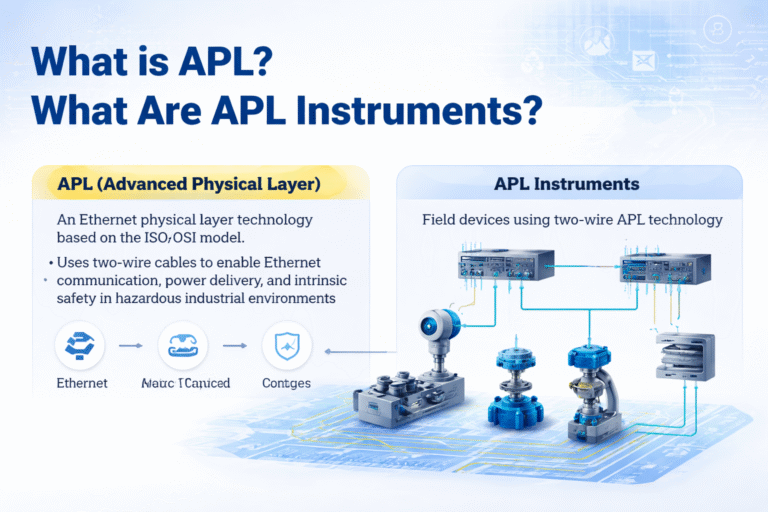
What is APL? What Are APL Instruments?
APL (Advanced Physical Layer) is an Ethernet physical layer communication technology defined by the ISO/OSI model. It enables Ethernet communication over two wires, integrating data transmission, power supply, and intrinsic safety, making it particularly suitable for hazardous industrial environments.
APL instruments are field devices that use this two-wire Ethernet technology, typically working with APL field switches and APL power switches. A typical control system supporting APL can manage:
- 31 APL power switches
- 256 APL field switches
- Up to 3072 APL field instruments
These devices transmit both data and power over two wires, utilizing technologies like Manchester encoding to enhance noise immunity and simplify signal decoding.
Key Advantages of APL Technology
- Simplified System Architecture
- Eliminate traditional control system interface cards.
- No need for complex cable trays.
- Achieve:
- 100% reduction in system I/O cards.
- 90% reduction in control cabinet space.
- 80% reduction in wiring costs.
- 50% faster project completion.
- Intrinsic Safety
- APL meets intrinsic safety requirements for explosive environments by limiting current, voltage, and power, ensuring safety even in the event of equipment failure.
- Long-Distance Transmission
- Supports communication distances exceeding 1000 meters, ideal for large or distributed industrial installations.
- High Bandwidth and Real-Time Performance
- Provides high data throughput and low latency, suitable for real-time data collection and control in Safety Instrumented Systems (SIS).
- Strong Electromagnetic Interference Immunity
- APL’s advanced encoding and signal processing techniques provide excellent resistance to electromagnetic interference from common industrial sources like motors and variable frequency drives.
APL in Safety Instrumented Systems (SIS)
- Integration of Sensors and Actuators
- Data Collection: APL directly connects field sensors such as temperature, pressure, and level sensors to control systems. For example, a temperature sensor in a reactor can transmit real-time data to an SIS controller, triggering alarms when thresholds are exceeded.
- Actuator Control: APL can transmit control commands quickly and accurately to emergency shutoff valves or pressure relief devices, enabling immediate pipeline shutdown and hazardous material control during abnormal conditions.
- System Architecture and Network Design
- Distributed Architecture: APL supports distributed deployments across different devices or areas, allowing equipment in various workshops to connect to a central control room for unified monitoring and management.
- Redundancy and Fault Tolerance: APL networks can be designed with redundancy, automatically switching paths in case of communication failure to ensure uninterrupted operation, which is critical for high-reliability SIS systems.
- Enhanced Safety and Reliability
- Fault Detection and Diagnostics: APL supports real-time diagnostics such as line breakage, short circuits, and signal quality monitoring. Combined with SIS self-diagnostics, potential risks can be detected early, accelerating maintenance response times.
- Data Integrity and Security: APL uses data verification and security mechanisms to ensure that data is not tampered with and only authorized devices can access it, enhancing network security and system stability.

Value Brought by APL Instruments
- End-to-End Digital Communication: APL enables end-to-end digital communication from the enterprise IT layer to field devices.
- Open Architecture: It supports parallel access to control, diagnostics, asset management, configuration, and analytics.
- Comprehensive System Diagnostics: APL provides full-system diagnostics, reducing wiring costs, speeding up commissioning, and shortening project timelines.
- Smart Device Configuration and Diagnostics: APL has the potential to integrate with edge AI for advanced analytics and predictive maintenance.
Challenges to Consider
| Issue | Description |
|---|---|
| Compatibility | Integration with existing sensors and control systems may require additional interfaces or modifications. |
| Cost | Initial investment (equipment, power modules, wiring) is higher, placing pressure on small and medium-sized enterprises. |
| Standard Evolution | Continuous adaptation to new safety, electromagnetic compatibility, and communication standards is necessary. |

Future Trends
APL has significant potential when combined with IoT (Internet of Things) and AI (Artificial Intelligence):
- IoT enables intelligent device monitoring and remote maintenance.
- AI allows for predictive maintenance and risk analysis based on real-time data.
As the technology matures and costs decrease, APL is expected to expand beyond traditional industries like petrochemical to sectors such as pharmaceuticals and food processing, where safety requirements are also stringent.