
RS485 is often mistaken for a communication protocol, but in reality, it’s a physical layer standard. This article aims to clarify common misunderstandings, explain the basics of RS485, and highlight its differences from protocols like Modbus RTU. Practical tips on wiring, installation, and troubleshooting will also be provided.
What is RS485?
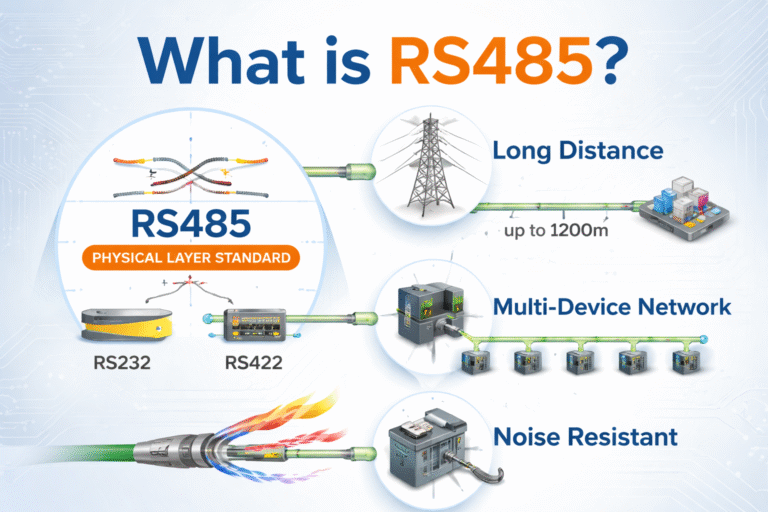
RS485 is not a communication protocol; it is a recommended standard (RS) that defines the electrical characteristics for differential signal transmission. Other related standards include RS232 (single-ended communication) and RS422 (differential point-to-point communication).
Unlike RS232, which is designed for short-distance communication, RS485 offers long-distance transmission (up to 1200 meters under ideal conditions) and supports multi-point communication (one master can connect to multiple slaves). These advantages make it one of the most widely used standards in industrial automation.
Wiring Considerations
The recommended topology for RS485 is a bus (daisy-chain) configuration. In this setup, all devices are connected sequentially along a main cable.
Engineering Tips:
- Recommended Cable: Shielded twisted pair (e.g., RVSP 2×0.5), with a characteristic impedance of approximately 120 Ω.
- Termination Resistors: For cable lengths greater than 100 meters, 120 Ω termination resistors should be installed at both ends of the bus.
- Avoid Star Topology: Using a star topology (branch connections) leads to signal reflection, communication instability, and more complicated troubleshooting.
Device Capacity on a Single Bus
The number of devices that can be connected to a single RS485 bus depends on the capabilities of the transceiver chips used (common limits are 32, 128, or 256 nodes). However, for reliable system operation, the following practical guidelines should be followed:
- For 32 nodes (1 unit load UL): Early RS485 transceivers – Limit to ≤30 devices per bus.
- For 128 nodes (1/4 UL): Modern low-load transceivers – Limit to ≤60–80 devices per bus. For over 50 devices, segmentation is recommended.
- For 256 nodes (1/8 UL): Advanced low-load transceivers – Limit to ≤120–150 devices per bus. Use repeaters for larger systems.
- For more than 256 nodes: Specialized hubs or repeater architectures are required. It is not recommended to use a single bus for such large systems.
Transmission Distance
The transmission distance for RS485 is influenced by factors such as baud rate, cable quality, number of nodes, and interface circuit design.
- Ideal Conditions: Low baud rate (e.g., 9600 bps), single node, high-quality cable → up to 1200 meters.
- Practical Engineering: Multiple nodes, connectors, and converters reduce effective distance.
- Engineering Experience:
- ≥100 meters: Ensure proper terminal resistor matching.
- ≥1000 meters: Consider using repeaters or signal amplifiers.

RS485 ≠ Modbus RTU
A common misconception is equating RS485 with Modbus RTU. However, they serve different roles:
- RS485: A physical layer standard (the “roadway”).
- Modbus RTU: A communication protocol (the “vehicle”).
RS485 is merely a transport medium that can carry multiple protocols, including Modbus RTU. These two are at different layers of the OSI model and should not be confused.
Communication Speed
The communication speed in RS485 is determined by the baud rate, data frame length, and hardware performance, not the protocol itself. Modbus RTU is efficient and compact, and its performance bottleneck comes from the serial communication mechanism, not the protocol.
In most industrial applications, response times of a few milliseconds are sufficient.
Master-Slave Communication Architecture
RS485 systems typically operate on a master-slave structure:
- Advantages: Simple wiring, low cost, easy implementation.
- Disadvantages: Polling mechanism, which limits communication efficiency. Not suitable for high-speed or real-time data applications.
This is an engineering trade-off between cost and performance.

Conclusion
RS485 is a physical layer standard, not a communication protocol. The best configuration uses a bus (daisy-chain) topology, avoids star structures, and controls the number of devices per bus. For large systems, consider segmenting the network, and for long-distance communication, ensure proper termination or use repeaters. Modbus RTU often operates over RS485, but the two should not be confused. Ultimately, the success of an RS485 system depends on choosing the right topology, cable type, and device layout for your specific application, ensuring stable and reliable communication.