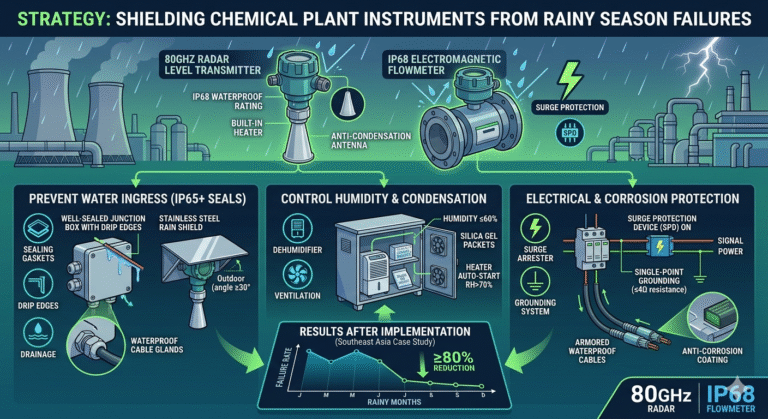
A Complete Protection Strategy for Chemical Plants
Every rainy season, many industrial plants face unexpected instrument failures β signal drift, short circuits, corrosion, or even complete shutdowns.
But the real problem is not the rain itself β
π itβs the lack of proper protection against moisture, condensation, and surge damage.
Based on real field experience, this article provides a complete and practical protection strategy to help you ensure stable operation during harsh weather conditions.
β οΈ Common Risks During Rainy Season
Industrial instruments are highly vulnerable to:
- Moisture ingress and water accumulation
- Internal condensation due to temperature differences
- Lightning and surge damage
- Cable insulation degradation
- Corrosion in aggressive environments
Without proper protection, these issues can lead to unexpected downtime and costly repairs.

π§ Protection Strategy: 4 Core Principles
We recommend a systematic approach based on:
- Prevent water ingress
- Control humidity and condensation
- Protect against lightning and surges
- Avoid corrosion and short circuits
π 1. Environmental Preparation (Eliminate Moisture Sources)
Outdoor Instruments
- Install stainless steel rain shields (angle β₯30Β°)
- Mount instruments β₯1.5m above ground
- Ensure no water accumulation around installation points
Junction Boxes & Cabinets
- Add sealing gaskets and drip edges
- Install drainage holes with dust protection
- Use ventilation fans to maintain slight positive pressure
Cable Trenches
- Ensure slope β₯2β° for drainage
- Seal cable entries with waterproof materials
- Apply anti-corrosion coating
π§ 2. Humidity Control (Prevent Condensation)
Condensation is one of the most overlooked failure causes.
Recommended Measures:
- Install dehumidifiers (humidity β€60%)
- Use silica gel inside cabinets
- Enable air conditioning in βdehumidification modeβ
- Select instruments with built-in heaters (auto start at RH>70%)
π 3. Instrument Protection (Sealing & Proper Selection)
Sealing Measures
- Tighten all enclosure bolts
- Use PTFE gaskets for flange connections
- Apply waterproof cable glands + heat shrink sealing
- Avoid exposed cable joints
Recommended Protection Level
- General outdoor: IP65+
- Heavy rain / flooding risk: IP67 / IP68
- Corrosive environments: IP68 + anti-corrosion coating
β‘ 4. Electrical & Surge Protection
Surge Protection Devices (SPD)
- Install SPD on signal lines (4β20mA, RS485)
- Install SPD on power supply (AC/DC)
- Response time β€25ns, grounding resistance β€4Ξ©
Grounding System
- Single-point grounding
- Separate instrument and power grounding
- Ground resistance β€4Ξ©
Cable Selection
- Use armored waterproof cables
- Avoid standard rubber cables in outdoor environments
π 5. Inspection & Maintenance (Critical for Reliability)
Routine Checks
- Inspect for water ingress and corrosion
- Verify cable dryness and tight connections
- Monitor signal stability
Before Rainy Season
- Replace aging seals
- Test heaters, pumps, and SPD
- Clean cable trenches
During Rainy Season
- Increase inspection frequency
- Perform insulation testing
- Check grounding condition
π οΈ Real Case Study (From Field Experience)
A chemical plant in Southeast Asia experienced repeated transmitter failures every rainy season.
Root Cause:
Condensation inside junction boxes + poor sealing
Solution Implemented:
- Upgraded sealing structure
- Installed cabinet heaters
- Added drainage design
β
Result:
Failure rate reduced by over 80%, and system stability significantly improved.
π‘ Recommended Instrument Solutions
To minimize risks, we recommend using:
- IP68 Electromagnetic Flowmeters
β Ideal for flood-prone or outdoor installations - 80GHz Radar Level Transmitters
β Strong anti-condensation performance, stable in dusty & humid silos - Transmitters with Built-in Heaters
β Prevent internal moisture and signal drift - Surge-Protected Instrument Systems
β Essential for lightning-prone regions
π― Final Thoughts
Rainy season failures are predictable and preventable.
With proper:
- Environmental design
- Sealing and material selection
- Surge protection
- Routine inspection
π You can significantly reduce downtime and maintenance costs.