
In the world of instrumentation, thread connections are a fundamental part of installation, maintenance, and repair. From installing pressure gauges to connecting valves and fixing instruments to pipelines, the correct choice and installation of threads directly impact the seal integrity, safety, and longevity of the system. As an instrumentation engineer, mastering commonly used thread specifications is not only a basic skill but also key to ensuring the quality and efficiency of your work.
In real-world scenarios, you might often hear requests like, “Please grab an M20×1.5 connector from the warehouse” or “We need to install a G1/2 valve in the project.” If you’re unsure about these thread specifications, not only can your work efficiency suffer, but you could also make installation mistakes that lead to leaks or even safety incidents. This article will break down the most commonly used thread specifications in instrumentation work, helping you transition from merely knowing to truly mastering the essentials.
Thread Basics: Understanding Thread Specifications
2.1 Basic Thread Elements
To understand thread specifications, you first need to know the essential elements of a thread:
Major Diameter: The largest diameter of the thread, also known as the nominal diameter.
Minor Diameter: The smallest diameter of the thread.
Pitch Diameter: The imaginary cylinder’s diameter where the thread’s groove and crest widths are equal.
Pitch: The axial distance between two adjacent thread peaks along the pitch diameter.
Lead: The axial distance between two points on the same thread helix.
Thread Angle: The angle between the sides of the thread.
Hand: The direction in which the thread is wound, either right-hand or left-hand.
2.2 Main Thread Classifications
| Classification | Type | Characteristics | Applications |
|---|---|---|---|
| By Standard | Metric Thread | Measured in millimeters, 60° thread angle | Domestic instrumentation, mechanical equipment |
| Imperial Thread | Measured in inches, 55° thread angle | Imported equipment, petrochemical | |
| UN/UNF Thread | Measured in inches, 60° thread angle | US equipment, aerospace | |
| Pipe Thread | Used for pipe connections | Instrumentation pipes, hydraulic systems | |
| By Shape | Triangular Thread | Used for connection and sealing | Instrument fittings, valves |
| Trapezoidal Thread | Used for power transmission | Lead screws, adjustment mechanisms | |
| Sawtooth Thread | Unidirectional force | Hydraulic presses, jacks | |
| By Function | Connecting Threads | Used for fastening and connecting | Bolts, nuts |
| Power Transmission Threads | Used for motion and force transmission | Lead screws, driving rods | |
| Sealing Threads | Used to ensure sealing | Pipe threads, tapered threads |

Understanding Metric Threads: M20×1.5
3.1 Decoding M20×1.5
Let’s take the commonly used M20×1.5 as an example to understand how metric thread specifications are represented:
M: Metric thread
20: Nominal diameter, the major diameter of the thread is 20mm
×1.5: Pitch, the distance between adjacent threads is 1.5mm
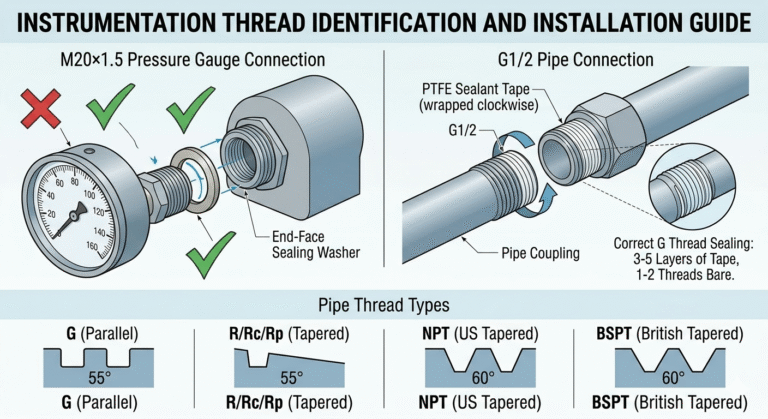
In instrumentation work, M20×1.5 is a standard pressure gauge connector thread. Why is this specification commonly used?
Moderate Strength: The 20mm diameter provides sufficient strength without being too bulky.
Good Sealing: The 1.5mm pitch offers a suitable number of thread turns for effective sealing.
High Versatility: It is an internationally recognized pressure gauge connector standard.
Ease of Installation: Its size is manageable for both manual installation and removal.
3.2 M20×1.5 Technical Parameters
| Parameter Name | Value | Description |
|---|---|---|
| Nominal Diameter | 20 mm | Major diameter of the thread |
| Pitch | 1.5 mm | Distance between adjacent threads |
| Thread Angle | 60° | Standard metric thread angle |
| Thread Height | 0.974 mm | Theoretical height of the thread |
| Pitch Diameter | 19.026 mm | Calculated diameter |
| Minor Diameter | 18.376 mm | Minor diameter of the thread hole |
| Hand | Right-hand | Default direction, unless specified otherwise |
| Tolerance Class | 6H/6g | Internal thread 6H, external thread 6g |
3.3 Complete Representation of Metric Threads
In technical drawings and specifications, metric threads may be represented more completely:
M20 × 1.5 – 6g – LH
Where:
M20: Metric thread, nominal diameter of 20mm
×1.5: Pitch of 1.5mm
6g: External thread tolerance class (6g position)
LH: Left-hand thread
If the pitch is not specified, it is considered a coarse thread. For M20, the coarse pitch is 2.5mm, so M20×1.5 is considered a fine thread. Fine threads have the following advantages:
Better Self-locking: Smaller pitch, offering better self-locking properties, and less prone to loosening.
Higher Strength: The thread root is thicker, providing higher strength.
Better Sealing: More thread turns in a given length for a more reliable seal.
Suitable for Thin-Walled Components: Requires lower material strength.
Note: If the thread specifications are unclear, always measure with a thread gauge or caliper to confirm. M20×1.5 and M20×2.5, although having the same nominal diameter, have different pitches and cannot be used interchangeably.
Understanding Imperial Pipe Threads: G1/2
4.1 Decoding G1/2
G1/2 represents an imperial pipe thread. Let’s break it down:
G: Represents a 55° non-sealing pipe thread (previously denoted as Rp for cylindrical internal threads).
1/2: The nominal size of the pipe in inches.
It’s important to note that 1/2 inch refers to the pipe’s nominal size, not the actual thread diameter. The actual diameter of a G1/2 thread is approximately 20.955mm, which explains why G1/2 and M20 are often compatible.
4.2 G1/2 Technical Parameters
| Parameter Name | Value | Description |
|---|---|---|
| Nominal Size | 1/2 inch | Pipe nominal size |
| Threads Per Inch | 14 threads | Pitch is 1.814mm |
| Thread Angle | 55° | Standard for imperial pipe threads |
| Major Diameter | 20.955 mm | Maximum diameter of the thread |
| Pitch Diameter | 19.793 mm | Calculated diameter |
| Minor Diameter | 18.631 mm | Minimum diameter of the thread |
| Effective Length | 14 mm | Minimum engagement length |
| Taper | None | Cylindrical thread, no taper |
4.3 Pipe Thread Types
There are various pipe thread types commonly used in instrumentation:
| Thread Code | Name | Thread Angle | Features | Application |
|---|---|---|---|---|
| G | Cylindrical pipe thread | 55° | Non-sealing, requires filler | Low-pressure water pipes, instrument air lines |
| R/Rp/Rc | Sealing pipe thread | 55° | Tapered 1:16, seals via thread | Hydraulic, pneumatic pipelines |
| NPT | Sealing pipe thread (US) | 60° | Tapered 1:16 | US equipment, petrochemical |
| BSPT | British standard tapered pipe thread | 55° | Tapered 1:16 | British Commonwealth equipment |
| PT | Japanese pipe thread | 55° | Tapered 1:16 | Japanese equipment |
4.4 Sealing Methods for G Threads
G threads are non-sealing threads and require additional sealing methods:
Sealant tape: The most commonly used method, suitable for water, air, and similar media.
Sealant compound: Suitable for higher-pressure applications.
O-ring seals: Best sealing effect by machining an O-ring groove.
Metal or rubber gaskets: Common in flanged connections.
Pro Tip: When using sealant tape, wrap it clockwise (as viewed from the threaded end), with an appropriate thickness (typically 3-5 layers). Leave 1-2 threads unwrapped to prevent sealant from entering the pipe.
M20×1.5 vs. G1/2: Comparison and Application
5.1 Size Comparison
| Comparison | M20×1.5 | G1/2 | Analysis |
|---|---|---|---|
| Nominal Diameter | 20 mm | 1/2 inch | Different units, similar sizes |
| Actual Major Diameter | 20.000 mm | 20.955 mm | About 0.955mm difference |
| Pitch | 1.500 mm | 1.814 mm | Difference of 0.314mm |
| Thread Angle | 60° | 55° | Difference of 5° |
| Thread Height | 0.974 mm | 0.960 mm | Similar |
| Sealing Method | End face sealing | Thread sealing or filler | Different sealing principles |
| Applicable Standard | GB/T 7306.1 | GB/T 7307 | Different national standards |
5.2 Choosing Between M20×1.5 and G1/2
M20×1.5: Best for direct connections to pressure gauges, temperature gauges, and other instruments requiring end-face sealing. Suitable for domestic equipment and systems requiring frequent disassembly.
G1/2: Used primarily for piping connections, especially in imported European equipment, low-pressure water, and air systems.
5.3 Conversion and Transition Options
To transition between M20×1.5 and G1/2 threads, common solutions include:
Conversion connectors: One end M20×1.5, the other end G1/2.
Transition flanges: Used to connect different thread types.
Field machining: Thread machining on pipe fittings to support both thread types.
Important Reminder: Although M20×1.5 and G1/2 are close in size, never mix them up directly! They have different thread angles and pitches, and forcing them together can damage threads and cause leaks.
Conclusion
Understanding the correct thread specifications and ensuring proper installation is crucial in instrumentation. M20×1.5 is widely used for direct connections, while G1/2 is commonly used for piping systems. Always adhere to the correct standards and installation guidelines to prevent errors and ensure safe and reliable connections.
This article provides a clear overview of commonly used threads, and understanding these specifications will help avoid costly mistakes in the field.