
In steam flow measurement, vortex flow meters are commonly used due to their reliability and simplicity. However, when temperature and pressure compensation is not properly implemented or installation points are wrongly selected, even small errors can lead to significant measurement inaccuracies. This article provides an in-depth overview of the underlying logic of temperature and pressure compensation for steam vortex flow meters, proper installation standards, and key considerations to avoid common pitfalls when selecting integrated meters. After reading, you’ll have actionable insights that can directly improve steam measurement accuracy and eliminate the frustrations of inconsistent readings.
Why is Temperature and Pressure Compensation Essential in Steam Measurement?
Steam density changes significantly with variations in temperature and pressure. Most flow meters, such as differential pressure meters and vortex meters, measure the volumetric flow rate under operating conditions. However, the required measurement for industrial processes and energy metering is typically mass flow rate or the volumetric flow rate under standard conditions. Therefore, it is essential to measure the temperature and pressure of the steam in real-time to accurately calculate its density and convert the volumetric flow into the desired measurement.
Both temperature and pressure compensation are essentially corrections to account for changes in steam density.
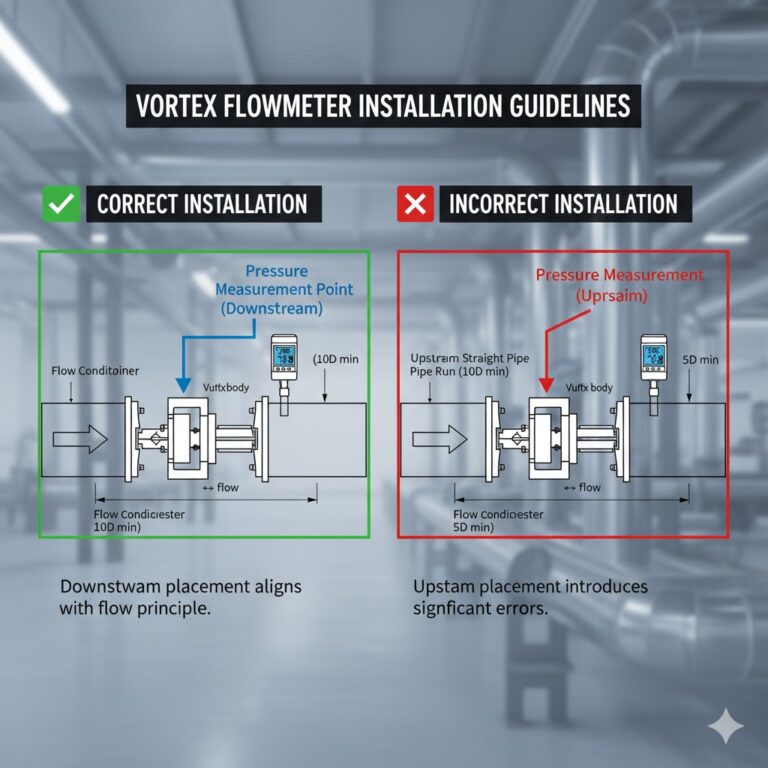
1. Compensating for Density Changes to Ensure Accurate Measurement
According to the fundamental flow equation (e.g., the mass flow formula for differential pressure flow meters), the flow measurement is proportional to the square root of the fluid density (ρ).
Since steam, whether superheated or saturated, has its density as a function of both temperature and pressure, any deviation from the designed operating conditions will result in changes in density, leading to significant errors in flow measurement.
For example:
If the steam is designed to operate at a pressure of 1.078 MPag and a temperature of 260°C, and the pressure drops by 0.35 MPag while the temperature rises by 50°C, without temperature and pressure compensation, the error could be -9.15% (reduction).
If the vortex flow meter is installed after the pressure reducing valve and the steam temperature remains high even after the pressure reduction, it may cause the steam to become superheated. If compensation is not done properly, the error could reach 28.37%. However, using pressure compensation reduces this error to 3.2%.
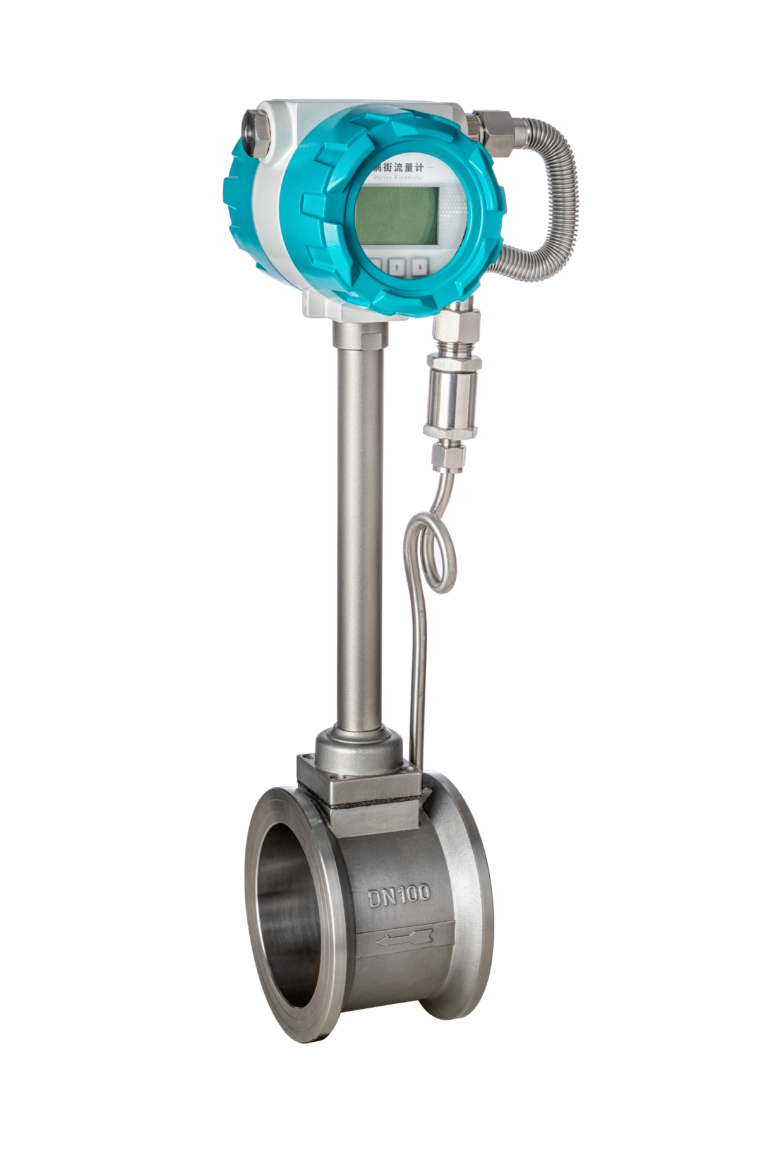
2. Adapting to Different States of Steam
Superheated Steam:
For superheated steam, temperature and pressure are two independent variables. If only one parameter is measured, it cannot accurately determine the density, leading to substantial errors in flow measurement. Therefore, both temperature and pressure compensation are required to uniquely determine the density.
Saturated Steam:
For saturated steam, temperature and pressure are related in a single value function. In theory, measuring either temperature or pressure alone should be enough to determine the density. As a result, either temperature compensation or pressure compensation can be used.
Recommendation for Saturated Steam:
Pressure compensation is preferred because:
Accuracy: Pressure measurements are typically more accurate than temperature measurements, and the selection of the pressure transmitter’s range has less impact on compensation accuracy compared to temperature measurements. Temperature measurement errors have a larger impact on saturated steam flow compensation.
Phase Changes: When saturated steam undergoes pressure reduction or velocity changes, it may turn into superheated steam. If pressure compensation is used, the error is minimal, even if a phase change occurs. However, using only temperature compensation could cause significant errors if the superheated steam is mistakenly treated as saturated steam.
For trade settlements and energy management purposes in steam measurement, temperature and pressure compensation is essential, whether for traditional mass flow metering or scientific heat flow measurement.
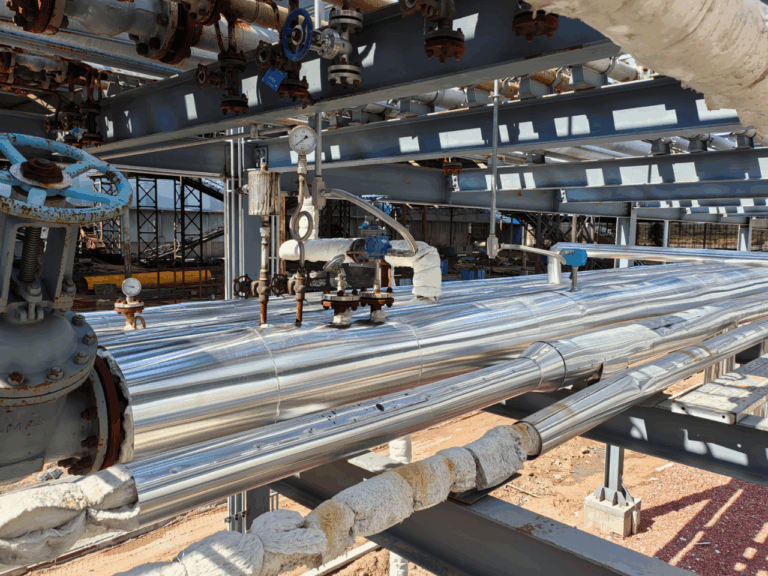
Where Should the Temperature and Pressure Measurement Points Be Installed? Stick to Standards, Not Just Experience!
To achieve precise and stable steam flow measurement, proper installation point placement is critical. This is because the static pressure and temperature of the fluid can vary at different points along the pipeline, and incorrect placement can introduce additional measurement errors.
Typically, along the flow direction, the installation sequence should be: Vortex flow meter → Pressure measurement → Temperature measurement. The measurement points must be installed on straight pipe sections, and both the flow meter and measurement points should be placed at appropriate distances from each other and any downstream disturbances (such as valves).
Key installation guidelines:
Pressure measurement: The pressure sensor should be installed as close to the vortex flow meter as possible to reflect the pressure at the flow meter’s location. It must be downstream of the vortex flow meter, as the flow meter measures volumetric flow at this point.
Temperature measurement: Typically, temperature sensors should be installed downstream of the pressure sensor to avoid interference with the flow. Usually, the temperature sensor is placed 150-200 mm downstream of the pressure sensor.
It’s important to note that different brands of vortex flow meters may have specific requirements for the location of temperature and pressure sensors. Always refer to the official installation manual provided by the manufacturer for the final installation position.
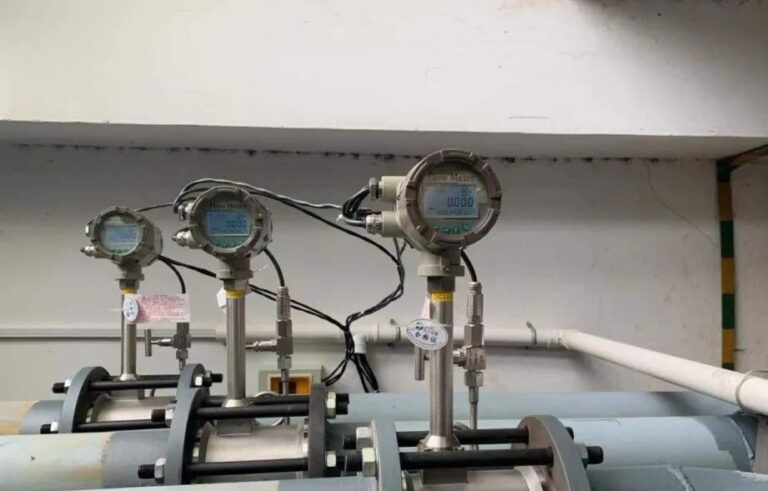
Integrated Temperature and Pressure Compensation: Convenient, But Watch Out for These Pitfalls
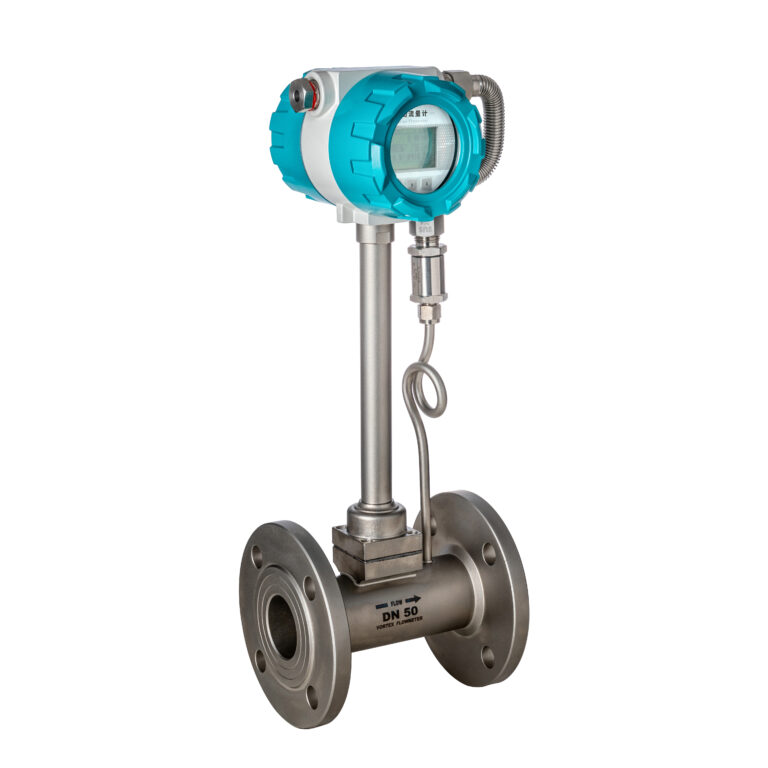
Many vortex flow meters now come with integrated temperature and pressure sensors, providing a compact solution that simplifies installation and reduces costs. However, there are some considerations:
Some well-known international brands offer vortex flow meters that only integrate temperature measurement and require an external pressure transmitter. This is important when designing and selecting instruments.
When choosing a meter with integrated temperature and pressure compensation, ensure the supplier’s product list is checked and confirm the specifications with the process engineering team.
Conclusion
Temperature and pressure compensation is critical in ensuring accurate steam flow measurement. By compensating for the changes in fluid density caused by variations in temperature and pressure, it is possible to eliminate measurement errors. For superheated steam, both temperature and pressure compensation should be used, while pressure compensation is generally recommended for saturated steam.
To ensure accurate and stable measurements, always follow the correct installation procedures for pressure and temperature measurement points. Furthermore, when selecting integrated vortex flow meters with built-in temperature and pressure sensors, ensure that the instrument specifications match the system requirements.
By following these guidelines, engineers can avoid costly measurement errors and ensure that steam flow measurement is precise and reliable, ultimately contributing to better process control and energy management.