
An actuator’s dead zone refers to the range of input signals where the actuator does not respond. Only when the input signal reaches a certain threshold does the actuator begin to operate. When the dead zone becomes too significant, it may lead to oscillations in the control system, degrading the system’s performance.
In industrial automation and control systems, the actuator dead zone is a crucial concept. Simply put, the dead zone is the region where there is no effective change in the actuator’s response (such as valve opening or stem displacement) despite changes in the input signal (such as electrical signals or pneumatic pressure). This is often referred to as the “dead travel” or “response lag zone.”
To help clarify the concept, let’s break it down from several dimensions:
1. Core Definition
When a control signal (e.g., a 4-20mA current signal from a controller) changes within a small range, the actuator (such as a control valve) does not move, meaning the output shaft remains stationary. The range of change in the input signal that causes no movement is the dead zone.
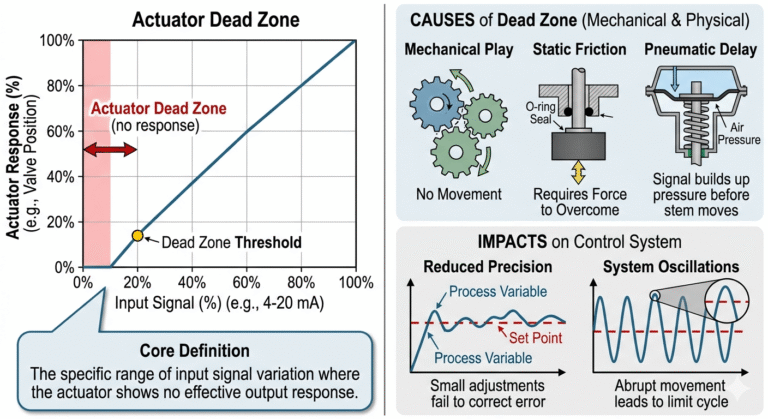
2. Causes of the Dead Zone
The actuator dead zone is typically caused by mechanical or physical factors, including:
Mechanical play: Gaps in gear transmissions or looseness at linkages. It’s like driving an old car with loose steering, where turning the steering wheel slightly has no effect on the wheels.
Static friction: Large static friction in seals or bearings inside the actuator. The input signal needs to build up enough force to overcome the “static friction” before the parts begin to move.
Insufficient torque: At low signal levels, the force generated by the actuator is insufficient to move the load.
Pneumatic actuator response delay: For pneumatic actuators, the diaphragm or piston must be pressurized sufficiently to overcome the spring tension, before the actuator starts to respond.
3. Impacts on Control Systems
The dead zone is an undesirable phenomenon in control systems, but engineers must face it. It can lead to:
Reduced control precision: As the system approaches the set point, the controller may send small adjustment signals, but due to the dead zone, the valve does not move, preventing precise control of temperature, pressure, or flow at the target value.
System oscillations (limit cycle oscillations): The controller keeps increasing the signal when the error is not eliminated. Once the accumulated signal exceeds the dead zone, the valve moves abruptly, causing overshooting of the controlled variable. The controller then adjusts in the opposite direction, leading to continuous small oscillations.
Delayed response: When process parameters change, the actuator may fail to respond quickly, causing delayed reactions in the system.
4. Dead Zone Measurement in Automation
In engineering, the dead zone is typically expressed as a percentage of the input signal.
For example, if a valve actuator has a dead zone of 1.0%, this means that if the input signal change is less than 1.0% (e.g., a 4-20mA signal change less than 0.16mA), the actuator will not move.
Conclusion
The actuator dead zone is a critical parameter for evaluating an actuator’s sensitivity and response performance. The smaller the dead zone, the more sensitive the actuator and the higher the control accuracy. Conversely, a larger dead zone results in slower system response and increased risk of system instability.