
In industries such as chemicals, oil and gas, and powder processing, level measurement instruments are not just simple tools. They play a key role in control systems while ensuring safety in hazardous areas.
Many accidents are not caused by equipment failure but occur because a critical issue was overlooked during the selection process — whether the explosion protection rating truly matches the risk at the site.
To better understand the differences in explosion-proof zones, let’s use a few analogies:
Zone 2 is like a city road — typically safe, with risks only arising under specific conditions.
Zone 1 resembles a mountain road — inherently hazardous, where even a small mistake can lead to severe consequences.
Dust explosion environments are like spaces covered with fine gunpowder — seemingly quiet, yet highly sensitive to ignition sources. Each environment requires a completely different approach to instrument selection.
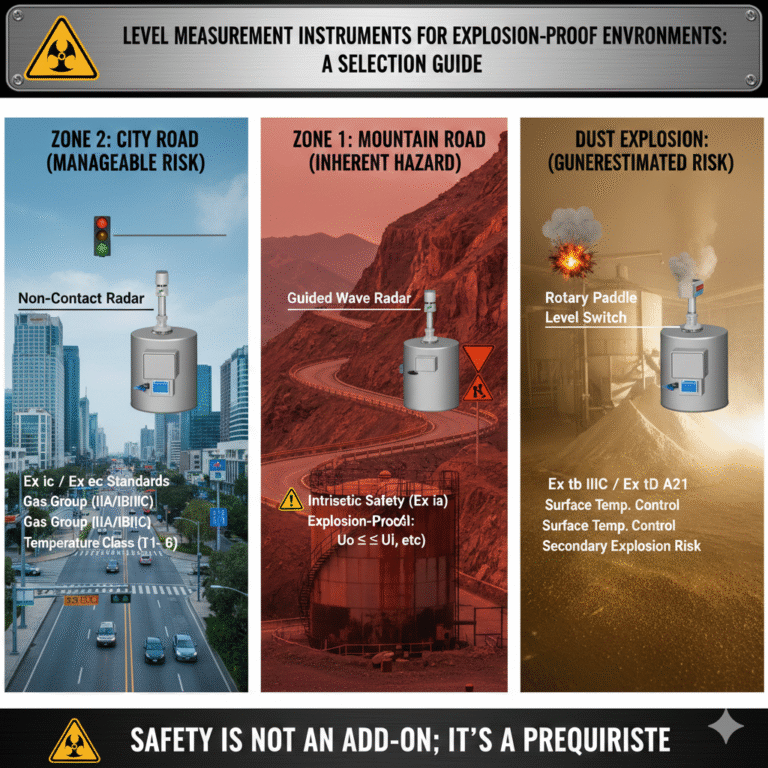
Zone 2: Risk is Manageable, But Never to be Ignored
Definition of Zone 2:
In normal operating conditions, explosive gases are not present, and if they do occur, they are only present for a short period.
Common in solvent storage areas, general chemical tanks, and some oil storage and transport zones, Zone 2 is relatively low-risk. However, “low-risk” does not mean “low-requirement.”
Common level measurement instruments used in Zone 2 environments include non-contact radar, guided wave radar, capacitive level meters, magnetic float transmitters, and ultrasonic sensors. Explosion-proof designs typically follow the Ex ic (intrinsic safety) or Ex ec (increased safety) standards.
The real focus during selection isn’t just on “whether there’s an explosion-proof certification,” but whether the full certification matches the site conditions — such as the gas group (IIA/IIB/IIC), temperature class (T1–T6), and equipment protection level (EPL Gc).
Temperature Class:
The maximum surface temperature of the device must always be below the ignition temperature of the surrounding flammable gases. This is often overlooked, but it’s a key factor in ensuring compliance:
T1 ≤ 450°C
T2 ≤ 300°C
T3 ≤ 200°C
T4 ≤ 135°C
T5 ≤ 100°C
T6 ≤ 85°C
A common misconception on engineering sites is thinking that Zone 2 can afford some “relaxation of standards,” or only focusing on the instrument body while neglecting cable sealing and grounding systems. Explosion protection is not just about individual devices; it’s a system. A mismatch in any part of the chain can create hidden risks.

Zone 1: A Constantly Hazardous Environment
In Zone 1, explosive gases are present under normal operating conditions — the environment is inherently hazardous.
Common areas include crude oil storage tanks, reactors, hydrogenation units, and some natural gas systems. The focus in Zone 1 is not “can it measure?” but “how is energy controlled?”
Typically, two approaches are used:
Intrinsic Safety (Ex ia) — Limits circuit energy so that gas cannot be ignited under any fault conditions.
Explosion-Proof (Ex d) — Allows internal explosions, but ensures they are contained within the housing and do not transmit to the external environment.
In most cases, intrinsic safety should be prioritized because it limits ignition energy from the source. However, for high-power, high-temperature, high-pressure, or large power consumption radar applications, explosion-proof designs may be more suitable.
For Zone 0 (where explosive gases are always present), Ex ia Ga is mandatory and non-negotiable.
It’s important to note that intrinsic safety isn’t as simple as selecting a single instrument. It must be coordinated with safety barriers, cable specifications, capacitance, and inductance, as well as the grounding system. This technical coordination must meet energy limitation conditions like Uo ≤ Ui, Io ≤ Ii, and Po ≤ Pi.
In Zone 1, the cost of error is high. Unlike Zone 2, where risks are sporadic, Zone 1 is always near the hazardous boundary, and any oversight can have magnified consequences.

Dust Explosion-Proof: A Risk Often Underestimated
Dust explosions, often overlooked compared to gas explosions, are equally complex and destructive.
In environments like cement plants, flour mills, lithium battery manufacturing workshops, and coal dust storage areas, dust accumulation on equipment surfaces can interfere with heat dissipation and increase the surface temperature. Once the first explosion occurs, the shockwave can lift the dust, creating a suspended dust cloud, which can trigger a much more severe secondary explosion.
The typical feature of dust explosions is “secondary explosions are far worse.”
In these environments, explosion-proof certifications are typically Ex tb IIIC T85°C Db or Ex tD A21 IP66 T120°C, and the focus is not only on temperature classes but also on confirming dust groups (IIIA/IIIB/IIIC), protection levels, and surface temperature limits.
Many mistakenly think dust explosion protection is simply about high IP ratings. This is a significant misunderstanding. The core concern with dust explosion protection is controlling surface temperature rise and the risk of dust ignition, not just the IP rating.
Instruments such as high-frequency radar, tuning fork level switches, vibrating rod level switches, rotary paddle level switches, and RF admittance devices are more commonly used in dust explosion environments. However, measurement techniques prone to dust accumulation or that are susceptible to interference need to be carefully evaluated.

What’s the Essence of Explosion-Proof Instrument Selection?
Many think that instrument selection is about matching functionality, but in explosion-proof scenarios, the first priority is always matching the safety classification.
For non-hazardous environments, instrument selection is about measurement technique. In explosion-proof settings, it’s about building a safety boundary.
The safety rating isn’t necessarily better when it’s higher; it should strictly match the site’s risk level. A higher rating increases costs, while a lower rating creates hidden risks.
Professional selection achieves a balance between safety, stability, and maintainability within the regulatory framework.

Summary
Before finalizing your model selection, make sure to double-check these parameters:
Hazardous area classification (Zone 0/1/2 or 20/21/22)
Gas group or dust category
Ignition temperature of the medium
Process temperature and pressure
Tank height and internal structure
Whether a safety barrier system is already in place
Power supply and grounding methods
Only with these parameters fully defined can you make a well-informed selection. Explosion-proof instrument selection is not about choosing a model — it’s about constructing a safety closed-loop.
Safety is not an add-on; it’s a prerequisite.