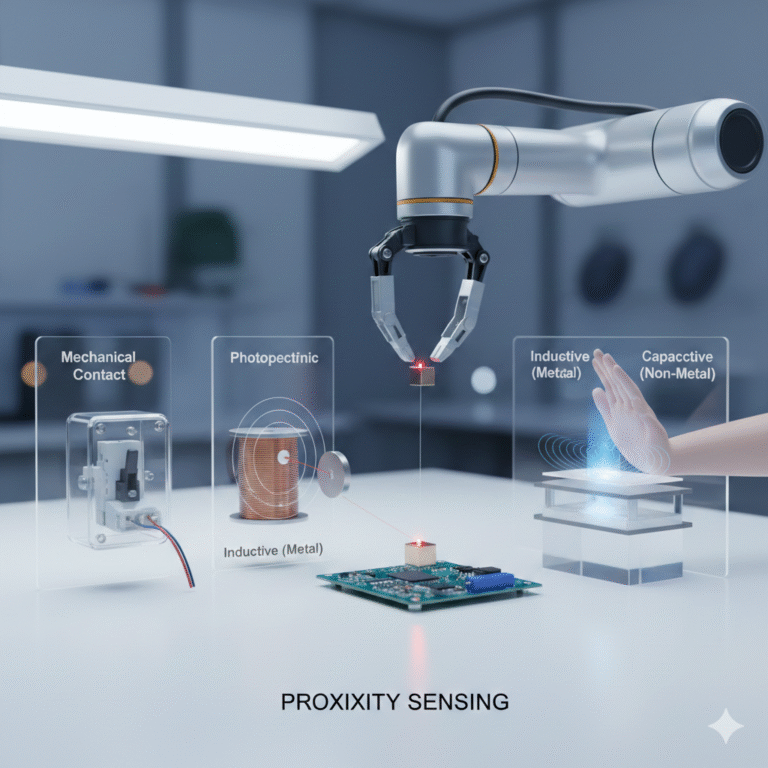
Proximity sensing involves detecting the presence or absence of an object, as well as its size or simple shape. Proximity sensors can be classified into contact and non-contact types and operate in either analog or digital modes. The choice of sensor depends on physical conditions, environmental factors, and control requirements.
Common types include:
Mechanical Contact Sensors: These use mechanical/electrical switches, often featuring microswitches for improved sensitivity and durability. They are commonly found in vibration-based level switches and flowmeters.
Pneumatic Proximity Sensors: These sensors work by disturbing or interrupting airflow. As contact-type sensors, they are not suitable for detecting lightweight components that can be moved by airflow.
Photoelectric Proximity Sensors: These detect objects by sensing whether a light beam, typically aimed at a photosensitive device like a photodiode, is interrupted. They are non-contact sensors but can be affected by environmental factors such as dust, smoke, or welding flash that might obstruct the light path.
Electrical Proximity Sensors: These can be contact or non-contact. Contact sensors work by completing a circuit, while non-contact sensors use inductive principles to detect metals or capacitive principles to detect non-metals.
2. Distance Sensing
Distance sensors are used to detect the proximity of an object to the sensor. Non-contact methods for short-range detection include capacitive, inductive, and magnetic technologies, while long-range detection relies on energy waves such as radio waves, ultrasound, or lasers.
3. Force Sensing
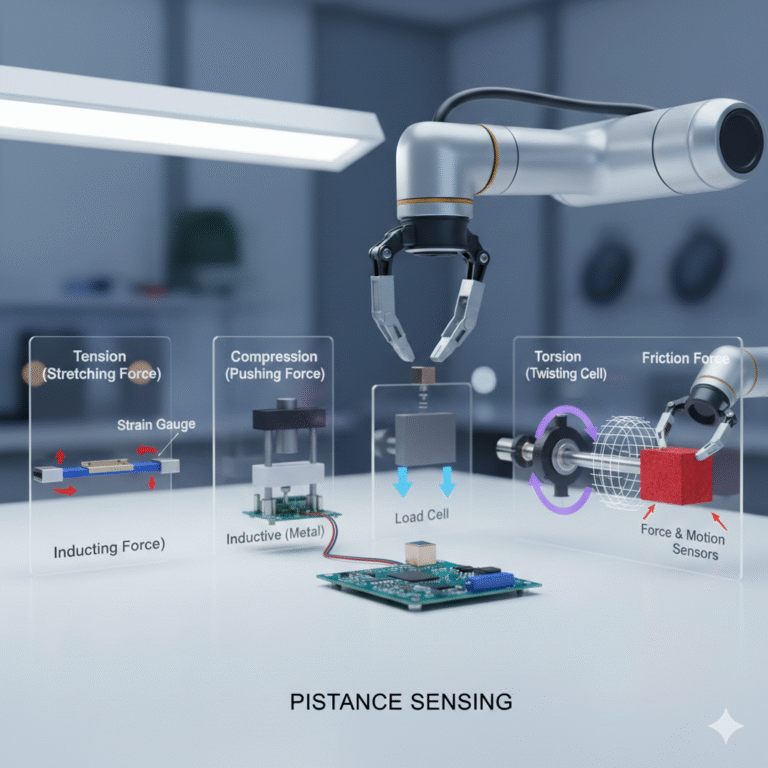
Force sensing involves detecting six main types of forces, which can be either static or dynamic:
Tension (Stretching Force)
Compression (Pushing Force)
Shear Force
Torsion (Twisting Force)
Bending Force
Friction Force
Tension is often measured indirectly using strain gauges, which detect changes in resistance when stretched. Pressure is typically measured using load cells, which detect changes in dimensions, pressure, or resistance under load. Torsion is viewed as a combination of tension and compression and is often measured using a combination of strain gauges and load cells. Friction is analyzed by combining force sensors and motion sensors to detect resistance to motion.
4. Tactile Sensing
Tactile sensing is based on direct contact detection. The simplest tactile sensors consist of a matrix of touch-sensitive elements arranged in rows and columns. Each sensor is activated upon contact, and the activated sensors (in digital mode) or signal strength (in analog mode) can determine the object’s size and shape. Mechanical, optical, and electronic tactile sensors have been developed for various applications.
5. Thermal Sensing
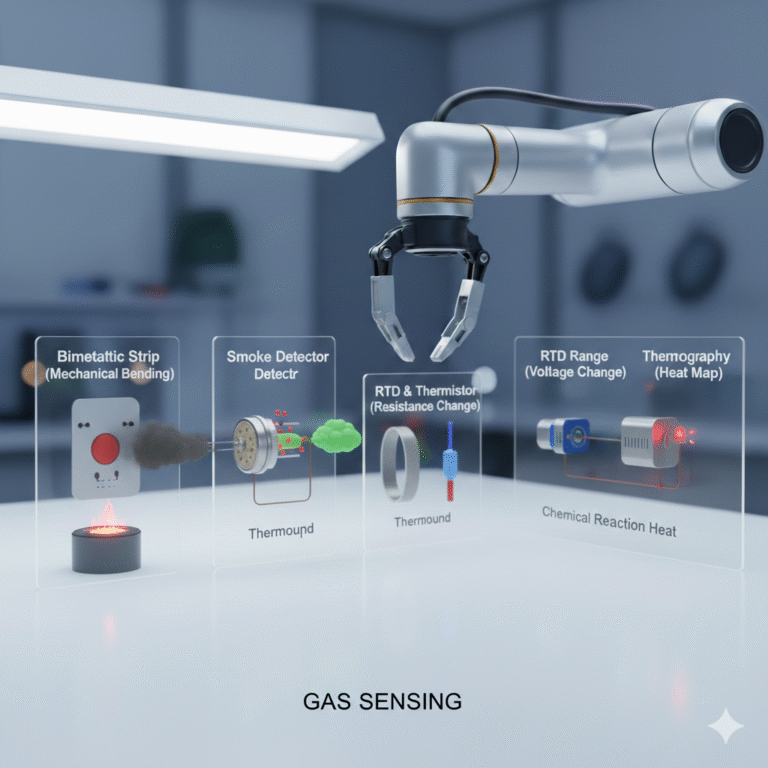
Thermal sensing is crucial for process control and safety monitoring. The method chosen depends on the required temperature range:
Bimetallic Strips: Simple temperature detection through mechanical bending.
Thermocouples: Measure temperature differences through changes in voltage.
Resistance Temperature Detectors (RTD): Measure temperature through resistance changes in metal conductors.
Thermistors: Semiconductor devices that detect temperature changes via resistance.
Infrared Thermography: Used to detect low-level heat sources in complex systems.
6. Acoustic Sensing
Acoustic sensors detect and sometimes differentiate sounds, making them ideal for applications such as speech recognition and anomaly detection (e.g., explosions). The most common acoustic sensor is the microphone. In industrial environments, background noise can be a challenge. By tuning the sensor to specific frequencies, different sounds can be distinguished.
7. Gas Sensing
Gas or smoke sensors detect specific gases through chemical reactions within the sensing material. These reactions cause physical expansion or generate enough heat to trigger a switching mechanism. Gas sensors are critical for safety and environmental monitoring.
8. Robotic Vision
Robotic vision is one of the most active research areas in sensor technology. It involves capturing images in real-time using cameras and converting them into a digital format that a computer system can analyze. This process must be completed rapidly to allow robots to adjust and respond while performing tasks.
Applications of robotic vision include:
Detecting object presence, position, and movement.
Identifying and recognizing parts.
Analyzing patterns, styles, and features.
Advanced robotic vision enhances industrial automation and artificial intelligence capabilities, though it requires significant storage and processing power.