
In the design and commissioning of industrial equipment, the following situations are often encountered:
A buzzing sound when equipment is running
Sudden, intense vibrations of cutting tools during machining
Increasing loosening of motor bases over time
Cracks appearing in pump machines after a few years of operation
The root cause? Insufficient damping.
Many people only associate damping with “shock absorption” but are unclear about:
What exactly is damping?
How does it differ from stiffness?
Why are vibration problems often related to damping?
This article thoroughly explains the concept of “damping” in industrial equipment.
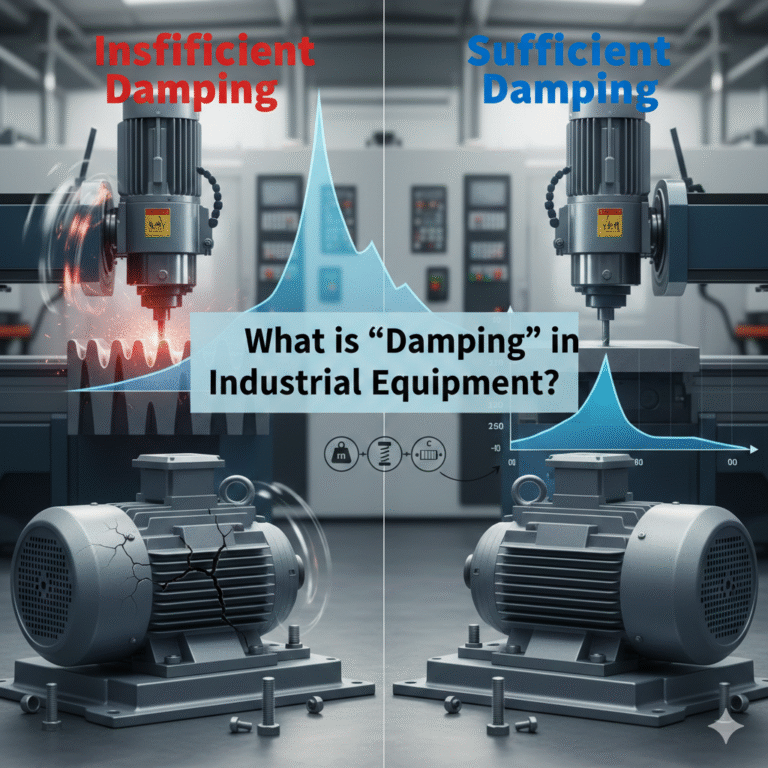
1. What is Damping?
In mechanical vibration theory, damping refers to the ability of a system to dissipate energy during vibration. When a device vibrates, it undergoes cyclical motion. As long as there is energy, it will continue to vibrate. Damping works by converting mechanical energy into heat or other forms, gradually reducing the amplitude of vibration.
2. What Happens Without Damping?
Consider this scenario: A motor is running at a speed close to its natural frequency. What happens?
Vibration in industrial equipment can be caused by various factors, including motor rotation excitation, unbalanced forces, impact loads, and external periodic excitations. When the excitation frequency approaches the natural frequency of the structure, resonance occurs.
The danger of resonance lies in the fact that the amplitude of vibration is amplified. A 1mm vibration could become 5mm or even 10mm. This leads to problems such as loosened bolts, overloaded bearings, excessive noise, welding seam fatigue, and decreased machining accuracy.
Many machines are not “damaged” by external pressure but by “vibration damage.”
The real culprit in determining the amplitude is damping. It acts as the “brake system” for resonance. The greater the damping, the lower the resonance peak and the faster the vibration decays. This explains why many equipment failures are due to insufficient damping, not structural strength.
3. How to Understand Damping?
A vibration system typically consists of three core parameters:
Mass (m): Inertia of the system
Stiffness (k): Deformation and natural frequency
Damping (c): Vibration decay rate
These parameters control different characteristics of the system:
| Parameter | Controls |
|---|---|
| Mass | Inertia size |
| Stiffness | Deformation degree, natural frequency |
| Damping | Vibration decay speed |
Many engineering sites make the mistake of adding thicker steel plates to reduce vibration. But the vibration persists. Why?
Because:
Stiffness determines whether the structure will deform.
Damping determines how long the vibration will last.
Improving stiffness can alter the natural frequency, but without adequate damping, resonance can still cause significant vibration.
The optimal design approach should be:
Stiffness + Damping Collaboration.
Simply increasing stiffness might bring the system closer to the excitation frequency, which, without sufficient damping, could lead to prolonged vibration and instability.

4. Four Common Types of Damping in Industrial Equipment
Viscous Damping
Common in hydraulic shock absorbers, oil film bearings, and hydraulic buffers.
Characteristics: Resistance is proportional to speed. The faster the vibration, the greater the resistance.Material Damping (Structural Damping)
Why do high-end machine tools use cast iron beds? Because cast iron has strong internal energy dissipation capabilities. The material undergoes internal friction, converting vibration energy into heat. This is why cast iron structures are more stable than welded steel ones of the same stiffness.Friction Damping
Occurs between contact surfaces, common in preloaded bolt connections and large steel structures.
Advantages: Simple and effective.
Disadvantages: Uncontrollable and highly nonlinear.Air Damping
Resistance caused by air or fluid media. It typically has a small effect and is usually considered in lightweight structures or high-speed systems.
5. The Role of Damping in Industrial Equipment
Machine Tool Industry
Insufficient damping can lead to tool vibrations, surface ripple, dimensional errors, and reduced tool lifespan. High-end CNC machines are priced higher primarily due to their high-damping dynamic performance design.Motors and Pumps
Lack of damping can result in increased noise, base resonance, and loosened connections. Long-term vibrations are a key cause of equipment fatigue failure.Automation Equipment
In high-speed positioning systems, insufficient damping leads to oscillations, longer positioning times, and reduced control accuracy. The equivalent damping directly affects the dynamic performance in many servo systems.

6. How to Determine if Your Equipment Has Sufficient Damping?
There are three common methods used in engineering:
Frequency Spectrum Analysis
Check if the resonance peak is too high.Decay Testing
Strike the structure and observe how long the vibration takes to dissipate.Modal Analysis
Identify the structure’s natural frequency and damping ratio. Simple indicators:Slow decay → Low damping
High peak → Insufficient damping
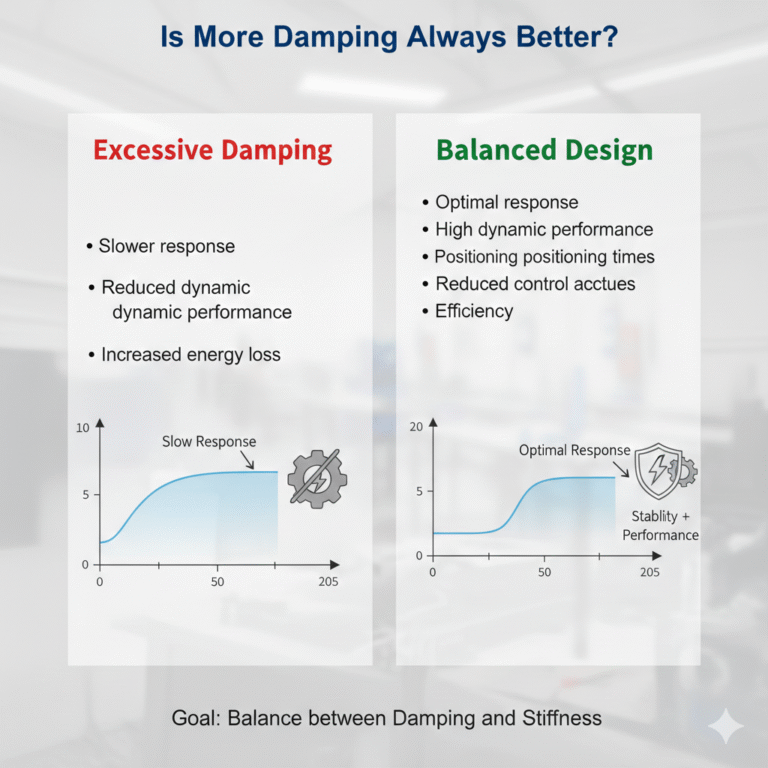
7. Is More Damping Always Better?
The answer is: Not necessarily. Excessive damping can cause:
Slower response
Reduced dynamic performance
Increased energy loss
These issues are more prominent in precision instruments. In vibrating level switches, damping is even a core working principle. Therefore, in engineering design and operation, the goal is not to achieve maximum damping, but rather to strike a balance between damping and stiffness.
Industrial equipment stability is essentially a matter of energy management. While vibration is inevitable, how quickly it is “consumed” determines the lifespan and precision of the equipment.
Conclusion
In industrial equipment design, damping is often an invisible parameter. It plays a crucial role in controlling resonance, vibration decay speed, dynamic stability, and fatigue risk. In precision equipment design, damping is not an additional feature but a core indicator.