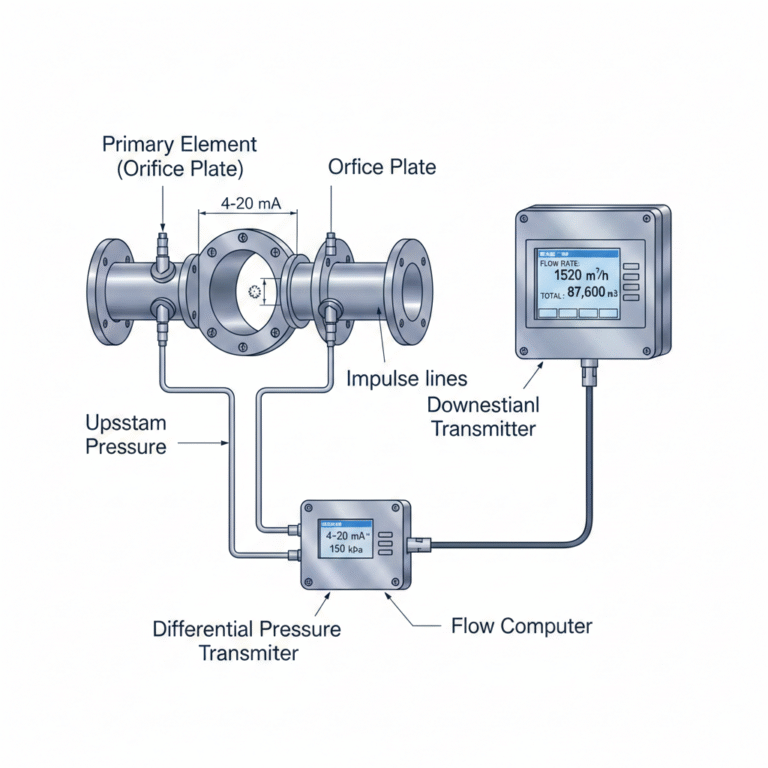
A Differential Pressure Flow Meter (DP Flow Meter) measures flow rate by detecting the pressure difference generated by a primary element installed in a pipeline. The flow rate is calculated based on:
Measured differential pressure
Known fluid properties
Geometric dimensions of the primary element and pipe
DP flow meters are widely used in accordance with ISO 5167 and GB/T 2624 standards and remain one of the most established flow measurement technologies in industrial applications.
2. Key Factors in Selecting a Differential Pressure Flow Meter
When selecting a DP flow meter, five major aspects must be considered:
Instrument performance
Fluid characteristics
Installation conditions
Environmental conditions
Economic factors
3. Instrument Performance Considerations
3.1 Accuracy, Repeatability and Rangeability
The overall accuracy of a DP flow meter depends on:
Differential pressure transmitter accuracy
Flow coefficient uncertainty
Fluid property accuracy (especially density)
Installation conditions
Although high-accuracy DP transmitters are available, improving transmitter accuracy alone does not significantly improve overall system accuracy if other parameters are uncertain.
DP flow meters are inherently non-linear instruments because:
This square-root relationship limits their rangeability. Traditional systems offer about:
3:1 to 10:1 rangeability
However, modern multi-range transmitters and advanced primary elements can expand this significantly.
3.2 Permanent Pressure Loss
One of the main disadvantages of DP flow meters is permanent pressure loss.
Different primary elements have significantly different pressure losses:
Primary Element
Relative Pressure Loss
Orifice Plate
High (100%)
Nozzle
30%–50% of orifice
Venturi Tube
5%–20% of orifice
Averaging Pitot Tube
Very low
For large diameter pipelines, pressure loss directly affects energy consumption and operating costs. Therefore, venturi tubes or low-loss designs are often preferred in high-flow applications.
4. Fluid Characteristics
4.1 Fluid Physical Properties
Accurate knowledge of the following parameters is critical:
Density
Viscosity
Isentropic exponent (for gas)
Compressibility factor
Moisture content
Among these, density is the most critical parameter.
Errors in density calculation directly affect flow accuracy. For gas and mixed fluids, density is often calculated from:
Pressure
Temperature
Composition
However, composition uncertainty can introduce additional errors.
4.2 Newtonian vs Non-Newtonian Fluids
ISO 5167 applies primarily to Newtonian fluids.
For non-Newtonian fluids (common in petrochemical industries), viscosity variations can significantly affect Reynolds number and flow coefficient stability.
4.3 Corrosion, Erosion, Fouling and Contamination
DP flow measurement depends on stable geometric dimensions.
Long-term changes due to:
Corrosion
Erosion
Scaling
Fouling
may alter the discharge coefficient without being easily detected.
In such cases, venturi tubes are generally more resistant than orifice plates.
5. Installation Conditions
To use ISO 5167 discharge coefficients directly, the installation must meet strict requirements:
Required upstream and downstream straight pipe lengths
Pipe roundness
Surface roughness
Proper pressure tapping method
Insufficient straight pipe length is one of the most common field issues.
If space is limited, possible solutions include:
Using venturi tubes (shorter straight length required)
Installing flow conditioners
Performing flow calibration
5.1 Integrated vs Remote Mounting
Integrated DP systems reduce:
Impulse line problems
Freezing risks
Leakage points
However, in high vibration or strong electromagnetic interference environments, remote-mounted transmitters are recommended.
6. Environmental Conditions
Modern DP transmitters contain microprocessors and electronic components. Therefore, consider:
Ambient temperature
Humidity
Vibration
Hazardous area classification
Proper enclosure protection (IP rating) and explosion-proof certification may be required.
7. Economic Considerations
Total cost includes:
7.1 Initial Purchase Cost
Primary element is relatively low cost, but system cost includes:
Impulse lines and auxiliary systems increase installation complexity.
7.3 Operating Cost
Pressure loss causes energy consumption, especially in large pipelines.
7.4 Calibration and Maintenance
Primary elements generally do not require frequent recalibration if installed properly, which is a major advantage.
8. Selection of Standard Primary Elements (ISO 5167)
When choosing between standard primary elements, consider:
Pipe diameter and Reynolds number limits
Required accuracy
Allowable pressure loss
Straight pipe length availability
Resistance to erosion and fouling
Structural complexity
Installation convenience
Long-term stability
General Comparison
Orifice Plate
Simple and low cost
High pressure loss
Easy to replace and inspect
Nozzle
Lower pressure loss than orifice
Suitable for high temperature and high pressure steam
Venturi Tube
Very low pressure loss
Excellent long-term stability
Higher initial cost
9. Conclusion
Despite the emergence of advanced flow technologies such as electromagnetic, Coriolis, ultrasonic, and vortex meters, Differential Pressure Flow Meters remain widely used due to:
Standardization (ISO 5167)
Proven reliability
Suitability for high temperature and high pressure
Strong adaptability in industrial environments
Proper selection requires a balanced evaluation of:
Accuracy requirements
Fluid characteristics
Installation constraints
Energy loss considerations
Overall lifecycle cost
10. Need Technical Support?
If you are selecting a DP flow meter, please provide:
Pipe diameter
Fluid type
Pressure and temperature
Flow range
Installation conditions
Our engineering team can help you select the most suitable primary element and transmitter configuration.