In industrial sites, pressure-related issues occur almost every day:
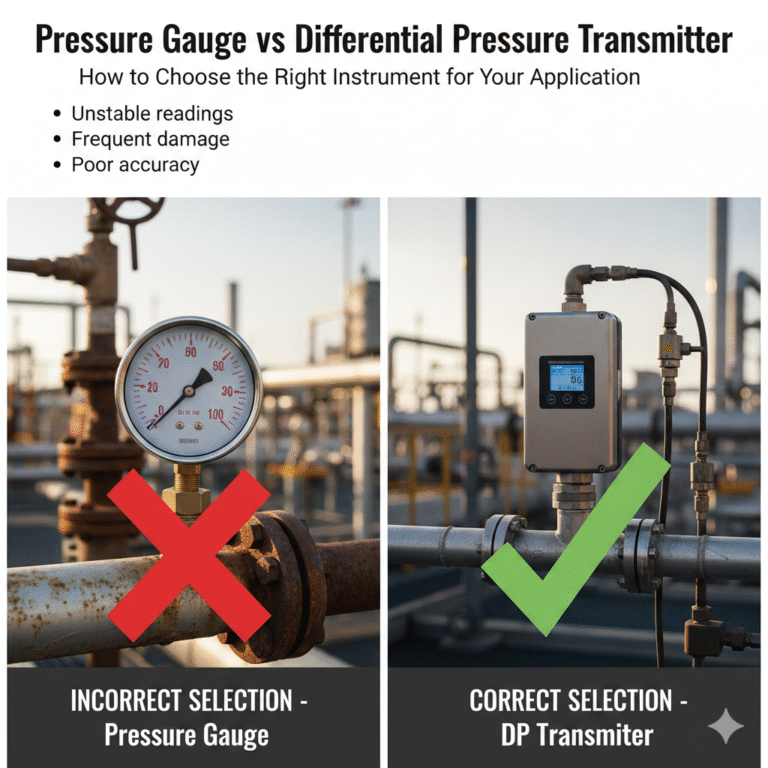
Unstable pressure readings
Fluctuating or drifting signals
Frequent instrument damage
Complaints about poor accuracy shortly after commissioning
After investigation, the conclusion is often the same:
The instrument itself is not defective — the problem started with incorrect selection.
This issue is especially common when choosing between a pressure gauge and a differential pressure transmitter (DP transmitter).
The Root Cause: What Are You Really Trying to Measure?
In many projects, pressure instrument selection is treated as a simple task:
Check the pressure range
Confirm the process medium
Match the connection size
Selection completed.
However, real operating conditions tell a different story.
Because the key question was never asked:
Are you measuring pressure — or are you using pressure to make decisions?
This is the first and most important distinction.
Pressure Gauge vs Differential Pressure Transmitter – Key Differences
Selection Aspect
Pressure Gauge
Differential Pressure Transmitter
Main Purpose
Local visual indication
Control, calculation, interlock
Measurement Type
Absolute or gauge pressure
Pressure difference between two points
Used for Control
No
Yes
Sensitivity to Dynamic Changes
Low
High
Suitable for Small Pressure Differences
❌ No
✅ Yes
Remote Transmission
Very limited
Standard function
Installation Sensitivity
Medium
High
If you only want to know whether pressure exists or not, a pressure gauge is usually sufficient.
If you need to evaluate system performance, detect blockage, calculate flow, or trigger control actions — a differential pressure transmitter is almost always required.
3 Common Selection Mistakes
1️⃣ Using a Pressure Gauge to Detect Flow or Blockage
A very common misunderstanding.
Many systems attempt to determine:
Pipeline blockage
Filter contamination
Flow abnormality
Using only a pressure gauge.
But pressure alone cannot reflect these changes reliably.
What truly indicates these conditions is the pressure difference across the component.
As a result, the gauge may show “normal pressure,” while the system is already deviating from optimal performance.
2️⃣ Selecting DP Range Too Close to Theoretical Maximum
A risky practice is selecting a differential pressure transmitter with a full-scale range equal to the theoretical maximum differential pressure.
In real operation, you may encounter:
Process fluctuations
Startup and shutdown surges
Fast valve actions
This may push the transmitter to operate near its limit, reducing:
Accuracy
Long-term stability
Sensor lifetime
A DP transmitter should not operate continuously at the edge of its range.
Proper safety margin is essential.
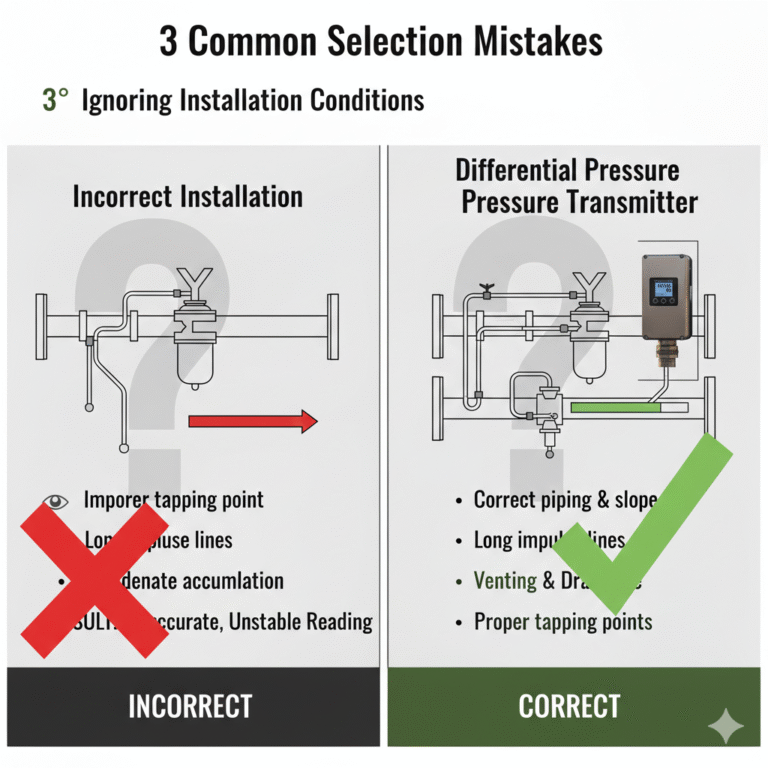
3️⃣ Ignoring Installation Conditions
Many “inaccurate” readings are not instrument problems, but installation issues:
Improper tapping point location
Long impulse lines
Condensate accumulation
Gas-liquid mixed phases without separation
Differential pressure transmitters are significantly more sensitive to installation conditions than pressure gauges.
Correct piping, slope, venting, and drainage are critical.
When You Must Consider a Differential Pressure Transmitter
You should strongly consider a DP transmitter if your application involves:
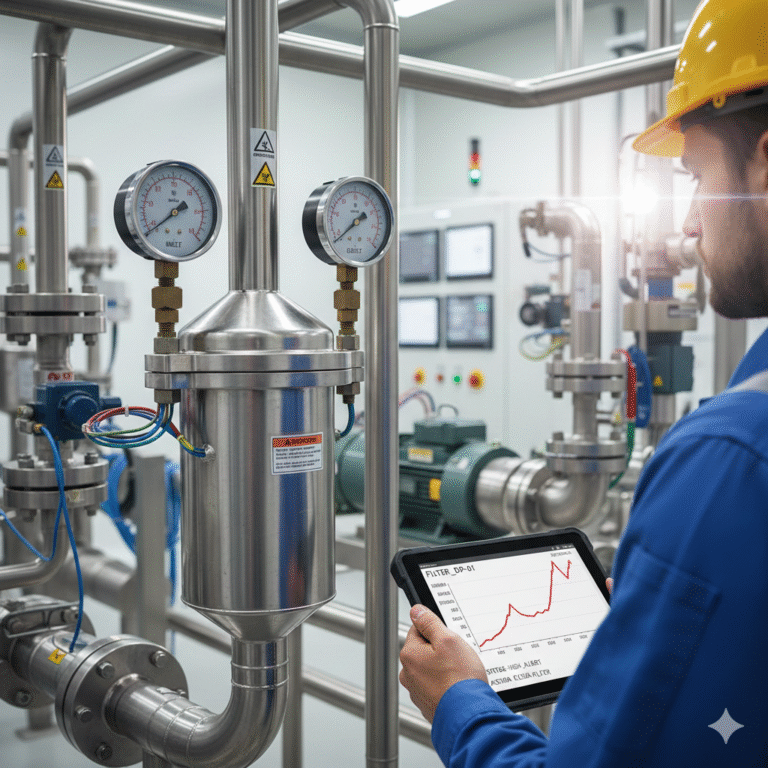
Monitoring filter or heat exchanger blockage
Flow measurement via orifice, venturi, or flow element
Level measurement in pressurized tanks
Remote signal transmission to PLC/DCS
Fast-changing process conditions
Alarm or interlock functions
In these cases, replacing pressure gauges repeatedly will not solve the root problem.
The correct solution is to shift the measurement focus:
From “pressure value” to “pressure difference logic.”
Engineering Insight
A pressure gauge answers:
“Is there pressure?”
A differential pressure transmitter answers:
“What is changing in the process?”
This distinction defines whether your system merely observes conditions — or actively controls them.
In practical projects involving flow measurement, filtration systems, and industrial process control, correct understanding of differential pressure logic significantly improves system reliability and reduces long-term maintenance cost.
Final Thought
Instrument selection is not about choosing a product.
It is about understanding the process objective.
Before selecting a pressure instrument, always clarify:
What decision depends on this measurement?
Is the pressure value itself important — or the difference between two points?
Answer that question first.
The correct instrument choice will become obvious.