
When using a differential pressure flowmeter to measure steam, where exactly should the shut-off valve on the pressure tap be installed — before or after the condensation tank? According to some literature, it should be installed after the condensation tank. However, in practice, most installations place it before the tank. Which of these is correct? Will installing it incorrectly affect measurement accuracy? Could it lead to future maintenance issues? Let’s clarify this debate by examining the core functions of the condensation tank and the original purpose of the shut-off valve.
Background
A certain thermal power company inquired about the installation position of the shut-off valve on a differential pressure flowmeter used to measure steam. Some documents suggest the shut-off valve should be installed after the condensation tank, as shown in the figure below. However, most installations have it placed before the tank. Which of these approaches is correct?
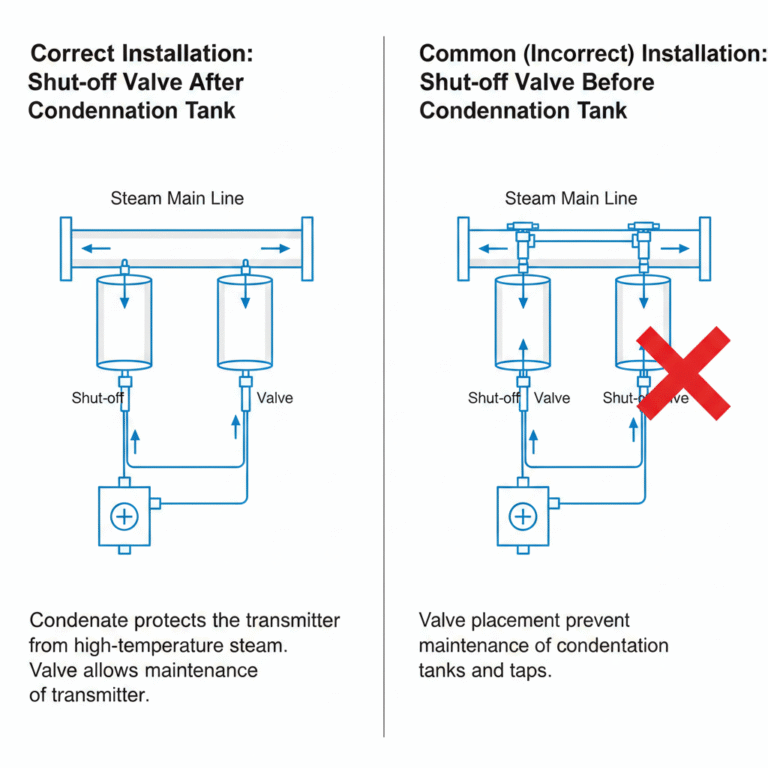
Correct Installation: Shut-off Valve After the Condensation Tank
The installation of the shut-off valve after the condensation tank is technically the correct practice. To understand why, let’s first explore the primary functions of the condensation tank:
Pressure Isolation: One of the primary roles of the condensation tank is to convert the vapor-phase differential pressure signal between the two pressure taps into the differential pressure signal of the condensate, without distortion. This allows the differential pressure transmitter to be isolated from the high-temperature steam.
Absorption of Condensate: When there is a change in differential pressure, the positive or negative pressure chamber of the differential pressure measuring instrument (previously a differential pressure gauge, now a differential pressure transmitter) absorbs a certain volume of condensate from the condensation tank. The tank’s larger cross-sectional area ensures that fluctuations in the liquid level are negligible, allowing for more accurate differential pressure measurement.
With advancements in differential pressure transmitter technology, the membrane box’s area and displacement have decreased significantly. As a result, the absorption of condensate from the tank has become negligible, and this second function is largely obsolete.

Practical Considerations for Shut-off Valve Installation
In the figure, the pressure tap and condensation tank before the shut-off valve are welded shut, which eliminates potential maintenance concerns. The purpose of the shut-off valve in this case is to facilitate maintenance of the downstream instruments, pressure taps, and associated components.
The shut-off valve should be positioned below the condensation tank, where it doesn’t require high specifications. A needle valve, for instance, is typically used as long as its diameter is large enough to allow smooth flow of air and condensate when the valve is opened.
Additional Functions of the Condensation Tank
Apart from its core functions, the condensation tank may also have other features, such as a freezing fluid filling port and an overflow port. If the shut-off valve is installed before the condensation tank, it would be impossible to maintain these ports. Therefore, a valve should also be added between the condensation tank and the pressure taps, though this valve requires higher specifications due to the high fluid temperature and the need for a straight-through flow.
For reliability, the shut-off valve located before the condensation tank should be welded to the pressure tap using the appropriate connection method.

Simplified Installation with Differential Pressure Transmitters
After the differential pressure gauge was replaced by a transmitter, the system could be simplified considerably. Fewer valves are needed, and a gas collector can be omitted because the differential pressure transmitter’s high and low chambers are equipped with exhaust valves that can handle venting tasks. The simplified installation diagram is shown below. The horizontal pressure tap should maintain a specific slope to ensure that air flows smoothly into the main pipe. Without the proper slope, air may remain in the pipes, causing zero-point drift in the transmitter.
Conclusion
Based on the core function of the condensation tank and future maintenance needs, it is clear that the shut-off valve should be installed after the condensation tank. Installing it before the tank could overlook the primary functions of the condensation tank and potentially cause maintenance issues down the line.