
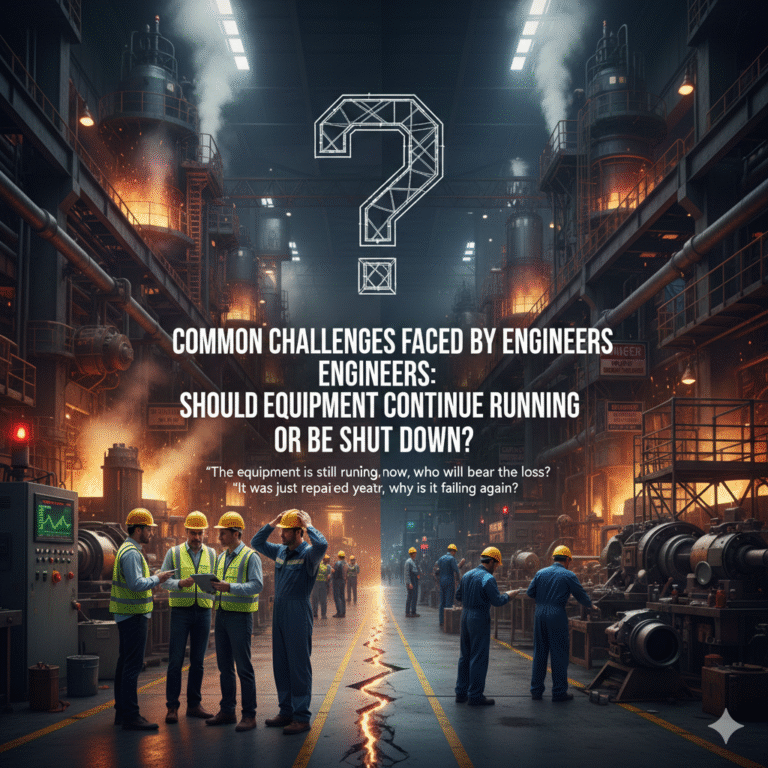
In industrial settings, it’s common to hear statements like:
“The equipment is still running, why shut it down?”
“If we shut it down now, who will bear the loss?”
“It was just repaired last year, why is it failing again?”
These questions are heard every day. But what’s more difficult is the aftermath of an incident when people often say, “It should have been shut down earlier.” Before the accident occurs, halting production is usually the most unpopular and doubted decision, because at that moment, the risks are not yet visible, but the immediate loss is clear.
1. Industrial Equipment Does Not Have Unlimited Operational Capability
In industrial production, major repairs, shutdowns, and suspensions are different levels of engineering measures. Equipment running under high temperature, high pressure, and heavy load conditions will inevitably experience material degradation, performance decay, and reduced safety margins. There is no such thing as a “stable” operating industrial system.
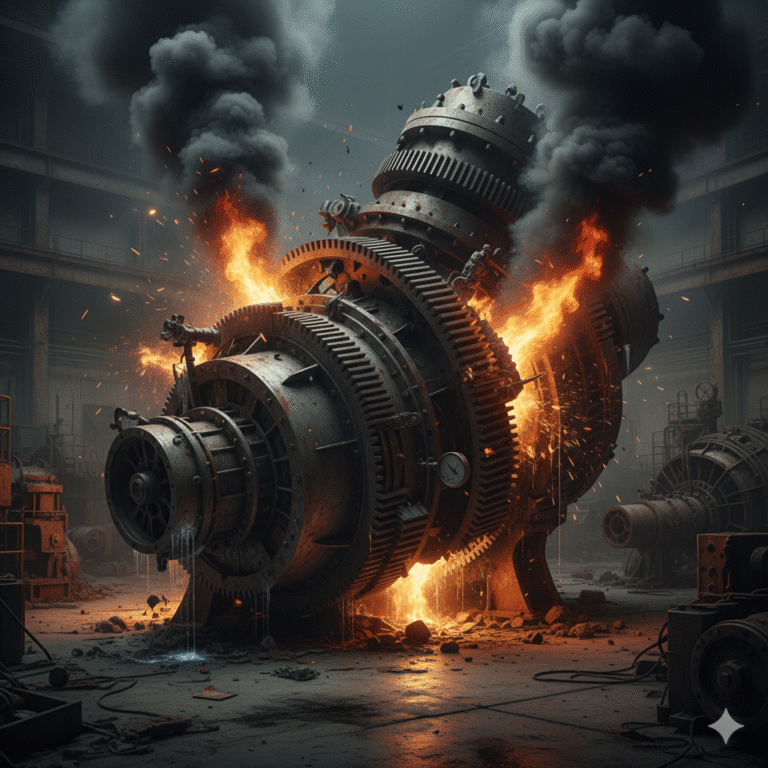
Every industrial installation is designed with a specific lifespan and operational boundaries. Operating beyond these boundaries leads to system failure – it’s just a matter of time. Continuing to run doesn’t maintain stability; it only masks the degradation process and consumes safety margins. Running the system without a shutdown is like overdrawing from a bank account.
2. What Is a “Major Repair”?
A major repair is not an option, but a necessary measure after a system has reached a certain operational stage. The focus is not on specific failure points, but on failure mechanisms that have already developed over the operation cycle. Major repairs are aimed at addressing problems that have formed during operation but have not yet escalated out of control.
If only the broken parts are repaired, it is called regular maintenance. Major repairs must include:
Disassembling and inspecting key pressurized, load-bearing, and rotating components
Replacing materials and components that have reached their life limits
Restoring the reliability of instruments, interlocks, and protective systems
Correcting operational deviations formed during operation
Failure to perform major repairs is equivalent to allowing the system to continue deteriorating.

3. What Is “Shut Down”?
Without a shutdown, effective maintenance is not possible. Operating systems are constantly supplied with energy and media, which makes it impossible to access, inspect, or service critical parts.
Shutting down means:
The system is removed from its production state
The system is energy-isolated
The system no longer performs its process function
The purpose of shutting down is to transition the system from “operating mode” to a state where it can be disassembled, inspected, and intervened.

4. What Is “Suspension”?
Suspension is not a management choice but an engineering risk judgment. Suspension means:
Production activities are halted
All efforts are focused on safety and maintenance
The system will no longer operate with risks
When the safety margin of a system can no longer be verified, and key failure modes lack control measures, continuing operation is a violation of regulations. In this state, suspension is not conservative but the only legal and reasonable engineering decision.
5. Without Suspension, Many Problems Are Impossible to Solve
Industrial systems are closed when in operation, carrying energy and media. In this state, key parts cannot be accessed, and their true condition cannot be verified. Maintenance itself is a high-risk operation. Running production while maintaining equipment only multiplies the risk. “Fixing problems without stopping production” is not a demonstration of engineering ability but simply shifting the risk to the site and time.
Once the system is forced to shut down, there is often no more room for decision-making.
6. Why Are We Seeing More Shutdowns Now?
Equipment does not fail suddenly. All accidents originate from engineering facts that have been ignored for a long time.
Just because parameters can still be adjusted and indicators are still acceptable does not mean the system is safe; it only means that the safety margin has not yet been exhausted.
The operating cycles of installations are being extended, pushing operating conditions closer to design limits. Safety, environmental, and compliance requirements have become stricter, and monitoring and diagnostic capabilities are clearer, revealing problems earlier.
The standards are not necessarily becoming “tougher,” but we no longer accept systems that rely on experience and luck to continue running.

Conclusion
In almost every post-incident review, one phrase is always heard: “We should have shut down earlier.” The premise of industrial production is that systems must be controllable. Once control is lost, continuing operation is a mistake. Failing to stop at the right time is not an overzealous action but a dereliction of duty. The ability to halt operations at the right moment reflects true engineering competence.