
Why Instrument Incidents Are Rarely Just Operator Errors
In daily instrumentation maintenance, draining and inspection of differential pressure (DP) transmitters are considered routine tasks. In practice, however, improper drain operations continue to cause serious equipment damage—especially in steam service.
Recently, a DP transmitter was severely damaged during a drain operation. Similar incidents have occurred before, and they are worth revisiting—not to assign blame, but to understand the real causes behind them.
A Common but Dangerous Practice
In many plants, technicians drain DP transmitters by directly opening the drain plug. Under certain operating conditions, this may appear to work without immediate consequences. As a result, the method is often copied by less experienced personnel without a proper understanding of process conditions.
Problems arise when this practice is applied to steam flow measurement.
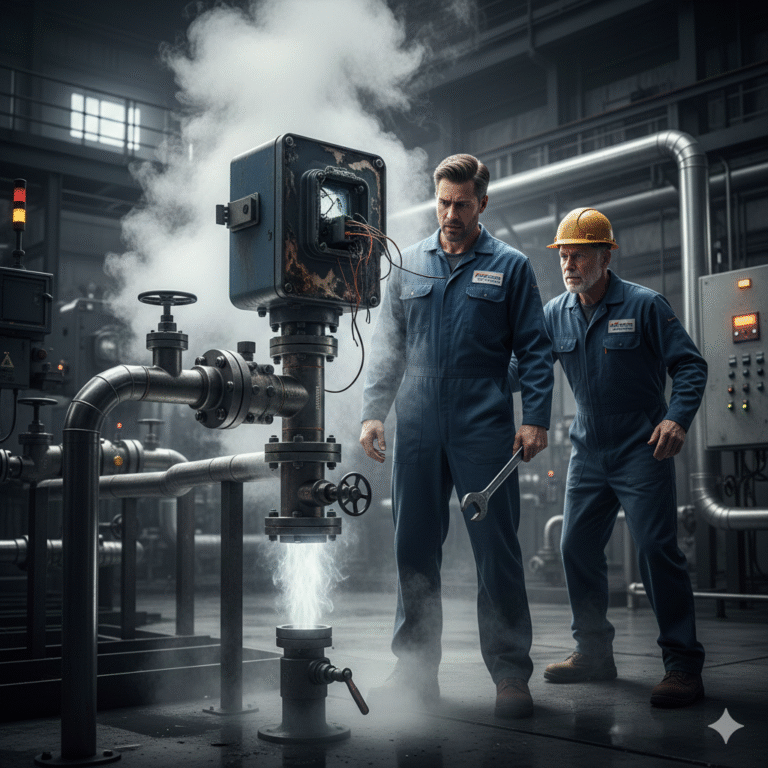
In one case, the drain plug of a steam DP transmitter was opened directly without isolating the transmitter via the manifold. High-temperature steam rushed into the impulse line and came into direct contact with the sensing diaphragm. The result was severe damage to the diaphragm capsule and, in some cases, burnt internal circuitry—leading to transmitter failure and process instability.
Not Just an Operator Mistake
After such incidents, the first reaction is often to blame the operator for carelessness or lack of skill. However, this view oversimplifies the problem.
In reality, these failures are rarely caused by individual negligence alone. They are usually the result of:
Insufficient understanding of measurement principles
Inadequate training for different process conditions
Lack of standardized operating procedures
Weak supervision and control of field operations
Why Steam Service Is Different
When a DP transmitter is used for steam flow measurement, the impulse lines are normally filled with condensate. This condensate acts as a thermal barrier, protecting the transmitter diaphragm from direct exposure to high-temperature steam.
If the manifold valves are not properly closed and the condensate is not handled correctly, opening the drain plug allows live steam to reach the diaphragm instantly. For operators who only remember the action—“open the drain to discharge”—without understanding the underlying principle, this mistake is almost inevitable.
This situation perfectly illustrates the weakest-link principle:
the reliability of an instrumentation system is not determined by its most experienced technician, but by its least prepared one.

How to Prevent Similar Incidents
To eliminate such avoidable failures, control measures must be established on three levels: training, procedures, and execution.
1. Strengthen Principle-Based Training
Operators should not only be trained on how to perform tasks, but also why certain steps are required. Training should clearly explain the differences between liquid, gas, and steam applications, with special emphasis on the protective role of condensate in steam service.
2. Establish Standardized Operating Procedures (SOPs)
Clear, step-by-step SOPs should be developed for draining, calibration, and maintenance of DP transmitters.
For steam flow applications, a typical drain procedure should include:
Closing the three-valve (or five-valve) manifold
Safely releasing or managing condensate in the impulse lines
Slowly opening the drain plug
Restoring the condensate seal after draining
Reopening the manifold in the correct sequence
Every step should be documented and mandatory.
3. Enforce Qualification and Mentorship
Operators should be certified for independent field work only after passing both theoretical and practical assessments. A structured “mentor–apprentice” system helps ensure that new technicians gain real understanding rather than copying habits.
4. Improve Field Supervision and Feedback
Supervisors should actively monitor field operations and correct unsafe practices immediately. Incident reviews should be shared across the team, turning individual mistakes into collective learning opportunities.

Final Thoughts
In instrumentation maintenance, details define safety and reliability. Every failure caused by improper operation is a warning signal—not only about technical gaps, but about weaknesses in training and management systems.
Improving technical skills requires solid theoretical foundations, while long-term operational stability depends on disciplined procedures and effective supervision. Only when all three are in place can similar incidents truly be prevented.