In engineering, scientific research, and industrial production, “pressure” is a fundamental concept found everywhere—from pressure drops in fluid pipelines, to material compressive strength, and the rated working pressure of gas storage vessels. Accurate understanding and use of pressure units are essential for ensuring reliable calculations and safe designs.
However, due to historical developments and industry differences, pressure units are not standardized across various measurement systems. Correct conversion becomes a common challenge in engineering practice. This article systematically organizes common pressure units, conversion relationships, and usage precautions, aiming to help engineers reduce risks arising from mixed units.
1. Definition of Pressure and International System of Units (SI)
Pressure is defined as the force applied per unit area, mathematically represented as:
In the International System of Units (SI), the unit of pressure is the Pascal (Pa), where:
Because the value of Pascal is too small for practical engineering applications, multiples of Pascal are often used:
kPa (kilopascal)
MPa (megapascal) — commonly used in domestic engineering mechanics, pressure vessels, and pumps.
For instance, the yield strength of materials is often expressed in MPa.
2. Common Pressure Units and Their Origins
Due to historical and measurement method differences, the following pressure units are commonly used across different fields:
Bar and Millibar (mbar)
Application: Meteorology, gas compression equipment
Conversion:
Standard Atmosphere (atm, at)
Application: Chemical industry, laboratories
Conversion:
(based on water column weight)
Millimeter of Mercury (mmHg) and Centimeter of Water (cmH₂O)
Application: Medical monitoring, ventilation measurements
Conversion:
Pounds per Square Inch (psi)
Application: North American standards, oil and gas industry, tire pressure
Conversion:
3. Quick Reference for Common Pressure Unit Conversions
Unit
Pa
MPa
1 Pa
1
1×10⁻⁶
1 kPa
1,000
0.001
1 MPa
1,000,000
1
1 bar
100,000
0.1
1 atm
101,325
0.101325
1 at
98,066.50
0.0980665
1 mmHg
133.322
1.33322×10⁻⁴
1 psi
6,894.76
0.00689476
Engineers can quickly reference this table for unit conversions or estimates.
4. Important Considerations in Engineering Applications
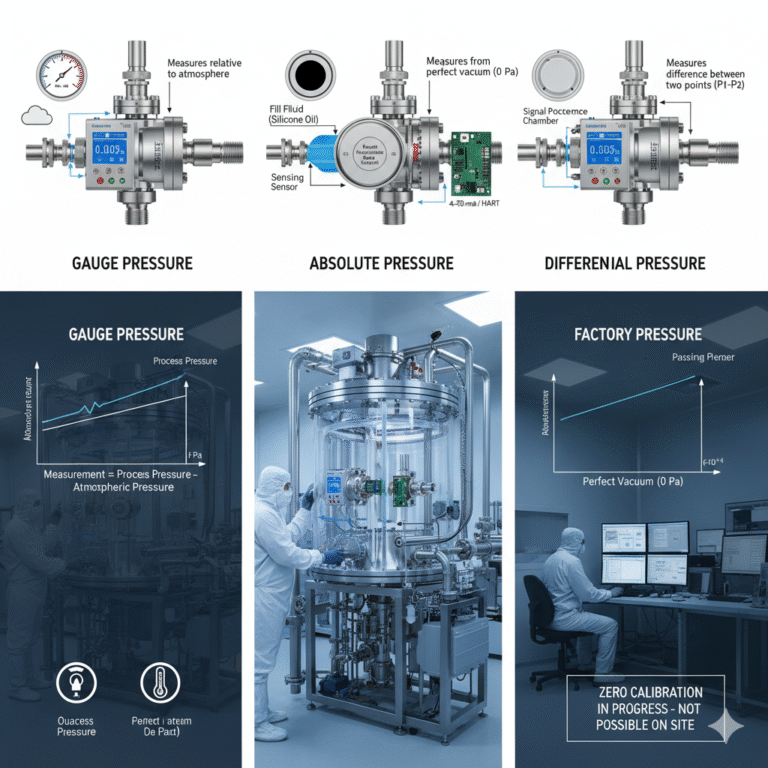
Understanding Gauge Pressure vs. Absolute Pressure In practical engineering, there are two common ways to express pressure:
Gauge Pressure (kPa(g), MPa(g)): Measured relative to atmospheric pressure.
Absolute Pressure (kPa(a), MPa(a)): Measured relative to absolute vacuum.
Conversion relationship:
Example: A pipeline pressure reading of 0.5 MPa(g) corresponds to an absolute pressure of approximately 0.601 MPa(a).
Standardization of Units on Equipment Nameplates and Specifications Many imported devices (e.g., compressors, valves, gas cylinders) may use psi or bar, while domestic design drawings often use MPa. Incorrect conversion can lead to issues such as inadequate pressure resistance or safety risks. Ensuring uniform units during engineering review is crucial.
Compatibility of Instrument and Sensor Output Units For pressure transmitters, the output units (MPa, bar, psi, %FS) must be consistent with the PLC or DCS system to avoid monitoring errors.
Caution in Gas Industry Units In industries like natural gas, pressure units such as kPa (low pressure), MPa (high pressure), bar (for some equipment), and psi (for imported instruments) are used. Ensuring standardization of units is vital to comply with industry regulations.
5. Efficient Pressure Unit Conversion in Practice
Use of “Base Unit Method” Convert all units to Pa first, then convert to the desired unit. This method avoids errors from chain conversions.
Use of Engineering Software or Simple Scripts MATLAB, Python (commonly used in engineering projects), engineering calculators, PLC internal unit conversion modules, or manufacturer-provided tools can automate unit conversions, ensuring traceability in calculations.
Clear Unit Notation in Documents and Reports High-quality technical documentation should ensure:
Consistent units in charts and graphs (e.g., MPa(g), kPa(abs), psi(g)).
Full unit notation when first introduced (e.g., MPa(g)).
Avoid ambiguous abbreviations for key parameters.
6. Conclusion
Pressure units, though fundamental, are crucial for engineering design, production safety, and accurate data. Mastering the proper units, conversion methods, and precautions significantly reduces engineering risks, improves communication efficiency, and prevents costly issues arising from incorrect unit usage. For engineers, developing a standardized habit of pressure unit conversion is an essential part of professional competence.