
Explosion protection levels are essential in ensuring safety in environments with flammable gases, vapors, or dust. The classification system defines the appropriate equipment and safety measures based on the characteristics of the hazardous environment. This article provides an in-depth look at explosion protection classifications, focusing on categories, temperature groups, explosion-proof methods, and marking systems.
1. Categories Based on Usage
Explosion protection classifications primarily consider the type of environment and the nature of the explosive atmosphere:
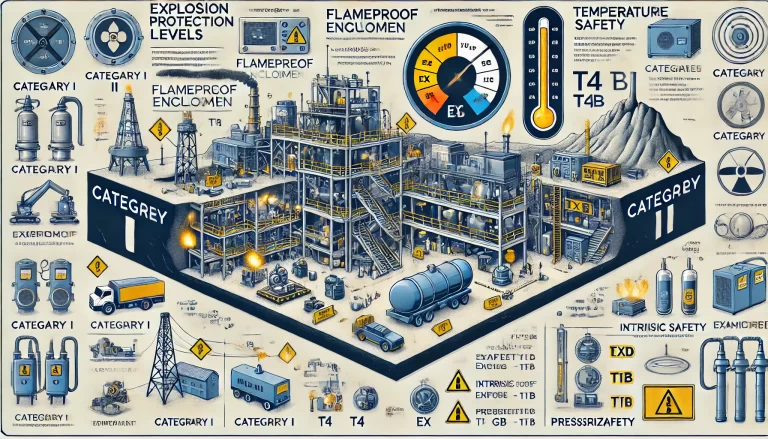
Category I: Equipment designed for underground mines, particularly coal mines, where methane and combustible dust pose a significant risk.
Category II: Equipment for environments outside mines where explosive atmospheres may occur due to flammable gases, vapors, or mists. This category is further divided into:
- IIA: Suitable for environments with less severe explosive atmospheres (e.g., propane).
- IIB: For intermediate risk levels (e.g., ethylene).
- IIC: For the most severe explosive atmospheres (e.g., hydrogen, acetylene).
2. Temperature Groups
The maximum surface temperature of equipment plays a crucial role in preventing ignition of explosive atmospheres. Temperature groups are classified as follows:
- T1: Maximum surface temperature > 450°C.
- T2: Maximum surface temperature ≤ 450°C and > 300°C.
- T3: Maximum surface temperature ≤ 300°C and > 200°C.
- T4: Maximum surface temperature ≤ 200°C and > 135°C.
- T5: Maximum surface temperature ≤ 135°C and > 100°C.
- T6: Maximum surface temperature ≤ 100°C and > 85°C.
The selection of equipment depends on the ignition temperature of the explosive substances present in the environment.
3. Explosion-Proof Methods
Various explosion-proof methods ensure the safe operation of electrical and non-electrical equipment in hazardous environments. Each method is suitable for specific zones and risk levels:
Flameproof Enclosure (d):
- Encases potential ignition sources in a robust enclosure.
- Prevents external explosive atmospheres from entering the enclosure.
- Commonly used in Zone 1 and Zone 2 environments.
Increased Safety (e):
- Prevents the formation of sparks, arcs, or excessive heat under normal operation.
- Suitable for Zone 1 and Zone 2.
Intrinsic Safety (ia/ib):
- Limits electrical energy to prevent ignition under normal and fault conditions.
- “ia” is suitable for Zones 0, 1, and 2, while “ib” is for Zones 1 and 2.
Pressurization (p):
- Maintains a protective gas inside the equipment to exclude explosive substances.
- Used in Zones 1 and 2.
Other Methods:
- Oil Immersion (o): Equipment is immersed in oil to isolate ignition sources.
- Powder Filling (q): Encloses equipment with sand or quartz to suppress ignition.
- Non-Sparking (n): Prevents sparks during normal operation.
4. Equipment Marking
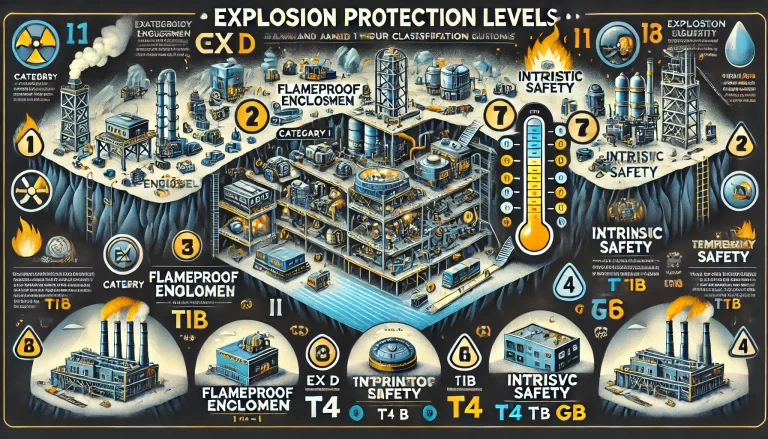
Explosion-proof equipment is marked with standardized codes to convey essential information. An example of a marking code is “Ex d IIB T4 Gb”, which translates as:
- Ex: Equipment complies with explosion-proof standards.
- d: Flameproof enclosure type.
- IIB: Suitable for intermediate explosive gas atmospheres (e.g., ethylene).
- T4: Maximum surface temperature of 135°C.
- Gb: Equipment protection level for use in Zone 1.
Zones are categorized as follows:
- Zone 0: Continuous presence of explosive atmosphere.
- Zone 1: Explosive atmosphere likely during normal operation.
- Zone 2: Explosive atmosphere unlikely but possible.
5. Standards and Regulations
International standards, such as the IECEx scheme and ATEX directives, govern the design, manufacturing, and testing of explosion-proof equipment. These regulations ensure that equipment meets rigorous safety requirements for hazardous environments.
Conclusion
Understanding explosion protection classifications is vital for selecting and maintaining equipment in hazardous environments. Proper classification ensures that the risk of ignition is minimized, safeguarding personnel, equipment, and facilities. Businesses operating in explosive environments should adhere to relevant standards and regularly inspect equipment to maintain compliance and safety.