
The Flowmeter Was Powered On, But the Flow Reading Stayed at Zero
In industrial applications, one of the most common complaints about electromagnetic flowmeters is:
“The flowmeter is installed, powered on, but the display shows 0.00 m³/h even though the system is running.”
When this happens, many users immediately suspect the flowmeter itself:
- The sensor may be damaged.
- The converter may have a problem.
- The calibration may be incorrect.
- The instrument may not be measuring properly.
However, in many real-world applications, the flowmeter is working correctly. The actual problem often comes from the process conditions or pipeline system.
A recent troubleshooting case showed exactly this situation.
A Real Field Case: The Electromagnetic Flowmeter Showed 0.00 m³/h
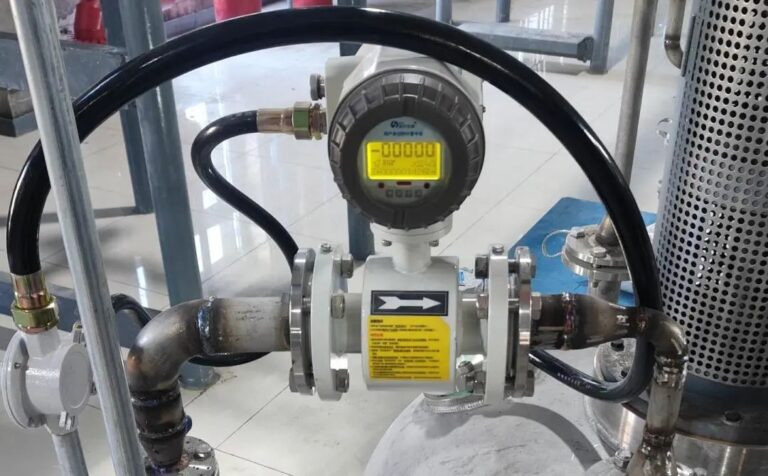
A customer installed electromagnetic flowmeters in their process pipeline. After starting the system, the operator found that the instantaneous flow display remained at:
0.00 m³/h
The customer contacted us and provided photos of the display.
The first inspection showed:
- The flowmeter was powered normally.
- The display screen was working.
- No obvious alarm message appeared.
- The totalizer value had changed slightly between different photos.
This indicated that the instrument might not be completely inactive.
Before making any conclusion, we asked the customer to check several important points:
- Whether the medium was actually flowing.
- Whether the pipeline was completely filled.
- Whether the flow direction matched the arrow on the sensor body.
- Whether both installed flowmeters had the same issue.
- A video showing the complete installation and operating condition.
The Actual Cause Was Not the Flowmeter
After physically checking the pipeline, the customer found the real problem:
The NRV (Non-Return Valve) was blocked.
The blocked check valve prevented the process fluid from flowing normally through the measurement section.
After the customer repaired the NRV, the electromagnetic flowmeter immediately returned to normal operation and displayed the correct flow value.
This case shows an important lesson:
A flowmeter can only measure the flow conditions that actually exist in the pipeline.
If there is no effective flow through the sensor, the instrument will correctly display zero.
Why Pipeline Problems Can Cause Zero Flow Reading
Blocked Valves or Check Valves
Valves are common components in industrial pipelines. A blocked valve, stuck valve, or damaged NRV can stop or restrict the fluid flow.
Typical symptoms include:
- Flowmeter display remains at zero.
- Pump is running but no flow is detected.
- Upstream pressure appears normal.
- The instrument itself shows no fault.
Before replacing the flowmeter, always check whether the pipeline components are operating correctly.
The Pipeline Is Not Completely Filled
Electromagnetic flowmeters require the measuring tube to be full of conductive liquid.
If the pipe contains air pockets or the installation location allows partial filling, the measurement signal may become unstable or show zero flow.
Common causes include:
- Installation at a high point of the pipeline.
- Insufficient back pressure.
- Incorrect installation after a pump.
- Empty pipe conditions.
For liquid applications, a full pipe condition is one of the most important installation requirements.
Incorrect Flow Direction
Electromagnetic flow sensors have a marked flow direction arrow.
During installation or maintenance, the sensor may sometimes be installed in the opposite direction.
Always confirm:
- The actual process flow direction.
- The arrow direction on the sensor body.
- The configured flow direction parameters.
Many instruments are shipped with standard factory settings, and reverse flow output may not be enabled.
A Practical Troubleshooting Sequence for Zero Flow Problems
When an electromagnetic flowmeter displays zero flow, engineers can follow this sequence:
Step 1: Check the Process Condition
First confirm:
- Is the pump running?
- Are valves open?
- Is liquid actually moving?
- Is there enough pressure difference?
Do not start by replacing the instrument.
Step 2: Check the Pipeline
Inspect:
- Filters.
- Check valves.
- Control valves.
- Blockages.
- Air accumulation.
Many “instrument problems” are actually pipeline problems.
Step 3: Check the Flowmeter Installation
Confirm:
- Correct installation direction.
- Full pipe condition.
- Proper grounding.
- Correct electrical connection.
Step 4: Check Instrument Parameters
If the mechanical system is confirmed normal, then check:
- Pipe diameter setting.
- Flow range.
- Low flow cutoff setting.
- Empty pipe detection.
- Output configuration.
The Lesson From This Case
Industrial instruments do not work independently from the process system.
A flowmeter is only one part of a complete measurement system. Pumps, valves, filters, pipelines, and operating conditions all influence the final measurement result.
When a customer reports:
“The flowmeter shows zero.”
The correct approach is not to immediately replace the instrument.
A professional troubleshooting method should always start from the entire system:
Process → Pipeline → Installation → Parameters → Instrument
In many cases, finding the real cause can solve the problem faster and avoid unnecessary replacement costs.
Conclusion
A zero reading from an electromagnetic flowmeter does not always mean the meter has failed.
Blocked valves, empty pipes, incorrect installation, or insufficient flow conditions can all create the same symptom.
Good troubleshooting begins with understanding the complete application, not just looking at the instrument display.