
Large-diameter globe valves are widely used in steam lines, boiler systems, high-pressure water services, and other industrial piping systems. But anyone who has operated one manually under a high differential pressure knows the problem:
The valve can become extremely difficult to close—and sometimes just as difficult to reopen.
An operator may apply considerable force to the handwheel and still fail to achieve tight shutoff. In other cases, reversing the valve installation seems to make closing easier, only to create a new problem: the valve becomes difficult to open after shutdown.
Why does this happen?
The answer is not simply that “large valves require more force.” The real causes involve differential pressure, disc area, stem friction, flow direction, seat condition, operating practice, and valve design.
Understanding these factors is important not only for troubleshooting, but also for selecting the right valve and actuator for large-diameter, high-pressure applications.
1. Why Does Valve Size Matter So Much?
The most important factor is the hydraulic force acting on the valve disc.
A simplified relationship is:
F = ΔP × A
where:
- F = force acting on the disc
- ΔP = differential pressure across the valve
- A = effective pressure area of the disc
As valve diameter increases, the effective area increases approximately with the square of the diameter.
This means that increasing valve size does not produce a proportional increase in hydraulic load—the load can increase much faster.
For a small globe valve, the operator may barely notice this effect.
For a DN200 or DN300 valve operating under significant differential pressure, however, the resulting axial load can become enormous.
2. What Forces Must Be Overcome When Closing a Globe Valve?
For a conventional globe valve, the operator does more than simply move the disc downward.
The handwheel and stem mechanism must overcome several forces, including:
- Hydraulic force caused by differential pressure across the disc
- Friction between the stem and packing
- Friction within the stem, disc, guides, and operating mechanism
- Additional seating force required to achieve tight shutoff
The total operating torque therefore depends on much more than valve diameter alone.
Valve size, pressure class, differential pressure, stem diameter, packing design, seat geometry, flow direction, lubrication, temperature, and mechanical condition can all affect the required handwheel torque.
In many large high-pressure valves, however, the hydraulic load becomes the dominant factor.
3. A DN200 Globe Valve at 10 Bar: A Simple Example
Consider a DN200 globe valve installed in a steam line with a differential pressure of approximately 10 bar.
For illustration, assume an effective pressure diameter of approximately 200 mm.
The effective area is approximately:
A = π × (0.1 m)² ≈ 0.0314 m²
A differential pressure of 10 bar is:
ΔP = 1,000,000 Pa
Therefore:
F = ΔP × A
F ≈ 1,000,000 × 0.0314
F ≈ 31,400 N
That is approximately 31.4 kN of hydraulic force.
This is only a simplified example—the actual effective pressure area and operating force depend on the internal valve geometry and manufacturer design.
Nevertheless, it clearly demonstrates why manually operating a large globe valve under high differential pressure can become extremely difficult.
And this calculation does not yet include packing friction, stem friction, guide friction, or the additional seating force required for shutoff.
Simply using a larger handwheel does not always solve the underlying problem.
4. Why Does Flow Direction Affect Valve Operation?
Many conventional globe valves are installed according to the manufacturer’s specified flow direction.
Depending on the valve design, differential pressure may assist or oppose the movement of the disc.
This is why flow direction can have a major influence on operating force.
A valve installed in one direction may be difficult to close under pressure. Reversing the direction may reduce the closing force—but it can also increase the force required to reopen the valve.
This creates a common field situation:
Easier to close, but harder to open.
However, reversing a globe valve should never be treated as a universal solution.
Flow direction can also affect:
- seat loading
- stem and disc stability
- packing load
- flow-induced vibration
- erosion patterns
- shutoff performance
- safe operation
The correct installation direction should therefore follow the valve manufacturer’s design and application recommendations.
If operating torque is excessive, the better solution is usually to evaluate the valve design, differential pressure, actuator requirements, or pressure-balancing arrangement rather than simply reversing the valve.

5. Difficult to Close and Internal Leakage Are Not the Same Problem
This distinction is extremely important during troubleshooting.
A valve may fail to shut off properly for two fundamentally different reasons.
Case A: The Disc Cannot Reach the Required Seating Position
The operator or actuator cannot generate enough force to overcome the hydraulic and mechanical resistance.
In this case, the valve is not actually reaching full shutoff.
Possible causes include:
- excessive differential pressure
- insufficient actuator torque or thrust
- excessive packing friction
- stem damage or misalignment
- poor lubrication
- mechanical binding
- deposits inside the valve
Case B: The Disc Reaches the Seat but the Valve Still Leaks
Here, additional handwheel force may not solve anything.
The problem may be damage to the sealing surfaces.
Typical causes include:
- erosion
- corrosion
- deposits
- foreign particles
- thermal distortion
- damaged seat surfaces
- damaged disc surfaces
This is why operators should avoid assuming that every leaking globe valve simply needs to be “closed harder.”
Excessive force can damage the stem, handwheel, gearbox, actuator, or sealing components without solving the real problem.
6. Why Are Large Steam Globe Valves Prone to Seat Leakage?
Large globe valves are commonly installed near boiler outlets, steam headers, and main steam distribution lines.
These locations can be particularly demanding.
High differential pressure can create very high local velocities through the restricted flow area around the disc and seat.
Over time, this high-velocity flow can attack the sealing surfaces.
Depending on the actual steam condition and pressure reduction, damage mechanisms may include:
- high-velocity erosion
- wet-steam erosion
- condensate-related damage
- flashing-related damage
- corrosion
- solid-particle erosion
- deposition on sealing surfaces
Once the seat or disc sealing surface is damaged, the valve may no longer achieve tight shutoff even if the operator can fully close it.
7. Why Small-Opening Operation Can Be Especially Damaging
This is one of the most overlooked problems in large steam systems.
Before a large steam line is placed into full service, the piping often needs to be warmed gradually.
Opening the main valve fully while the downstream piping is cold can create severe thermal stress, rapid expansion, condensate movement, and potentially dangerous operating conditions.
Operators therefore often crack the main globe valve open slightly and allow a small amount of steam to pass through the system.
From an operational perspective, this may appear reasonable.
From the valve’s perspective, however, it can be extremely severe.
When a large pressure drop is concentrated across a very small opening, steam velocity around the seat can become very high.
The resulting jet can continuously attack the disc and seat surfaces.
If the main isolation valve is repeatedly or continuously used in this near-closed throttling condition, erosion can become much more severe than during normal fully open operation.
Eventually, the valve may develop permanent seat leakage.

8. Steam Quality and Deposits Also Matter
Mechanical erosion is not the only problem.
Steam systems may contain condensate, corrosion products, treatment chemicals, scale, or other contaminants.
When these materials reach the valve, they can:
- accumulate on the seat
- become trapped between sealing surfaces
- scratch the seat and disc
- accelerate corrosion
- interfere with complete shutoff
Deposits can be particularly troublesome because the valve may appear mechanically normal while still failing to seal.
Repeatedly applying more handwheel force does not remove the underlying cause and may make the damage worse.
9. What Should You Check When a Large Globe Valve Will Not Close?
Before replacing the valve, determine whether the problem is hydraulic, mechanical, or related to the sealing surfaces.
A practical inspection should include:
Differential pressure
Is the valve being closed against an unusually high pressure difference?
Flow direction
Is the valve installed according to the manufacturer’s specified flow direction?
Stem movement
Does the stem move smoothly throughout its entire travel?
Packing condition
Has the packing gland been overtightened, creating excessive stem friction?
Gear operator
If a gearbox is installed, is it lubricated and operating correctly?
Disc and seat condition
Are there signs of erosion, corrosion, deposits, scratches, or foreign material?
Operating practice
Is the valve frequently used for throttling or long periods of small-opening operation?
Actuator sizing
For automated valves, does the actuator provide sufficient thrust or torque at the maximum expected differential pressure?
These checks help separate an operating-force problem from a genuine sealing failure.
10. What If the Valve Closes Easily but Will Not Reopen?
A valve that becomes extremely difficult to reopen after shutdown deserves special attention.
Possible reasons include:
- high differential pressure holding the disc against the seat
- excessive seating force
- thermal expansion
- stem or guide binding
- deposits around the seating surfaces
- inappropriate flow direction for the specific valve design
This is another reason why simply reversing the installation direction is not always a satisfactory solution.
A valve should be evaluated for both closing force and opening force under the maximum expected operating differential pressure.

11. Better Engineering Solutions
For large-diameter, high-pressure globe valves, relying on operator strength should not be the primary design strategy.
Several engineering approaches can significantly improve reliability.
Use a Gear Operator
A gearbox increases mechanical advantage and reduces the handwheel force required from the operator.
This is one of the simplest solutions for large manually operated valves.
Use an Electric or Pneumatic Actuator
For frequently operated or very large valves, powered actuation is usually more practical.
The actuator must be sized according to the maximum required stem thrust or operating torque—not merely according to nominal valve size.
Consider a Pressure-Balanced Design
Some large globe valves use balanced disc or pressure-balancing arrangements to reduce the net hydraulic force acting on the disc.
This can dramatically reduce the required operating force in high differential-pressure service.
Use Suitable Hard-Facing Materials
Where erosion is severe, hard-facing materials such as Stellite or other wear-resistant alloys may improve the service life of the seat and disc.
Material selection should match the actual pressure, temperature, fluid condition, and erosion mechanism.
Avoid Using the Main Isolation Valve for Continuous Throttling
A globe valve can regulate flow, but repeatedly holding a large high-pressure isolation valve at a very small opening may dramatically accelerate seat erosion.
If the system requires frequent low-flow warm-up operation, a dedicated bypass or warm-up line may be a better solution.
12. A Dedicated Warm-Up Bypass Can Make a Big Difference
For large steam lines, one practical arrangement is to install a smaller bypass valve around the main isolation valve.
During startup, the bypass can be opened first.
This allows the downstream piping to warm gradually and pressure to begin equalizing without forcing the entire pressure drop through a tiny opening in the main valve.
Once the line has warmed and the pressure difference has decreased, the main valve can be opened more easily.
This arrangement can provide several benefits:
- reduced operating force
- less seat erosion
- smoother system startup
- reduced thermal shock
- easier pressure equalization
- longer main-valve service life
For severe steam service, the bypass arrangement should be engineered for the actual pressure, temperature, flow requirement, and startup procedure.

13. Do Bellows-Sealed Globe Valves Solve the Problem?
Bellows-sealed globe valves are valuable when external leakage through the stem packing must be minimized.
They are widely used for hazardous, toxic, high-temperature, or other services where fugitive emissions are a concern.
However, a bellows seal does not automatically solve excessive operating force caused by differential pressure across a large valve disc.
The hydraulic load may still dominate.
Therefore, when a large valve is difficult to operate, the first question should not simply be:
“Should we use a bellows-sealed valve?”
A better question is:
“What force is acting on the disc, and how much stem thrust or operating torque is required under the maximum differential pressure?”
That leads to the correct engineering solution.
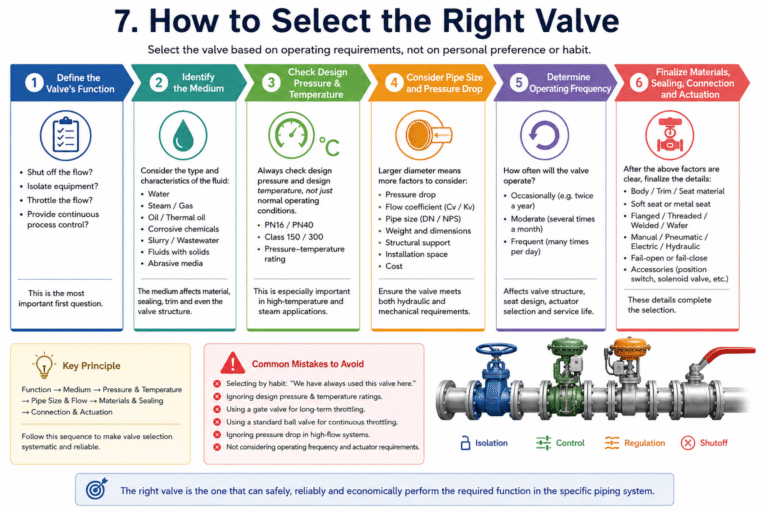
14. Practical Selection Recommendations
When selecting a large-diameter globe valve for steam or other high differential-pressure service, do not evaluate only:
- nominal diameter
- pressure class
- body material
- connection type
Also consider:
- maximum differential pressure during opening and closing
- required stem thrust or operating torque
- specified flow direction
- actuator or gearbox sizing
- seat and disc materials
- expected throttling conditions
- steam quality
- startup and warm-up procedures
- pressure-balancing requirements
- bypass requirements
- required shutoff performance
These factors often determine whether the valve will operate reliably after installation.
Conclusion
When a large-diameter globe valve becomes difficult to close or reopen, the problem is rarely explained by valve size alone.
The real issue is usually the interaction between differential pressure, effective disc area, flow direction, mechanical friction, seat condition, valve design, and operating practice.
A DN200 valve operating at a 10-bar differential pressure can theoretically experience tens of kilonewtons of hydraulic force. Under these conditions, expecting an operator to solve the problem simply by applying more force to the handwheel is often unrealistic.
At the same time, a valve that leaks after closing may not have an operating-force problem at all. Its seat may already have been damaged by erosion, deposits, corrosion, or prolonged small-opening operation.
For large, high-pressure valves, the better approach is to consider the entire system:
Calculate the load, verify the flow direction, inspect the sealing surfaces, evaluate the operating procedure, and select the appropriate gearbox, actuator, balanced design, or bypass arrangement.
The goal is not simply to make the valve easier to turn.
It is to make sure the valve can open, close, and seal reliably under the actual operating conditions of the plant.